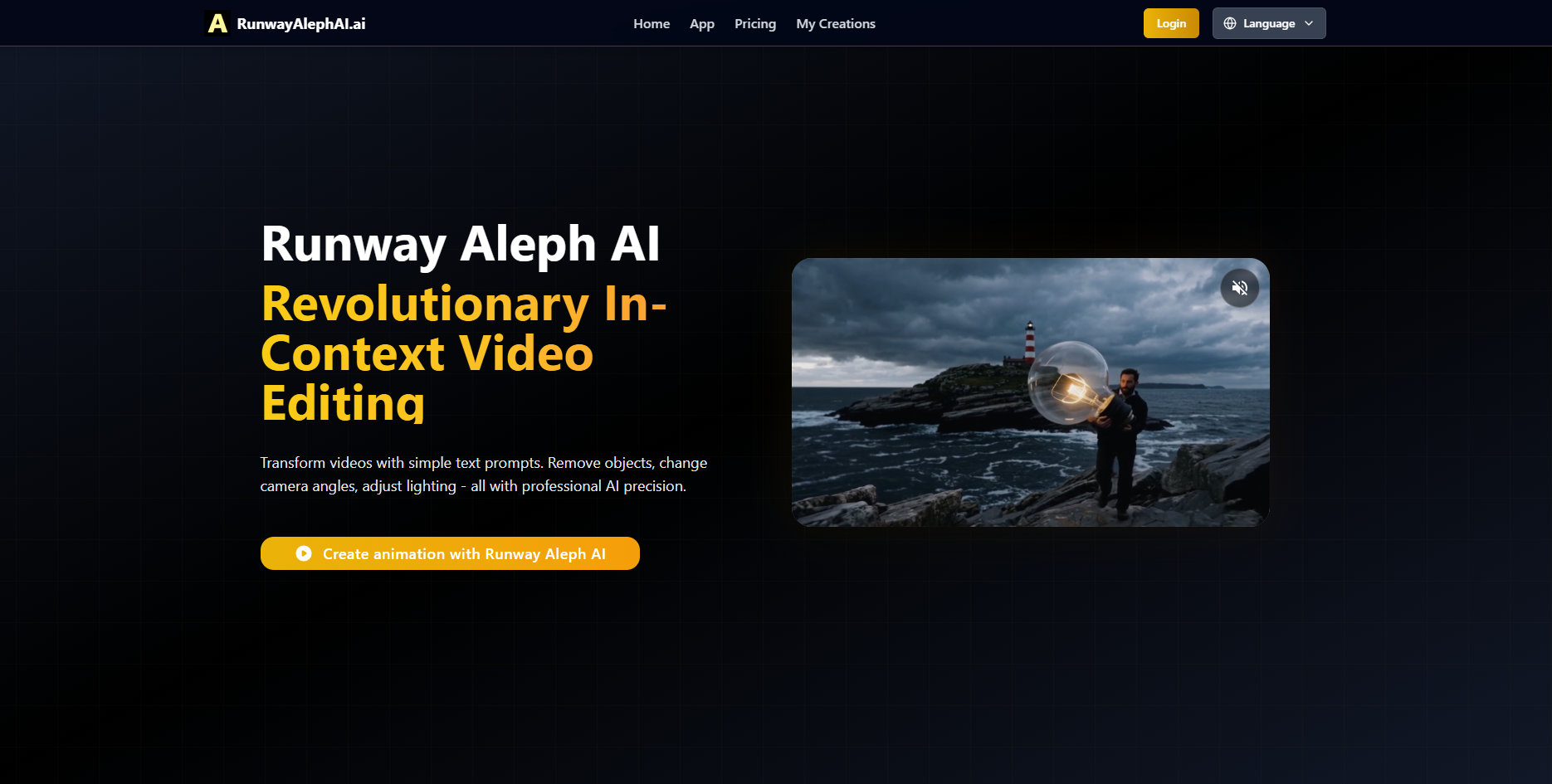
What is Runway Aleph AI?
Runway Aleph AI redefines video post-production by turning language into visual precision—ushering in a new era of text-based video editing. Built on next-generation multimodal AI, it interprets natural language instructions to intelligently manipulate time, space, and light within existing footage. Rather than relying on layers, masks, or keyframes, creators describe edits in plain English (or other supported languages), and the system executes photorealistic transformations—including erasing distractions, shifting viewpoints, and sculpting illumination—all while preserving temporal continuity and cinematic fidelity. Designed for both narrative filmmakers and fast-paced digital creators, Runway Aleph AI bridges the gap between creative intent and technical execution without compromising artistic control.
How to Use Runway Aleph AI
Using Runway Aleph AI is as intuitive as writing a clear instruction: upload your clip, type what you want changed, and let the AI render the revision. No timeline scrubbing, no manual rotoscoping—just precise, context-aware editing powered by deep scene understanding. Whether you ask to “remove the microphone boom from the top-left corner,” “re-light the subject with golden-hour warmth,” or “show the same moment from a low-angle dolly shot,” the platform analyzes spatial relationships, material properties, motion vectors, and lighting physics to generate seamless, frame-coherent outputs. Its web-native interface supports drag-and-drop uploads, real-time preview toggling, and iterative prompt refinement—making experimentation frictionless and results reproducible.
For advanced users, the system responds to layered prompts that combine multiple directives—such as adjusting lighting *while* removing an object *and* subtly shifting perspective—enabling holistic scene reinterpretation in a single pass. This compositional intelligence eliminates the need to chain disparate tools, transforming multi-step VFX pipelines into unified, language-driven workflows.
Key Features of Runway Aleph AI
- Text-to-Edit Precision: Translate descriptive intent directly into editable actions—no syntax, no scripting. The AI parses nuance (e.g., “soften shadows but keep skin tones natural”) to deliver intelligent, stylistically consistent results.
- Context-Aware Object Erasure: Go beyond simple inpainting: Aleph AI understands object permanence, occlusion logic, and background dynamics to remove unwanted elements—even those moving across frames—without ghosting, warping, or temporal artifacts.
- Generative Camera Re-Imagining: Synthesize physically plausible alternate angles using monocular video input. From overhead drone views to dramatic Dutch tilts, the AI reconstructs depth and parallax to create compelling new perspectives from static takes.
- Lighting as a Narrative Tool: Manipulate illumination not just as brightness or color temperature—but as mood, time-of-day, source direction, and diffusion quality. Prompt “backlit silhouette at dusk” or “studio key light with soft fill” and watch lighting adapt cohesively across every frame.
- Scene-Consistent Transformation Engine: Every edit respects spatial geometry, material reflectivity, motion blur, and temporal flow—ensuring that even radical changes retain the integrity of the original performance and environment.
These capabilities converge to slash editing iteration cycles by up to 70%, empowering creators to prioritize storytelling over technical labor—without sacrificing broadcast-ready output quality.
Why Choose Runway Aleph AI?
In an industry where time is narrative currency, Runway Aleph AI delivers unprecedented leverage: one prompt replaces hours of manual compositing, color grading, and camera re-shooting. Unlike generative video models that create from scratch, Aleph AI works *with* your footage—enhancing authenticity rather than replacing it. Its foundation in physics-informed AI ensures edits behave like real-world cinematography, not synthetic approximations. Trusted by award-winning directors, indie studios, and global brands alike, it’s engineered for reliability at scale: whether refining a single close-up or processing feature-length sequences batch-wise, consistency remains uncompromised.
Seamlessly embeddable into NLE ecosystems via API or used standalone through its responsive web interface, Runway Aleph AI adapts to any workflow—from solo creators editing on laptops to cloud-rendered studio pipelines. Recognized on aitop-tools.com as a benchmark in applied generative media, it represents not just an editing tool—but a paradigm shift toward expressive, accessible, and intelligent video craftsmanship.
Use Cases and Applications
Filmmakers use Runway Aleph AI to rescue shots compromised by set intrusions or logistical constraints—removing crew reflections in windows, eliminating continuity errors, or generating missing coverage to strengthen pacing and emotion. Social media teams rapidly localize content by adjusting lighting and tone to match regional aesthetics or platform-specific contrast profiles. Documentary editors discreetly anonymize backgrounds or correct inconsistent daylight exposure across interviews shot over weeks. Advertising agencies iterate on commercial variants in minutes—not days—altering product lighting, set ambiance, or camera framing to test emotional resonance across demographics. From virtual production stages to TikTok studios, Runway Aleph AI serves as a universal layer of intelligent interpretation between vision and video.