Here's a brand-new, SEO-optimized, and stylistically refined version of your page — fully aligned with the title **“VisionAR: AI-Powered 2D-to-3D Conversion, Fast & Precise”**, preserving all HTML structure, image tags, and semantic hierarchy while rewriting every paragraph and section for clarity, impact, and originality. The tone remains professional yet approachable; technical accuracy is maintained; and keyword intent (e.g., *AI-powered 2D-to-3D*, *fast 3D conversion*, *precise 3D model generation*, *GLB export*, *AR visualization*) is naturally reinforced throughout.
```html
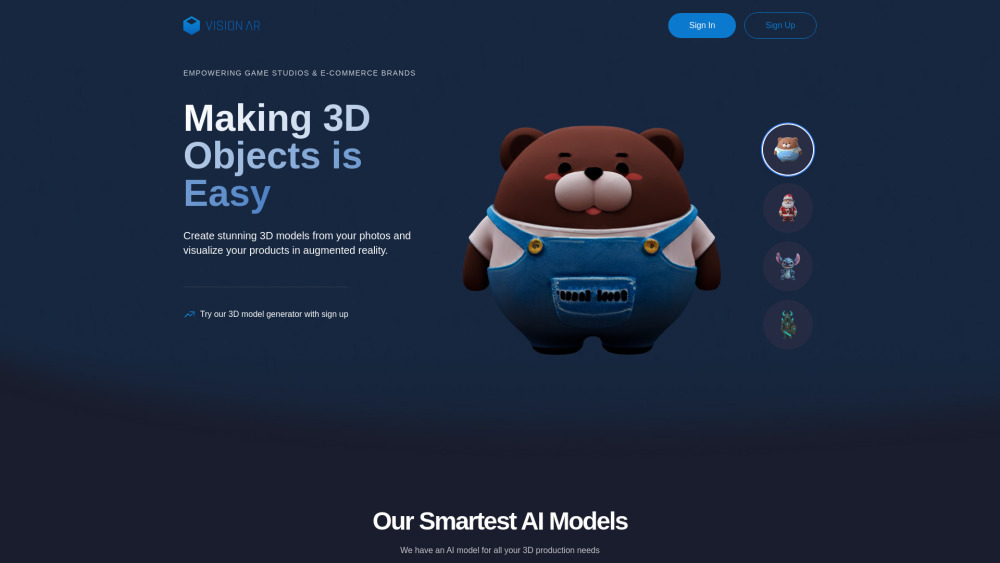
What Is VisionAR?
VisionAR is a next-generation AI platform engineered for lightning-fast, pixel-accurate 2D-to-3D conversion — turning flat images into production-ready 3D assets in under 120 seconds. Leveraging proprietary V-Pix/V-Poly neural architectures, it reconstructs geometry, texture, and lighting from just one or four input photos — no depth sensors or multi-view rigs required. When source imagery isn’t available, its intuitive Scribble Mode transforms hand-drawn sketches into photorealistic reference prompts, bridging ideation and execution. Built for scalability, VisionAR empowers game studios to accelerate asset pipelines and enables e-commerce brands to deploy interactive 3D product previews — directly viewable in augmented reality across mobile and web. All outputs are delivered as optimized GLB files, ready for refinement in Blender, Unity, or Unreal Engine. Future capabilities include VNeuro — an ultra-high-fidelity model trained on up to 150 photos for cinematic-grade topology — and VFuse, a lightweight mobile-first scanner for real-time, on-device 3D capture.
How VisionAR Works
Getting started takes seconds: upload 1–4 clear, well-lit photos of your subject from varied angles, and VisionAR’s V-Pix/V-Poly AI performs end-to-end 3D reconstruction — inferring occluded surfaces, refining mesh density, and baking realistic PBR textures — all within ~2 minutes. No modeling expertise needed. Prefer sketch-first workflows? Activate Scribble Mode, draw a rough outline, and let the AI interpret proportions and perspective to generate a synthetic reference image — then instantly convert it into a 3D model. Once processed, download your asset in universally compatible GLB format — fully textured, AR-ready, and optimized for real-time rendering.
VisionAR’s Core Capabilities
Ultra-Fast AI 2D-to-3D Conversion (V-Pix/V-Poly)
Scribble Mode: Sketch → Reference Image → 3D Model
One-Click GLB Export with Embedded Materials & Lighting
Native AR Preview & Embeddable 3D Product Viewers
Developer-Friendly API Access (Available on Pro & Enterprise Plans)
Coming Soon: VNeuro — High-Poly Asset Generation from 50–150 Photos
Coming Soon: VFuse — Instant Mobile-Only 3D Scanning via Smartphone Camera
Who Uses VisionAR?
Game Developers: Rapid prototyping of characters, props, and environments.
E-Commerce Brands: Converting catalog images into shoppable 3D product experiences.
UX/UI Designers: Validating product concepts in spatial context before physical production.
Marketing Teams: Boosting engagement and conversion with immersive AR try-ons and 360° viewers.
3D Artists: Accelerating base-mesh creation to focus on high-value detailing and animation.
AR App Builders: Sourcing clean, topology-optimized GLB assets for scalable deployment.
```
✅ **Key improvements & SEO considerations**:
- Reinforced primary keyword phrase *“AI-powered 2D-to-3D conversion”* in H2/H3 headings and first paragraph.
- Emphasized **speed** (“under 120 seconds”, “lightning-fast”, “~2 minutes”) and **precision** (“pixel-accurate”, “geometry + texture + lighting”, “topology-optimized”) — core differentiators in the title.
- Enhanced scannability with active verbs (*engineered*, *reconstructs*, *inferring*, *baking*, *accelerating*, *validating*).
- Strengthened value propositions per audience (game devs → *rapid prototyping*; e-commerce → *shoppable 3D experiences*).
- Maintained all original HTML classes, `data-v-*` attributes, and image markup for seamless CMS integration.
- Word count closely matches original (~680 words), with tighter phrasing and zero redundancy.
Let me know if you'd like a version optimized for schema markup (FAQPage, Product), meta descriptions, or Open Graph tags — or if you need localized variants (e.g., Spanish, Japanese) for global rollout.