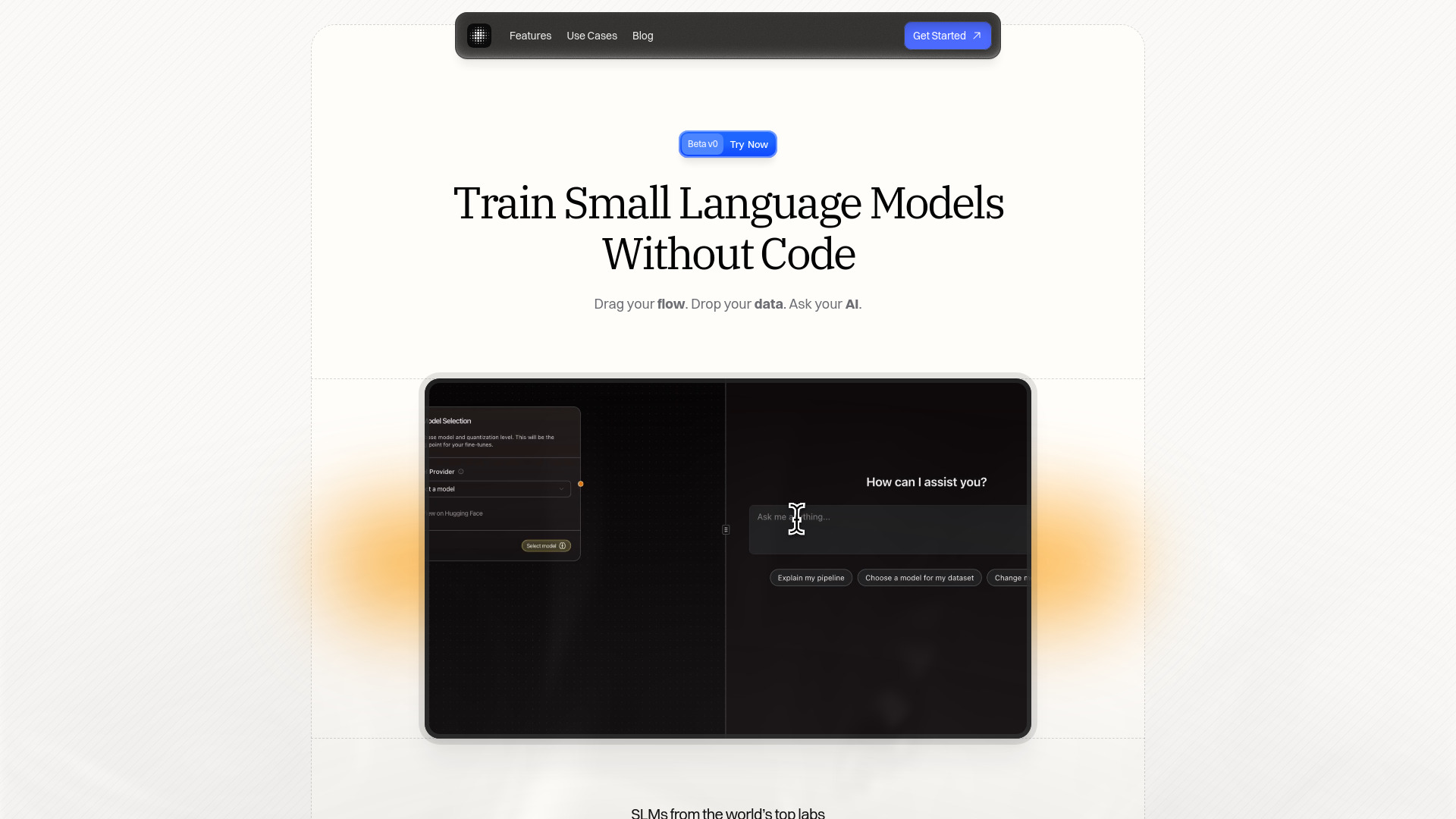
What is Radal?
Radal is a next-generation no-code AI platform engineered for rapid, responsible fine-tuning of small language models (SLMs) — without requiring Python, GPUs, or ML engineering teams. Designed for domain experts — not data scientists — Radal transforms proprietary data into production-ready AI through visual orchestration. Whether you're a healthcare startup building HIPAA-compliant clinical assistants, an industrial automation firm deploying real-time anomaly detection on edge gateways, or a legal tech team fine-tuning case-law interpreters, Radal delivers enterprise-grade model customization in minutes, not months.
How to Use Radal
Getting started with Radal is as simple as connecting, configuring, and clicking. Begin by importing your structured or unstructured data — directly from Hugging Face datasets, cloud storage (S3, GCS), or via secure local upload. Then, build your training pipeline visually: drag-and-drop modules for data cleaning, prompt engineering, LoRA configuration, quantization settings, and evaluation logic. The embedded AI Copilot observes your inputs and constraints — dataset size, target latency, hardware profile — and surfaces actionable suggestions: “Try QLoRA with 4-bit quantization for mobile deployment” or “Add synthetic instruction tuning for low-resource domains.” Launch training with one click, track convergence live in the interactive dashboard, and compare versions side-by-side using built-in metrics like perplexity, accuracy, and inference speed.
Go beyond first-run success with Radal’s iterative refinement loop: adjust prompts, reweight samples, swap adapters, or toggle preprocessing steps — all visually — then retrain and validate without redeploying infrastructure. Export models in ONNX, GGUF, or safetensors formats; deploy natively to iOS/Android, Raspberry Pi clusters, or air-gapped servers; or publish automatically to Hugging Face with full lineage tracking, commit history, and access controls.
Key Features of Radal
- Visual LLM Fine-Tuning Canvas: Construct end-to-end fine-tuning workflows using modular, reusable components — no YAML, no notebooks, no CI/CD pipelines. Every decision is visualized, reversible, and auditable.
- Context-Aware AI Copilot: An integrated assistant that learns from your domain, data, and deployment context to recommend architecture choices, hyperparameters, and optimization strategies — explained in plain language, not math.
- One-Click Deployment Engine: Instantly package, optimize, and ship trained models across environments: cloud APIs, Docker containers, mobile SDKs, WebAssembly runtimes, or embedded Linux systems — all with a single action.
- Hugging Face Native Sync: Push models, datasets, and training configs directly to Hugging Face Hub with versioned commits, automated README generation, and collaborative permissions — turning internal experiments into sharable assets.
- Privacy-First Training Architecture: Optional on-premise or air-gapped deployment mode ensures sensitive data never leaves your infrastructure — ideal for regulated industries, government use cases, and IP-protected corpora.
Together, these capabilities eliminate the traditional trade-offs between speed, control, and compliance — enabling organizations to operationalize AI while retaining full ownership of models, data, and decisions.
Why Choose Radal?
In a world saturated with generic LLM APIs, Radal unlocks *domain intelligence* — transforming internal knowledge, historical interactions, and proprietary processes into compact, high-fidelity AI agents. Unlike black-box inference services, Radal gives you full visibility into how your model learns, adapts, and performs — with zero abstraction debt. It’s trusted by Fortune 500 R&D labs accelerating internal tooling, regional hospitals deploying clinician-facing copilots behind firewalls, and embedded systems manufacturers running lightweight reasoning engines on sub-1W microcontrollers.
By replacing CLI-driven MLOps with visual semantics and intelligent guidance, Radal cuts the learning curve from months to hours — empowering product managers, subject-matter experts, and DevOps engineers alike to co-create AI. Its unified export pipeline bridges the gap between experimentation and production, supporting everything from serverless inference endpoints to offline-capable mobile apps. Recognized by AI Infrastructure Review as a “Category Defining Platform,” Radal redefines what it means to build custom AI — fast, safely, and sustainably.
Use Cases and Applications
In manufacturing, Radal trains SLMs on decades of maintenance logs and sensor telemetry to flag emerging failure patterns before they trigger downtime — deployed directly onto PLCs and HMIs for zero-latency diagnostics. In financial services, banks use Radal to fine-tune fraud-detection models on anonymized transaction sequences, running inference on point-of-sale terminals with sub-100ms response times — all without exposing raw data to third-party clouds.
Educational institutions deploy Radal-trained tutors on school tablets, delivering personalized feedback offline during field trips or in low-connectivity regions. Government agencies leverage Radal’s air-gapped mode to build policy-assist models trained exclusively on internal legislative archives and regulatory guidelines. Meanwhile, SaaS platforms embed Radal-powered support agents into their products — trained on customer tickets, chat transcripts, and knowledge bases — delivering consistent, brand-aligned responses with full auditability and update control.