Table of contents
Qwen Image AI : 20B MMDiT, Flawless English/Chinese Text, Free Trial
Qwen Image AI: Revolutionary 20B MMDiT model—generates stunning visuals with flawless multi-line English & Chinese text. Professional quality. Free trial!
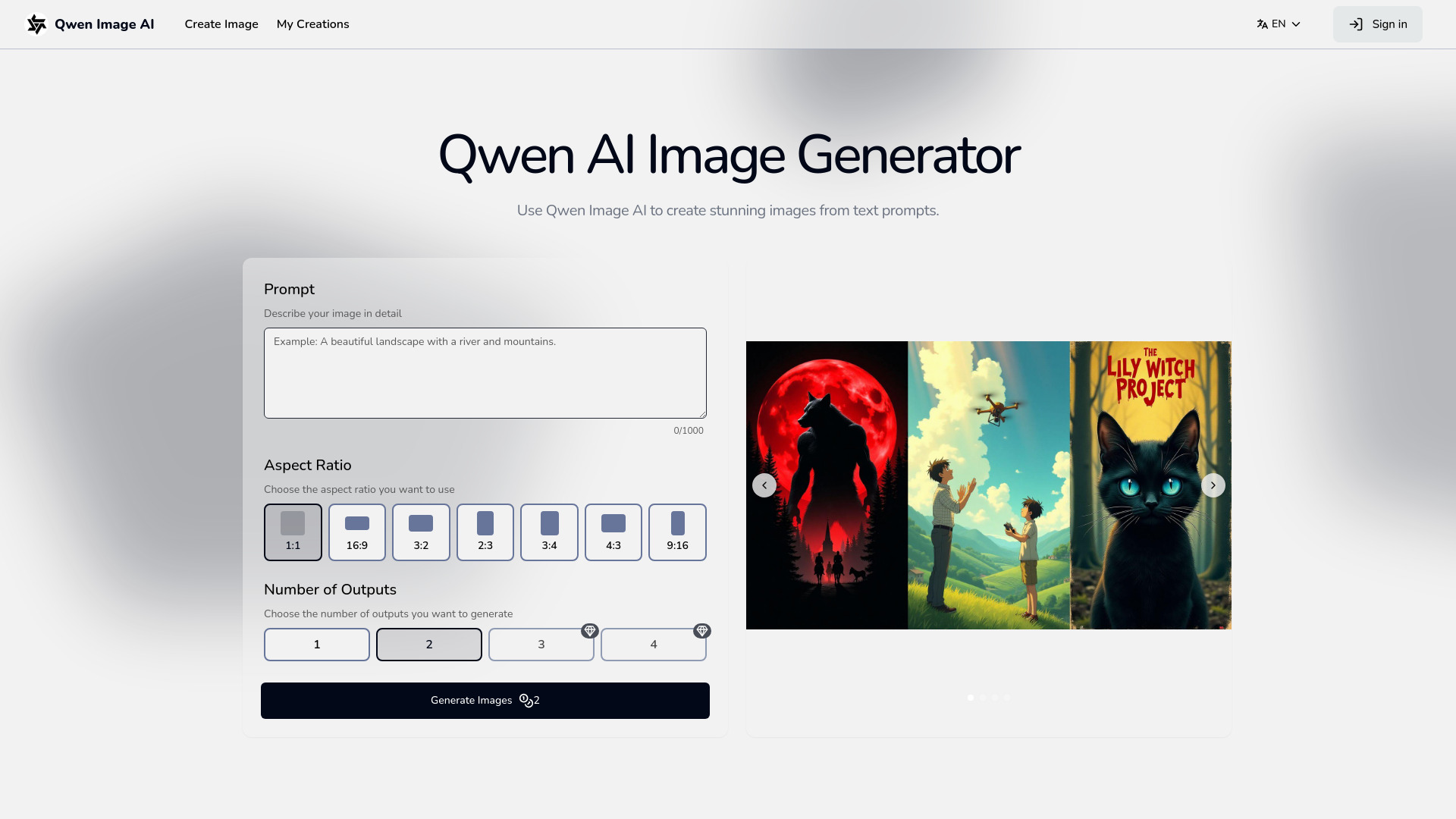
What Is Qwen Image AI?
Qwen Image AI is an open-source, state-of-the-art image generation system engineered by Alibaba’s Qwen research team. At its core lies a revolutionary 20-billion-parameter Multi-Modal Diffusion Transformer (MMDiT)—a next-generation architecture purpose-built to unify high-fidelity visual synthesis with *native-grade text integration*. Unlike legacy models that treat text as an afterthought, Qwen Image AI renders English and Chinese typography with studio-quality precision: full paragraphs, multi-column layouts, embedded captions, and even mixed-language compositions—all generated natively in the image canvas, not overlaid post-hoc. This makes it the first truly production-ready AI tool for creatives who cannot compromise on textual accuracy.
How to Get Started with Qwen Image AI
Launch your creative workflow in under 30 seconds—no installation, no credit card required. Start with a clear, descriptive prompt: specify subject, style (e.g., “cinematic product shot,” “ink-wash illustration”), layout preferences, lighting, and crucially—any embedded text, including language, font tone, and placement intent. Then fine-tune generation settings: choose between speed-optimized or detail-enhanced MMDiT variants, set aspect ratio (1:1, 16:9, 4:5, or custom), and generate up to four distinct outputs per run. Within ~7 seconds, view crisp, 1024×1024+ resolution images—each rendered with pixel-aligned, anti-aliased, linguistically accurate text. Download instantly or iterate with one-click refinements.
Your free trial grants full access to all core features—including advanced editing—so you can validate quality, test multilingual workflows, and assess real-world performance before scaling.
Why Qwen Image AI Delivers Unmatched Text-to-Image Precision
- True Bilingual Typography Engine: The only publicly available model trained end-to-end on aligned English–Chinese visual-text pairs—enabling grammatically coherent, context-aware rendering of idioms, punctuation, vertical/horizontal alignment, and script-specific kerning rules.
- 20B MMDiT Architecture: A massive, multi-modal foundation model that jointly encodes text semantics and visual structure—eliminating hallucinated characters, garbled glyphs, or misplaced line breaks common in smaller or unimodal diffusion systems.
- Zero-Compromise Editing Suite: Modify styles without re-prompting; insert or erase objects with mask-guided inpainting; enhance textures in localized regions; and *edit generated text directly*—change wording, adjust font weight, or switch languages—all within the native interface.
- Designer-Centric Workflow: Built for iteration: compare variations side-by-side, save prompt templates, export layered PNGs for further refinement in design tools, and export metadata (prompt, seed, parameters) for reproducibility and compliance.
This isn’t just incremental improvement—it’s a paradigm shift. Where other tools force workarounds (e.g., manual text overlay in Photoshop), Qwen Image AI embeds typographic integrity into the generative DNA itself—saving hours per project and unlocking new use cases previously deemed impractical for AI.
Who Benefits Most from Qwen Image AI?
Brands launching global campaigns rely on Qwen Image AI to produce identical visual assets—with perfectly localized messaging—in English, Simplified Chinese, Traditional Chinese, and hybrid variants—without redesign cycles. UI/UX designers rapidly prototype app screenshots and marketing banners featuring live interface text. Educators create bilingual infographics and learning cards where readability and linguistic nuance are non-negotiable. Publishers generate cover art with legible titles and subtitles across language editions. And independent creators explore expressive hybrids—like calligraphic poetry over photorealistic landscapes—where text isn’t decoration, but narrative core.
Qwen Image AI: Frequently Asked Questions
What does “20B MMDiT” actually mean—and why does it matter?
The “20B” refers to 20 billion trainable parameters—the largest open multimodal diffusion backbone dedicated to text-aware image synthesis. “MMDiT” (Multi-Modal Diffusion Transformer) signifies its unique cross-attention design: it doesn’t just *condition* on text—it co-optimizes visual tokens and linguistic tokens in shared latent space. This is why it handles paragraph-length Chinese text with zero character collapse, while most 1B–3B models fail beyond 3–4 words.
Is the free trial truly unrestricted?
Yes. The free tier includes unlimited prompt submissions, full access to all MMDiT variants, editing tools, and HD downloads—no watermarks, no usage quotas, and no forced logins. It’s designed to let professionals stress-test realism, typography fidelity, and workflow fit before committing to enterprise plans.
How does Qwen Image AI handle complex Chinese typography?
It trains on curated datasets spanning traditional printing standards (e.g., Kangxi radicals, stroke-order fidelity), modern UI fonts (Noto Sans CJK, Source Han Serif), and contextual layout rules—ensuring correct glyph selection for homophones, proper spacing around punctuation (、。!?), vertical text flow, and harmonious sizing relative to Latin characters in bilingual headers.
Can I integrate Qwen Image AI into my existing pipeline?
Absolutely. As an open-source platform, it offers REST APIs, Python SDKs, and Docker deployment options. Pre-trained weights and inference scripts are hosted on Hugging Face and ModelScope. Enterprise users benefit from private model hosting, SSO support, audit logs, and SLA-backed uptime—details available at qwenimageai.com.
What artistic styles does it support out of the box?
From hyperrealistic product photography and documentary-style street scenes to hand-drawn comics, ukiyo-e reinterpretations, cyberpunk vector art, and minimalist editorial layouts—Qwen Image AI responds faithfully to stylistic cues in prompts. Its training corpus emphasizes cultural authenticity, so “Chinese ink painting” yields nuanced xieyi brushwork—not generic “Asian aesthetic” clichés.
`, ``, ``, `- `, `
- `, `
- `, `