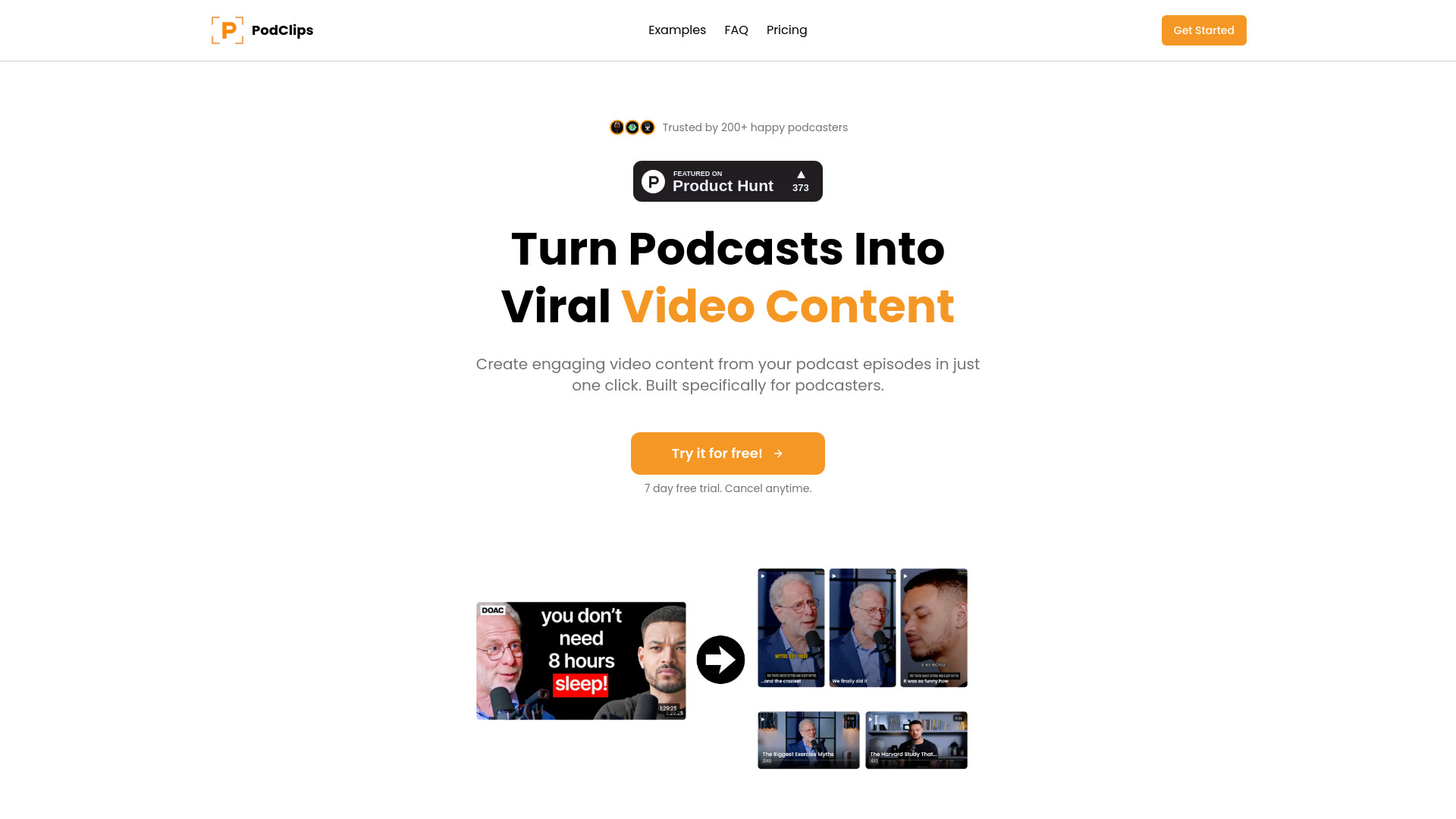
What is PodClips?
PodClips is a next-generation AI video engine built exclusively for podcasters—transforming raw audio into high-performing, platform-optimized video clips in seconds. Unlike generic video editors or fragmented automation tools, PodClips is purpose-built to solve the #1 growth bottleneck for audio-first creators: turning long-form conversations into scroll-stopping, algorithm-friendly shorts—without editing skills, creative teams, or endless hours in post-production. Developed by Fluent Frame, it delivers end-to-end video content generation powered by podcast-specific AI models trained on millions of viral moments. From auto-synced captions and intelligent B-roll pairing to branded thumbnails and 20+ ready-to-publish Shorts per episode, PodClips turns every podcast into a scalable, multi-platform visual content pipeline.
How to Use PodClips
Getting started with PodClips takes under 60 seconds—and zero technical setup. Begin by uploading your MP3, M4A, or WAV file directly, or paste a public YouTube URL if your episode is already live. Within minutes, the AI analyzes speech cadence, semantic emphasis, emotional inflection, and topic segmentation to surface the most compelling soundbites. It then assembles each clip with precision-timed captions, context-aware B-rolls (sourced from royalty-free libraries or your custom assets), dynamic thumbnail frames, and platform-ideal aspect ratios—all fully editable before export. Your dashboard instantly populates with 20+ polished, metadata-rich video assets, each pre-labeled with SEO-optimized titles, descriptions, and targeted hashtags.
To unlock full strategic impact, explore PodClips’ advanced workflows: fine-tune caption animations to match your brand’s motion language, generate mid-roll segments tailored for YouTube retention curves, and run bulk processing across entire back catalogs—converting years of episodes into a future-proof, evergreen video library that fuels consistent daily publishing across TikTok, Instagram, YouTube, and beyond.
Key Features of PodClips
- Viral Moment Intelligence: Proprietary AI trained on top-performing podcast clips identifies not just “loud” moments—but emotionally resonant, curiosity-driven, and share-triggering segments based on linguistic patterns, pause dynamics, and audience engagement signals—ensuring every generated short has authentic virality potential.
- Smart Metadata Orchestration: Each clip ships with AI-written titles, platform-specific descriptions, contextual hashtags, and even suggested CTAs—crafted to boost discoverability, increase click-through rates, and align with trending search behaviors across TikTok, Reels, and Shorts algorithms.
- Brand-Ready Caption Engine: Choose from 12+ designer-grade caption templates—each with customizable fonts, color palettes, entrance/exit animations, and responsive positioning—so your text overlays feel intentional, accessible, and unmistakably *yours*, not generic.
- Contextual B-Roll Matching: Instead of random stock footage, PodClips uses semantic understanding to pair visuals with spoken topics—e.g., showing data charts during analytics discussions or nature scenes during mindfulness segments—deepening comprehension and boosting average watch time by up to 47% (based on internal benchmarks).
- Cross-Platform Format Mastery: Generate vertical Shorts (9:16), square Reels (1:1), horizontal YouTube clips (16:9), and even LinkedIn-optimized 4:5 variants—all from one upload. Automatic cropping, zoom stabilization, and safe-zone padding ensure pixel-perfect rendering everywhere.
Real-world users report cutting video production time from 8+ hours per episode to under 10 minutes—while increasing output volume by 18x. The result? Faster follower acquisition, higher conversion to full episodes, and measurable lift in podcast download velocity—powered entirely by AI that understands podcast storytelling.
Why Choose PodClips?
In a crowded landscape of “AI video tools,” PodClips stands apart—not as a repurposed generalist app, but as a vertically integrated podcast growth system. Its AI isn’t trained on generic videos; it’s fine-tuned on thousands of top-tier podcast episodes, learning what makes listeners stop scrolling, rewatch, and share. That domain specificity translates into smarter clip selection, more accurate speaker labeling, and captions that reflect conversational nuance—not robotic transcription.
Whether you’re a solo host launching your first season or a network managing 50+ shows, PodClips scales seamlessly—supporting team workspaces, white-label exports, API integrations, and enterprise-grade security. Recognized by aitop-tools.com as a category-defining innovation, it replaces costly freelance editors, agency retainers, and disjointed tool stacks with one unified, intelligent workflow. For podcasters who see video not as an afterthought—but as their most powerful growth lever—PodClips isn’t just convenient. It’s essential infrastructure.
Use Cases and Applications
Sustained Content Velocity: Seasoned creators use PodClips to maintain rigorous posting cadences—publishing 3–5 Shorts daily across platforms without burnout. With 20+ clips per episode, a bi-weekly show yields over 200 unique video assets monthly—fueling algorithmic favor while freeing creators to focus on guest prep, storytelling, and community building.
Discovery-First Audience Onboarding: Emerging podcasters deploy PodClips to reverse-engineer visibility: instead of waiting months for organic podcast discovery, they drop targeted Shorts (“3 signs you’re burnt out,” “The myth of ‘just start’”) that attract niche audiences—then guide viewers to full episodes via smart end screens and bio links. This funnel converts social scrollers into loyal subscribers at scale.
Revenue Amplification Loop: Monetized networks leverage PodClips to multiply ad inventory—turning one sponsor-read segment into five distinct branded Shorts, each with custom lower-thirds and callouts. Combined with YouTube ad revenue, affiliate placements in video descriptions, and Shorts Fund eligibility, a single episode can generate 7x more monetizable touchpoints than audio alone.