Table of contents
Palmier - AI Software Engineering Assistant : Auto Code Reviews, Bug Fixes & PRs — Ship 40% Faster!
Palmier: Autonomous AI coding assistant that automates code reviews, bug fixes & PRs—ship 40% faster. Free trial! 🚀
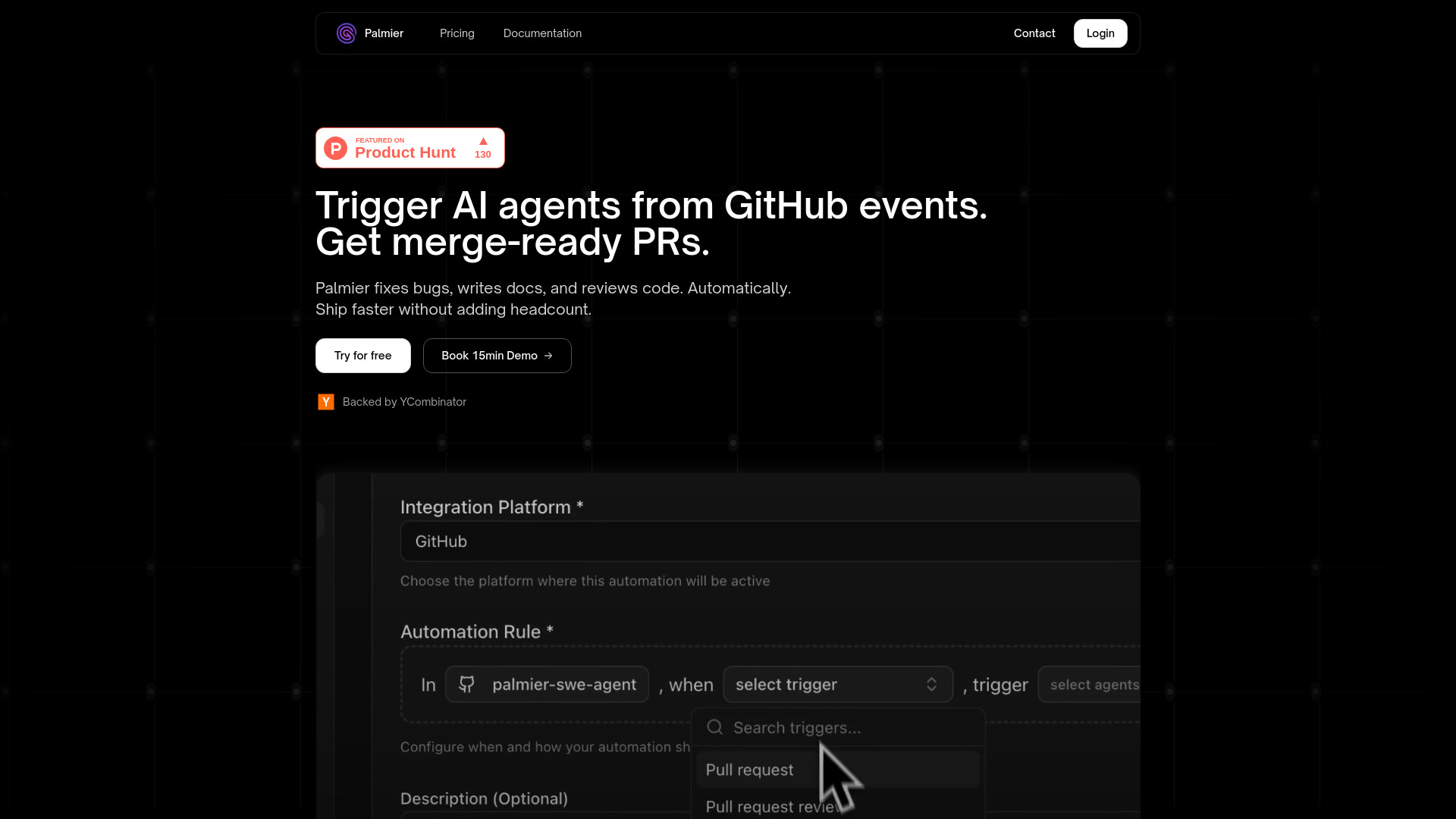
What is Palmier?
Palmier is an autonomous AI software engineering assistant purpose-built to eliminate bottlenecks in modern development workflows. Unlike traditional coding copilots, Palmier operates independently across your entire SDLC — understanding context, reasoning over diffs, and executing production-grade engineering tasks without constant human prompting. It autonomously reviews pull requests, diagnoses and fixes bugs, generates documentation-ready code, writes unit tests, flags security vulnerabilities, and delivers merge-ready PRs — all triggered by your existing GitHub events. The result? Teams ship high-quality software 40% faster — not by cutting corners, but by removing friction, repetition, and wait time.
How to Use Palmier
Getting started takes under two minutes. Begin by installing the Palmier GitHub App and granting repository access via OAuth — no code changes or infrastructure setup required. Then, define your automation logic using intuitive event-based rules: trigger actions when a PR opens, a review is submitted, an issue is labeled “bug”, or a CI pipeline fails. Choose from intelligent, pre-trained AI agents — such as *PR Guardian* (deep semantic review), *BugSquasher* (root-cause analysis + patch generation), *TestWeaver* (coverage-aware test authoring), or *DocuMind* (contextual README and API doc sync) — or compose custom agents using Palmier’s low-code workflow builder.
Once live, Palmier observes, analyzes, and acts — asynchronously and securely. It processes code in ephemeral, isolated sandboxes, never stores your source, and never retrains its models on your codebase. Multiple agents run in parallel, enabling coordinated workflows — for example, reviewing a PR *while* generating tests *and* updating documentation — all before the first human reviewer clicks “Approve”.
Key Features of Palmier
- Fully Autonomous Engineering Execution: Palmier doesn’t suggest — it ships. From triaging Jira tickets to implementing features, fixing regressions, and opening validated PRs, it handles end-to-end engineering tasks with precision, driving a measurable 40% reduction in time-to-production.
- Context-Aware Code Review & Repair: Goes beyond syntax and style checks. Palmier interprets business logic, detects architectural drift, validates edge-case handling, and auto-generates targeted fixes — turning feedback into actionable, tested code — not just comments.
- GitHub-Native, Event-First Automation: Leverages GitHub’s native webhook ecosystem to respond instantly to any event — PR updates, issue transitions, deployment statuses, or even custom labels. No polling, no delays, no middleware.
- Zero-Trust Code Security: Your code never leaves your environment. Palmier enforces strict sandboxing, prohibits persistent storage, and guarantees zero model training on customer data — meeting SOC 2, ISO 27001, and enterprise compliance requirements out of the box.
- Concurrent Specialized AI Agents: Run dedicated agents side-by-side: one auditing security posture, another optimizing performance hotspots, and a third drafting release notes — reducing PR cycle time by up to 45% through intelligent parallelization.
Every capability is engineered to compound impact: fewer context switches, faster feedback loops, higher code quality scores, and accelerated release cadence — all while preserving full ownership, control, and auditability.
Why Choose Palmier?
In a landscape crowded with AI helpers that augment developers, Palmier *augments development itself*. It’s trusted by engineering teams who’ve hit scaling ceilings — where adding engineers creates coordination overhead, not linear velocity gains. Palmier breaks that ceiling: automating the 30–40% of engineering work that’s repetitive, rule-based, and delay-prone — like cross-team PR reviews, boilerplate test writing, or post-merge documentation updates. It catches critical bugs before QA, surfaces hidden tech debt during refactors, and ensures every merged PR meets your team’s quality bar — consistently, scalably, and silently.
Recognized as a top-tier AI dev tool on aitop-tools.com, Palmier integrates natively with GitHub, supports fine-grained permissions, and scales from solo maintainers to Fortune 500 engineering orgs — all with the same enterprise-grade privacy, compliance, and reliability.
Use Cases and Applications
Frontend teams use Palmier to auto-generate Jest snapshots, validate accessibility linting, and update Storybook docs on every component PR — slashing manual verification time. Backend squads deploy it to analyze database migration scripts, generate rollback safeguards, and enforce OpenAPI spec compliance — preventing production incidents before deployment. DevOps teams configure Palmier to auto-remediate misconfigured Terraform resources or inject observability telemetry into new services.
Engineering leaders deploy Palmier to standardize quality across distributed teams: enforcing consistent error-handling patterns, auto-documenting API contracts, and ensuring every feature includes metrics instrumentation — all without requiring individual contributors to memorize checklists. The outcome? A 40% faster shipping rhythm, sustained code health, and freed-up engineering bandwidth redirected toward innovation — not toil.
Frequently Asked Questions About Palmier
What makes Palmier different from other AI coding tools?
Palmier is built for *execution*, not assistance. While others offer autocomplete or chat-based suggestions, Palmier autonomously completes engineering workflows — analyzing code, diagnosing issues, writing tests, generating patches, and opening production-ready PRs — all triggered by your GitHub activity. It reduces time-to-merge by 45% and accelerates overall delivery by 40%, with zero compromise on security or code ownership.
How does Palmier protect my intellectual property and code privacy?
With absolute rigor. Palmier performs all analysis in short-lived, air-gapped sandbox environments. Your code is never cached, logged, stored, or transmitted beyond your GitHub instance. Its AI models are pre-trained and immutable — no customer code is ever used for inference tuning or retraining. This zero-retention, zero-training architecture satisfies strict enterprise security policies and regulatory frameworks.
Which platforms and tools does Palmier integrate with?
Palmier is deeply native to GitHub — supporting all core events (pull_request, issues, workflow_run, pull_request_review, etc.) and seamlessly interacting with GitHub Actions, Projects, Discussions, and Codespaces. Future integrations with GitLab, Bitbucket, and Jira are in active development — but today, GitHub-first teams get the deepest, most reliable automation experience.
What engineering tasks can Palmier handle autonomously?
Palmier automates the full spectrum of repeatable, logic-driven engineering work: intelligent PR review with inline suggestions and auto-fixes; root-cause bug detection and patch generation; automated test suite expansion with coverage gap analysis; security vulnerability scanning (SAST) and remediation guidance; contextual documentation and changelog updates; code refactoring aligned with team standards; and custom workflow orchestration — all governed by your rules and guardrails.
Is Palmier appropriate for small teams or only large enterprises?
Absolutely — and especially powerful for small-to-midsize teams. Startups use Palmier to punch above their weight: maintaining enterprise-grade quality, security, and velocity without hiring dedicated SREs, QA engineers, or documentation specialists. As teams grow, Palmier scales transparently — enforcing consistency across dozens of repositories and hundreds of contributors. Flexible plans on aitop-tools.com ensure the right fit, whether you’re shipping your MVP or managing a 200-engineer platform.
`, ``, ``, `
- `, `