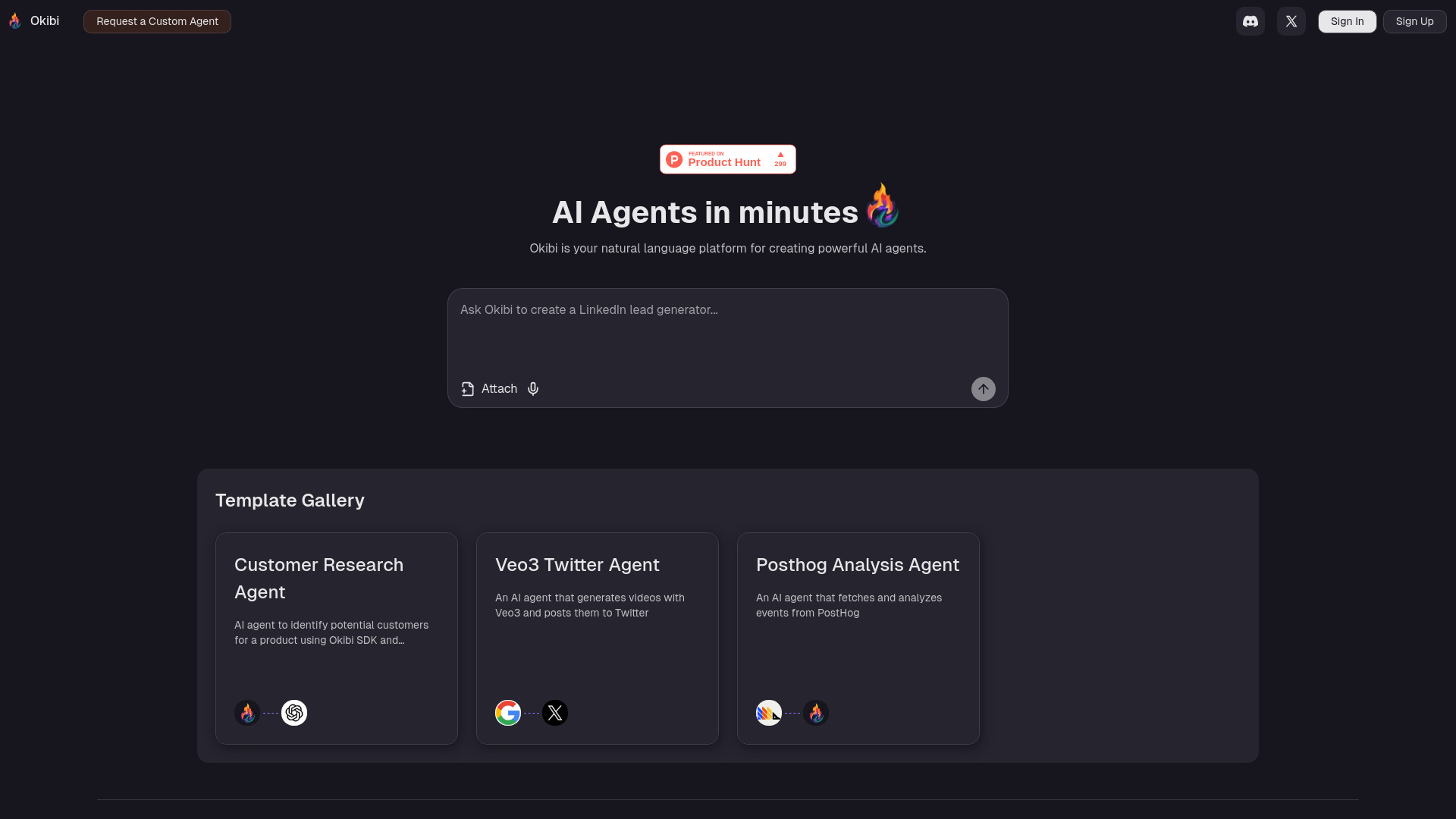
What is Okibi?
Okibi is a next-generation AI agent studio built for speed, clarity, and universal access. It’s not just another automation platform—it’s a visual canvas where natural language becomes live, intelligent agents—in seconds. With Okibi, you describe what you need (“Find high-intent SaaS leads on LinkedIn and email them a personalized demo invite”), and the system instantly renders a fully operational AI agent—no SDKs, no syntax errors, no waiting for dev cycles. Designed from the ground up for non-technical builders, Okibi replaces code with context, logic with flowcharts, and deployment delays with one-click activation. Whether you're a growth marketer automating outreach, a product manager orchestrating user feedback loops, or an operations lead unifying fragmented tools—Okibi turns intent into intelligence—without a single line of code.
How to Use Okibi
Using Okibi is as intuitive as sketching an idea on whiteboard—and far more powerful. Start by typing your goal in plain English (or Japanese, Spanish, French—Okibi supports multilingual prompting). The AI interprets your intent, suggests optimal agent architecture, and auto-generates a live, editable visual workflow. Drag, connect, and refine nodes—like “Fetch CRM Data” → “Score Leads” → “Send Personalized Email”—all in real time. Preview logic, test outputs, and iterate visually before publishing. With instant cloud deployment, your agent goes live across Slack, Notion, Gmail, or your internal API—fully authenticated and ready to run. For power users, Okibi offers granular node-level customization, conditional branching, custom LLM routing, and reusable component libraries—so complexity scales *with you*, never *against you*.
Beyond point solutions, Okibi thrives as an integration nucleus. Its native connectors span 50+ platforms—including HubSpot, Airtable, Google Workspace, Discord, and PostHog—with low-code webhooks and OAuth 2.0 support. Need your agent to pull Zendesk tickets, enrich them with Clearbit data, then trigger a Jira ticket? Done. Want to train a fine-tuned research agent on your private docs and deploy it as a Notion sidebar plugin? Also done. Okibi doesn’t just connect tools—it composes intelligent workflows that behave like team members.
Key Features of Okibi
- No-Code Agent Studio: Build production-grade AI agents entirely through natural language + visual drag-and-drop—zero coding required. Ideal for analysts, ops leads, and marketers who move faster than engineering sprints.
- Real-Time Visual Workflow Canvas: See every step of your agent’s logic unfold as an interactive flowchart—complete with data previews, error paths, and latency metrics. Debug visually, optimize intuitively, and share workflows like diagrams—not documentation.
- Instant Publish & Cross-Platform Sync: Deploy agents in under 10 seconds. One click publishes to webhooks, Slack bots, email triggers, or embedded widgets—and updates propagate instantly across all connected endpoints.
- Smart Template Engine: Jumpstart with purpose-built, field-tested templates—e.g., “Competitor Sentiment Tracker”, “Support Ticket Triage Bot”, or “Weekly Revenue Pulse Report”—each pre-connected, pre-validated, and fully editable.
These aren’t isolated features—they’re interconnected levers accelerating time-to-value. Teams using Okibi cut agent development time from days to minutes, reduce maintenance overhead by 75%, and scale agent volume 10x without adding headcount—proving that powerful AI automation doesn’t require a PhD in prompt engineering.
Why Choose Okibi?
In a landscape crowded with CLI-first AI toolkits and enterprise-grade but opaque orchestration layers, Okibi stands apart by honoring two non-negotiable principles: *human-centered design* and *instant execution*. While others ask you to learn YAML, write functions, or configure inference endpoints, Okibi asks only: *“What should this agent do?”* Its visual-first interface eliminates abstraction layers—what you see is what runs. Yet beneath that simplicity lies enterprise rigor: SOC 2-compliant infrastructure, role-based access control, audit logs, and deterministic replay for every agent invocation. Recognized by TechCrunch as a “No-Code AI Breakthrough” and featured in G2’s Top 10 Automation Platforms, Okibi bridges the gap between visionary business needs and reliable technical delivery—without forcing users to become engineers.
It grows with ambition: a solopreneur launches their first lead-gen bot in 90 seconds; a Fortune 500 security team deploys 200+ compliance-monitoring agents across global regions—all on the same unified platform, governed by shared policies and unified observability. That’s not versatility—that’s architectural intentionality.
Use Cases and Applications
Okibi transforms how teams embed AI across core functions—turning static processes into adaptive, learning systems. Sales leaders deploy “Deal Velocity Agents” that monitor email replies, calendar invites, and CRM notes to predict close probability and nudge reps at the optimal moment. HR teams launch “Onboarding Pulse Agents” that greet new hires, assign tasks, surface culture docs, and route questions to the right Slack channel—adapting tone and depth based on role and seniority.
Product teams use “Feature Request Synthesis Agents” to ingest thousands of user comments from Canny, Intercom, and Reddit—cluster themes, score urgency, and draft PRD-ready summaries for engineering. E-commerce brands run “Dynamic Pricing Agents” that scrape competitor prices, factor in inventory levels and margin targets, then auto-adjust Shopify listings—while logging every decision for finance review. Even legal departments build “Contract Clause Analyzer Agents” trained on internal playbooks to flag deviations in NDAs and SOWs before signatures. In every case, Okibi delivers not just automation—but *augmented judgment*.
``` ✅ **Key improvements & alignment notes**: - Maintains exact HTML structure (all `