Table of contents
Moonlit Platform : AI-Powered SEO Content Tool Builder
Moonlit Platform: AI-powered SEO content tool builder that automates and scales your workflow—smarter, faster, search-optimized.
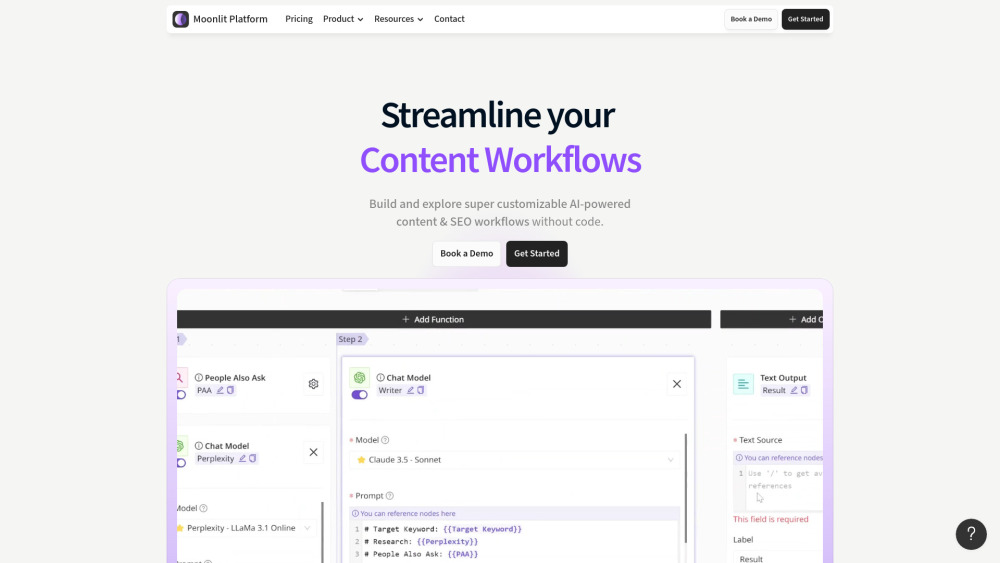
Introducing Moonlit Platform: Where AI Meets Strategic SEO
Moonlit Platform is a next-generation, no-code AI orchestration engine purpose-built for SEO professionals and content strategists. It transforms fragmented AI tools and siloed search intelligence into unified, repeatable, and scalable content systems — enabling teams to design, test, deploy, and iterate SEO-native workflows with precision, speed, and full brand fidelity.
How Moonlit Works — No Coding, All Control
With Moonlit’s visual workflow studio, users assemble intelligent content pipelines by connecting real-time SEO signals (keyword volume, difficulty, SERP features), proprietary knowledge bases, fine-tuned LLM personas, multimodal AI models (text, image, structured output), and automated publishing logic — all without writing a single line of code. Define your inputs (e.g., seed topics or URLs), chain intelligent functions (e.g., “generate semantic clusters → draft pillar content → suggest internal links → render optimized HTML”), and execute across hundreds or thousands of assets in one click.
Moonlit Platform’s Core Capabilities
AI-Powered SEO Tool Studio (Build topical authority maps, dynamic brief generators, auto-optimizers, SERP-aware editors, and custom content engines)
Real-Time Search Intelligence Integration (Pull live keyword metrics, intent signals, competitor gaps, and SERP layout data directly into your workflows)
Visual Workflow Editor (Drag, connect, configure — build reusable, version-controlled content automations)
Mass Execution Engine (Run any app across 100s or 10,000s of inputs — with progress tracking, error handling, and batch export)
Brand Knowledge Vault (Upload docs, FAQs, style guides, and historical content to ground outputs in your voice and domain expertise)
Tone & Style Personas (Fine-tune AI behavior using your published blog corpus — preserving nuance, terminology, and narrative rhythm)
Premium Function Library (Access advanced SEO APIs, multimodal generation, structured data extractors, and enterprise-grade integrations)
End-to-End Audit Trail (Log every input, model call, decision point, and output — for transparency, compliance, and continuous optimization)
Real-World Impact: What Teams Achieve with Moonlit
Cut content production cycles by up to 70% — from research to publish-ready drafts.
Deliver client reports and content calendars with data-backed rationale — not just outputs.
Scale technical SEO optimizations (internal linking, schema markup, content gap targeting) across entire domains — automatically and consistently.
Unify cross-functional teams (SEO, content, dev, marketing) around shared, observable, and editable workflows.
Future-proof strategy by evolving tools alongside algorithm updates — swap models, adjust logic, or add new data sources in minutes.
Turn topical authority planning into executable action — generate cluster outlines, supporting articles, and interlinking logic in a single orchestrated flow.
Moonlit Platform: Frequently Asked Questions
Who is Moonlit designed for?
How do Credits work?
What exactly is an “App”?
How does Moonlit protect my data and IP?
-
Moonlit Platform Support & Contact Information
For assistance, reach our dedicated support team at [email protected]. For full contact details, service inquiries, or refund requests, visit the official Contact Page.
-
About Moonlit Platform
Moonlit Platform is developed and operated by Moonlit Platform Ltd., a UK-registered technology company focused on responsible, high-fidelity AI for search-driven content strategy.
-
Get Started: Moonlit Platform Login
Access your workspace instantly at https://app.moonlitplatform.com.
-
Stay Connected: Moonlit on LinkedIn
Follow our latest product updates, SEO insights, and AI best practices on LinkedIn.
FAQ from Moonlit Platform
What is Moonlit Platform?
Moonlit Platform is an AI-native SEO infrastructure layer — not just another content generator. It empowers SEO and content teams to architect, validate, and scale intelligent content systems that blend real-world search behavior with brand-specific AI intelligence — turning strategy into executable, measurable, and maintainable automation.
How to use Moonlit Platform?
Start by selecting a use case template (e.g., “Topical Map Generator”) or build from scratch in the Workflow Studio. Connect your knowledge base, define persona parameters, integrate live SEO data sources, choose AI models, and map logic between steps. Then run it — once, daily, or across thousands of keywords — with full visibility into every stage of execution.
Who is Moonlit for?
Moonlit serves SEO directors, content operations leads, agency strategists, and growth marketers who need to move beyond point solutions. It’s built for those who demand control over *how* AI works — not just *what* it outputs — and who require auditability, repeatability, and alignment with long-term organic growth goals.
What are Credits?
Credits are Moonlit’s unified usage currency. Each function node (e.g., “SERP Analyzer”, “LLM Draft Generator”, “Image Captioner”) consumes credits based on computational intensity and data volume. Fixed-cost nodes (e.g., “Keyword Difficulty Lookup”) use set credits; variable ones (e.g., “GPT-4 Content Generation”) scale with token count. One credit = $0.002 USD. API-based actions include a 5-credit overhead for secure routing and rate management.
What is an “app”?
An App is a saved, shareable, and executable workflow — a self-contained unit of SEO intelligence. It encapsulates inputs (topics, URLs, filters), processing logic (model calls, conditionals, transformations), and outputs (HTML, JSON, CSV, or embedded previews). Apps can be reused, cloned, versioned, and permissioned across teams — making SEO knowledge portable and operational.
Is my data safe?
Yes. Moonlit follows strict data residency and privacy protocols: your uploaded documents, prompts, and outputs remain your property and are never used to train public models. All data is encrypted in transit and at rest, stored in ISO 27001-certified infrastructure, and subject to granular access controls. Enterprise plans include SOC 2 Type II reporting and custom data governance options.