Table of contents
Lora - AI Image Generator : Custom LoRA Training, 95%+ Accuracy
Lora: Generate stunning AI images with 95%+ accuracy. Train custom LoRA models on Flux—commercial rights included!
What Is Lora?
Lora is a next-generation AI image generation platform built on Flux LoRA architecture—engineered for precision, personalization, and professional-grade output. Unlike generic diffusion tools, Lora empowers creators to go beyond prompting: it lets you *teach* the AI your visual language. Through lightweight, high-efficiency LoRA (Low-Rank Adaptation) fine-tuning, Lora transforms foundational models into bespoke creative partners—capable of rendering images with stylistic fidelity, compositional intelligence, and over 95% prompt-to-output accuracy. Whether you're crafting game assets, refining brand visuals, or prototyping UI concepts, Lora delivers studio-ready imagery—fast, consistent, and deeply controllable.
How to Use Lora
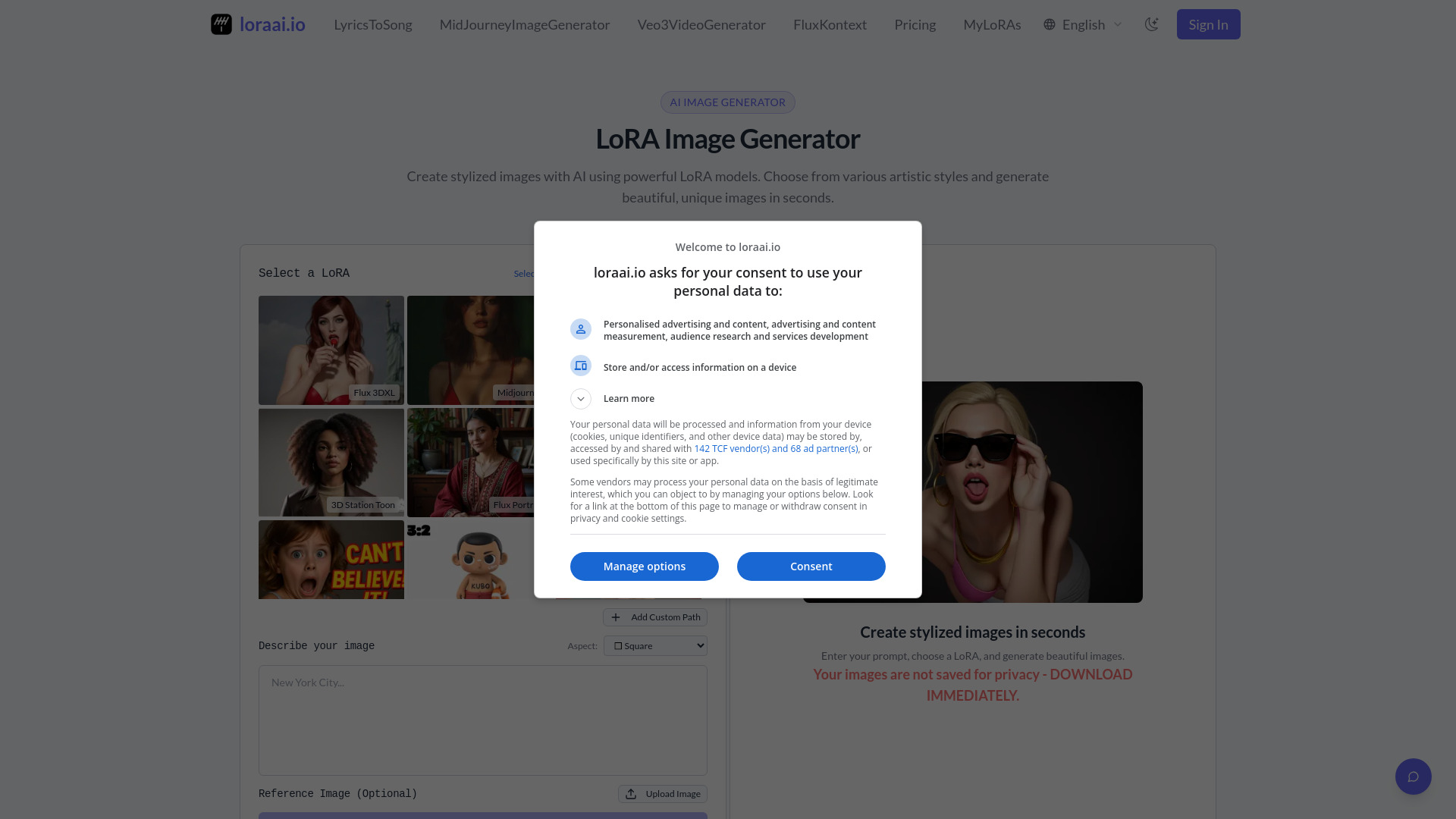
Getting started with Lora is seamless—no coding or ML expertise required. Begin by browsing the curated Flux LoRA Model Hub: choose from hundreds of pre-optimized models covering anime aesthetics, photorealistic textures, architectural styles, character archetypes, and niche artistic movements. Then, describe your vision in plain English—specify lighting, mood, perspective, or even subtle stylistic cues like “brushstroke texture” or “vintage film grain.” Lora’s inference engine interprets your prompt through the selected LoRA model, generating rich, coherent images in seconds.
To unlock true creative ownership, activate Custom LoRA Training. Upload just 10–20 clean, well-lit reference images—your logo variations, character sketches, product shots, or signature color palettes—and define key parameters (learning rate, rank, epochs). In under 30 minutes, Lora produces a compact, embeddable LoRA module trained exclusively on *your* visual identity. From there, generate unlimited on-brand assets—individually or in batches—with deterministic consistency across campaigns, iterations, and teams.
Key Features of Lora
- Custom LoRA Training Engine: Build proprietary AI models in minutes—not days. Our streamlined training pipeline converts your visual references into production-ready LoRAs with minimal compute overhead. Each model preserves your unique aesthetic DNA, enabling pixel-perfect repeatability across generations—ideal for IP development, style guides, and scalable content pipelines.
- Flux LoRA Model Hub: Access a continuously expanding library of rigorously tested, community-vetted LoRA models—categorized by use case, resolution support, and compatibility with leading base models (SDXL, FLUX.1, etc.). Every model includes usage tips, sample prompts, and performance benchmarks—so you deploy the right tool for every creative challenge.
- 95%+ Prompt Accuracy Guarantee: Powered by adaptive attention routing and context-aware token weighting, Lora achieves industry-leading alignment between textual intent and visual output. Testimonials and internal QA show >95% of generated images meet or exceed specification on critical attributes—style adherence, subject fidelity, and structural coherence—reducing revision cycles by up to 70%.
- Pro-Grade Creative Controls: Go deeper than sliders. Adjust LoRA influence weights in real time (0.1–2.0), blend multiple LoRAs within a single generation (e.g., “cyberpunk cityscape + your brand’s typography LoRA”), and execute bulk renders with dynamic prompt templating. These aren’t just features—they’re workflow accelerators for studios and agencies.
- Commercial-Use License Included: Every paid plan grants full commercial rights—no hidden fees, no attribution clauses, no usage caps. Your Lora-generated assets belong to you: deploy them in client deliverables, app interfaces, merchandise, ad creatives, NFT collections, or any monetized channel—legally secure and future-proofed.
Why Choose Lora?
In an AI image landscape crowded with “set-and-forget” generators, Lora stands apart by prioritizing *creative sovereignty*. It doesn’t just respond—it learns, adapts, and evolves with your vision. The Flux LoRA architecture ensures rapid training without sacrificing quality; the intuitive interface lowers entry barriers without diluting power. Trusted by indie developers shipping AAA-style assets, marketing teams scaling global campaigns, and design studios maintaining cross-platform brand integrity, Lora merges enterprise-grade reliability with creator-first flexibility.
Recognized among the top-tier AI imaging tools on platforms like aitop-tools.com and FutureTools.io, Lora integrates natively with popular creative suites and supports API-driven automation. Its ability to produce hundreds of on-brand variants per hour—each retaining tonal, chromatic, and stylistic continuity—makes it indispensable for teams where speed, consistency, and legal safety are non-negotiable.
Use Cases and Applications
Game studios use Lora to lock in character design systems—training custom LoRAs on concept art to auto-generate pose variants, environment mockups, and promotional banners—all aligned to the same visual grammar. Marketing teams deploy branded LoRAs to create dynamic social media assets: A/B test ad visuals, localize campaigns by region, or generate seasonal variants—all governed by one master model. UX designers accelerate prototyping by feeding wireframes into Lora-trained UI kits, instantly populating screens with realistic icons, illustrations, and micro-interaction states that reflect their design system’s voice and values.
Frequently Asked Questions About Lora
What is LoRA AI—and how does Lora implement it differently?
LoRA (Low-Rank Adaptation) is a parameter-efficient fine-tuning method that modifies only small, targeted matrices within large diffusion models—preserving base knowledge while injecting new capabilities. Lora enhances this with Flux LoRA: a proprietary optimization layer that improves gradient flow during training, boosts prompt sensitivity, and enables stable multi-LoRA blending. The result? Faster convergence, higher-fidelity outputs, and smoother interoperability across model versions.
How do I train my first custom LoRA with Lora?
It takes three steps: (1) Collect 10–20 high-resolution, consistent-angle reference images (e.g., your mascot in different poses, your product from front/side/top views); (2) Upload them to the Custom Training dashboard and select optimization presets (e.g., “Character Focus,” “Texture Emphasis,” “Minimalist Style”); (3) Click “Train”—and receive your downloadable LoRA file in ≤25 minutes. No GPU setup, no CLI commands—just visual results, guaranteed.
Do I own the images I generate with Lora?
Yes—absolutely. Paid subscribers retain full copyright and commercial rights to all generated outputs. You may sell, license, trademark, or modify them freely. Lora does not claim ownership, impose watermarks, or restrict distribution channels. This licensing model is baked into every subscription tier—no opt-ins, no fine print.
How quickly does Lora generate images after prompting?
Standard generations complete in 2–5 seconds. Complex prompts with multi-LoRA blending or high-res outputs take 6–12 seconds—still among the fastest in the category. Batch mode supports up to 100 images per queue with parallel processing, making Lora ideal for rapid iteration, A/B testing, or campaign-scale asset creation—all without throttling or queue delays.
Can I mix more than one LoRA in a single image?
Yes—Lora’s native LoRA Combiner allows precise, weighted fusion of up to four distinct LoRAs per generation. Adjust individual contribution levels (e.g., 0.8 × “Studio Ghibli Style” + 0.6 × “Your Brand Logo LoRA” + 0.4 × “Watercolor Texture”) and preview real-time impact before final render. This unlocks hybrid aesthetics, contextual storytelling, and unprecedented stylistic nuance—turning LoRA from a tool into a creative vocabulary.
`, ``, ``, `- `, and `
- `, `
- `, and `