Table of contents
Laiers.ai : Visual AI Chat Mapping, Branching Threads, Free!
Laiers.ai turns messy AI chats into clear, branching visual maps—explore multiple threads at once. Intuitive, powerful, free to try!
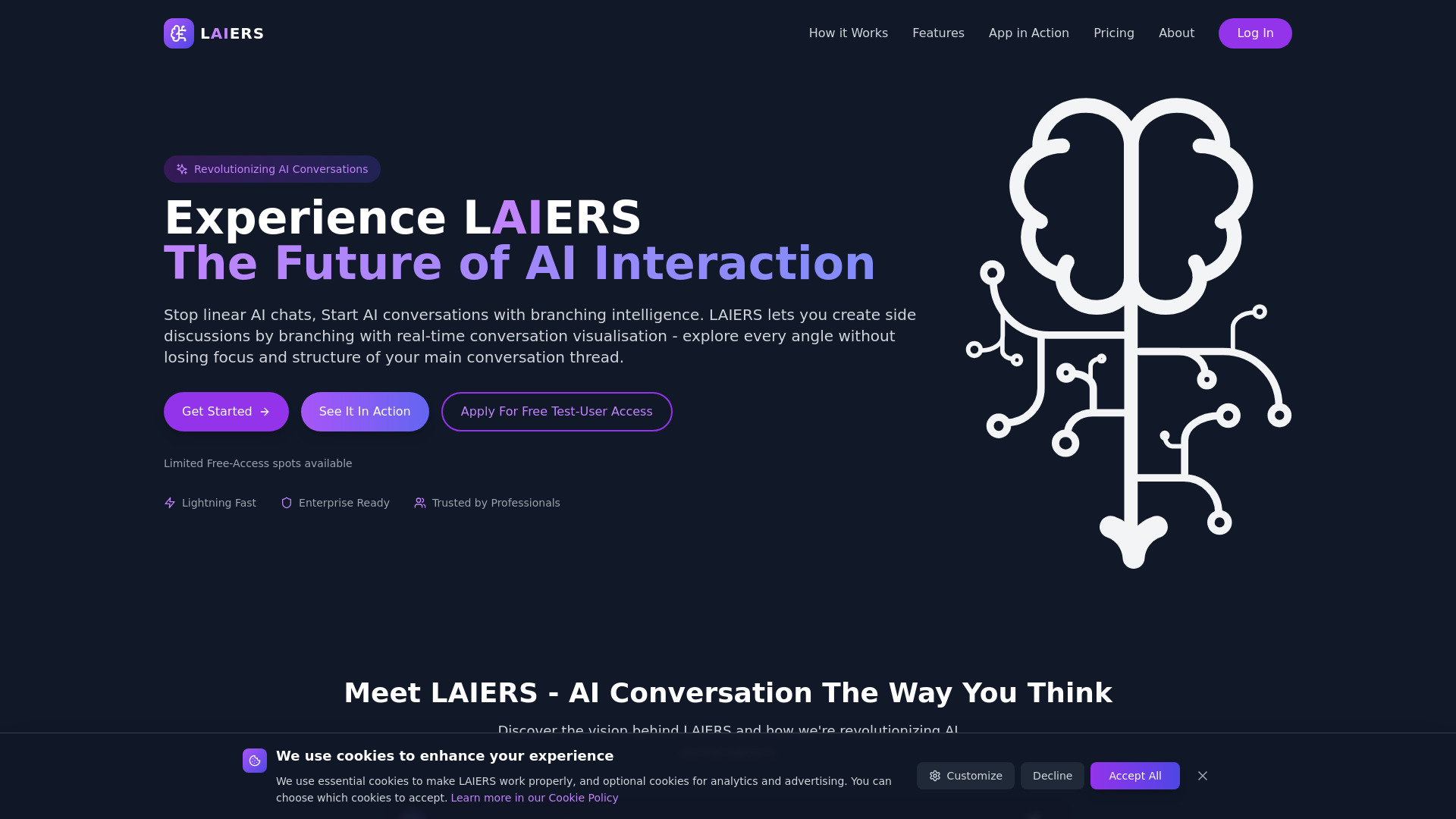
What is Laiers.ai?
Laiers.ai is a next-generation AI collaboration platform built for clarity—not clutter. Unlike conventional chat interfaces that scroll endlessly downward, Laiers.ai renders every conversation as an interactive, expandable knowledge graph. At its core lies a visual branching engine: one click on any phrase in an AI response instantly spawns a dedicated, context-aware thread—no manual copying, no lost context, no re-prompting. Think of it as mind-mapping meets AI dialogue: each node represents a focused idea, each branch a logical extension, and the entire map a living archive of your analytical journey. Purpose-built for professionals who juggle complexity daily, Laiers.ai turns fragmented exchanges into structured, navigable intelligence.
How to Use Laiers.ai
Getting started takes seconds—and mastery follows naturally. Begin with a simple prompt: “Outline risks in entering Southeast Asian fintech markets,” or “Compare pedagogical models for hybrid STEM instruction.” As the AI responds, highlight any insight, assumption, or open question—say, “regulatory fragmentation across ASEAN countries”—and click. Instantly, a new branch opens, pre-loaded with relevant context from the parent thread. Explore consequences, alternatives, or counterarguments in isolation—yet always anchored to the original strategic frame. Your growing tree appears in real time as a clean, zoomable flow diagram: color-coded nodes, collapsible paths, and intuitive drag-to-reorder navigation.
Work fluidly across environments. Draft a multi-branch analysis on your laptop during a planning session, then tap into the same live map on your phone while reviewing notes on transit. No app install, no sign-in friction—just open laiers.ai in Safari, Chrome, or Edge. The interface adapts seamlessly: desktop offers full drag-and-zoom precision; mobile delivers touch-optimized branching and one-tap node expansion. Your intellectual workflow stays uninterrupted, unfragmented, and universally accessible.
Key Features of Laiers.ai
- One-Click Branching: Transform ambiguity into action. Select *any* segment of AI output—whether a data point, a speculative clause, or a cited source—and generate a context-rich follow-up thread in under 500ms. No rephrasing. No context loss. Just intelligent inheritance.
- Real-Time Visual Mapping: Watch your reasoning unfold spatially. Nodes auto-arrange by relationship depth, with parent-child links, cross-branch references, and timeline-based color gradients. Export static SVGs for presentations—or embed live, interactive maps in Notion or Confluence.
- Parallel Thread Intelligence: Run 3, 7, or 12 branches simultaneously—each retaining awareness of sibling threads and shared assumptions. Ideal for stress-testing strategies, comparing frameworks, or auditing bias across interpretive lenses—all without tab-switching or mental overhead.
- Zero-Sync Cross-Device Continuity: Your map persists server-side with end-to-end encryption. Open a branch on iPad at 9 a.m., refine its logic on Windows at noon, and review conclusions on Android at 6 p.m.—all changes sync silently, instantly, and automatically.
- Context-Aware Inheritance: Every child branch inherits not just the selected text, but the full conversational memory leading up to it—including prior user clarifications, AI caveats, and even timestamped revisions. No more “remind me where we left off.”
Together, these capabilities redefine what’s possible in AI-augmented thinking: less backtracking, fewer forgotten insights, and dramatically higher fidelity in translating complex thought into actionable structure.
Why Choose Laiers.ai?
Most AI tools optimize for speed—not sense-making. Laiers.ai optimizes for *understanding*. While others ask you to linearize nonlinear thinking, Laiers.ai mirrors how experts actually reason: recursively, comparatively, and visually. It doesn’t replace deep work—it removes the friction that derails it. Researchers use it to trace methodological trade-offs across 20+ experimental designs. Strategists map competitive responses to regulatory shifts—branching each scenario into operational, financial, and reputational implications. Educators scaffold curricula by branching learning objectives into assessments, scaffolds, and differentiation tactics—all within one coherent map.
And it’s free. No tiered feature walls. No watermarked exports. No usage caps on branches, maps, or history. Just pure, unobstructed visual reasoning—powered by modern AI infrastructure and designed for professionals who demand rigor, not gimmicks. Recognized by AITop-Tools.com as “the first truly non-linear AI interface,” Laiers.ai isn’t an upgrade to chat—it’s the foundation for the next generation of AI-native cognition.
Use Cases and Applications
Academic Research: Map literature review gaps by branching each cited limitation into theoretical alternatives, empirical tests, and measurement refinements—preserving citation chains and methodological logic across all paths.
Product Strategy: Model go-to-market variations: one branch explores pricing elasticity in Tier-2 cities; another simulates channel partner incentives; a third audits compliance pathways—then compare decision criteria side-by-side in the unified map view.
Policy Analysis: Deconstruct legislative proposals by branching stakeholder impacts (e.g., “small business owners”), then further branch into economic, legal, and equity dimensions—ensuring no perspective collapses into summary bias.
Educational Design: Turn a course syllabus into a dynamic map: root node = learning outcome; children = weekly modules; grandchildren = lesson plans, formative checks, and accessibility adaptations—fully editable, shareable, and version-trackable.
Frequently Asked Questions About Laiers.ai
How does Laiers.ai differ from linear AI tools like Claude or Gemini?
Linear tools treat conversation as a monologue—you speak, AI replies, and everything lives in a single vertical feed. Laiers.ai treats it as a *dialogue network*. You don’t abandon one idea to pursue another—you grow both, side-by-side, with persistent relational meaning. It’s the difference between reading a textbook and building a 3D model of its concepts.
Is there a mobile app?
No—and intentionally so. Laiers.ai runs natively in any modern browser, leveraging progressive web app (PWA) standards. Install it to your home screen in one tap (iOS/Android), and it behaves like a native app—offline-capable, push-notification ready, and fully synced. Zero downloads. Zero updates. Just intelligence, always available.
Can I edit or rearrange my visual map?
Absolutely. Drag nodes to reorganize hierarchies. Merge overlapping branches with a right-click. Add custom labels, tags, or priority flags. Collapse sections to focus on high-level flows—or zoom into granular reasoning layers. Your map evolves *with* your thinking—not against it.
Is team sharing supported?
Laiers.ai currently focuses on individual cognitive augmentation—ensuring maximum speed, privacy, and contextual fidelity for solo deep work. Shared collaboration features are planned for future releases, grounded in the same design principle: structure first, scale second.
Where is my data stored—and is it private?
All conversation trees are encrypted in transit and at rest. You retain full ownership. Data never trains third-party models. Free-tier users enjoy unlimited storage and 90-day automatic retention—with optional manual export (JSON/SVG/PDF) anytime. Enterprise-grade security, personal-research simplicity.
`, ``, ``, `
- `, `