Table of contents
Codev: AI-Powered Full-Stack Dev Platform : No-Code, Instant, Powerful
Codev: Build full-stack web apps instantly—just describe your idea in plain English. AI handles the rest. Fast, no-code, powerful.
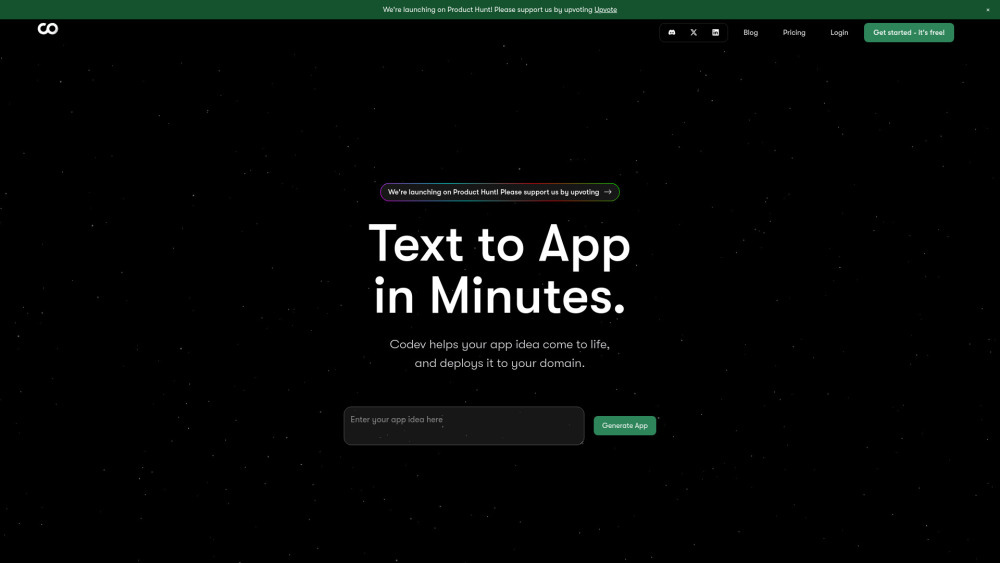
What is Codev?
Codev is a next-generation full-stack development platform powered by state-of-the-art AI—engineered to turn ideas into production-grade web applications in seconds, not weeks. Unlike conventional no-code tools that lock users into proprietary ecosystems, Codev delivers *real developer-grade output*: fully editable, self-hosted Next.js applications—with zero vendor lock-in. Whether you're a founder sketching a MVP, a marketer launching a campaign site, or a senior engineer prototyping fast, Codev gives you instant scaffolding, intelligent architecture, and complete code ownership—all from plain English.
How to use Codev?
Describe your app in everyday language—e.g., “A SaaS dashboard for freelance designers to track invoices and clients, with login, dark mode, and Stripe payments.” With one click, Codev generates a complete, type-safe, server-rendered Next.js application—including UI components, API routes, database schema, authentication flow, and responsive styling. Then deploy it live on your own domain—in under 60 seconds—with HTTPS auto-configured and zero infrastructure setup.
Codev's Core Features
Natural-language-to-full-stack generation — no prompts, no guesswork
Production-ready Next.js 14+ apps (App Router, Server Components, Turbopack-ready)
100% open-source–compatible output — download, edit, commit, and extend freely
One-click deployment to Vercel or custom domains with automatic TLS/SSL
Built-in Supabase integration — auto-generated tables, Row Level Security (RLS), auth hooks, and real-time subscriptions
Multi-model AI orchestration — switch between Claude 4 Sonnet, GPT-4.1, and Gemini 2.5 Pro per project for optimal reasoning & fidelity
Smart dependency resolution — installs, configures, and optimizes packages (Zod, tRPC, Drizzle, Clerk, etc.) automatically
Curated starter kits — battle-tested templates for SaaS dashboards, local service sites, content-first blogs, news aggregators, and mobile-first landing pages
Codev's Use Cases
Launch a revenue-generating SaaS product in hours—not months.
Build compliant, scalable websites for restaurants, salons, clinics, and contractors—no dev team needed.
Create high-conversion blog or newsletter sites with SEO-optimized metadata, RSS, and analytics hooks.
Generate responsive, performant landing pages for iOS/Android app launches—even before the native app exists.
Rapidly prototype internal tools, admin panels, or data dashboards with live Supabase backends.
Bootstrap AI-powered chat interfaces with context-aware RAG pipelines and streaming UIs.
Empower non-technical teams to ship real software—while developers reclaim time for complex logic and scaling.
FAQ from Codev
What is Codev?
How does it work?
What technologies does Codev use?
Do I need coding experience to use Codev?
Can I customize the generated code?
What are the limitations?
Can I deploy and go to production without any developer?
Can I make mobile apps (iOS/Android)?
-
Codev Company
Codev is developed by Wisp Labs, Inc.—a U.S.-based AI infrastructure company focused on democratizing high-fidelity software creation.
FAQ from Codev
What is Codev?
Codev is an AI-native full-stack development platform that transforms natural-language specifications into production-deployable Next.js applications—complete with frontend, backend, database, and DevOps configuration. It bridges the gap between no-code speed and pro-code flexibility, giving every user full control over their source code, architecture decisions, and long-term scalability.
How to use Codev?
Enter your idea in plain English (e.g., “A job board for remote React devs with filtering, saved searches, and email alerts”). Codev interprets intent, infers architecture, generates clean TypeScript, validates logic, and outputs a runnable project—ready for editing, testing, and deployment in seconds.
How does it work?
Behind the scenes, Codev orchestrates multiple specialized AI agents: a requirements synthesizer, a Next.js architect, a Supabase schema generator, a UI component builder, and a security-aware linter. Each step is grounded in real-world best practices—not just code generation, but *intelligent engineering*.
What technologies does Codev use?
Frontend: Next.js 14+ (App Router), Tailwind CSS, shadcn/ui. Backend: Next.js Server Actions + Route Handlers. Database: Supabase (PostgreSQL + Realtime). Auth: Supabase Auth or optional Clerk integration. Deployment: Vercel-native or custom domain via DNS + Let’s Encrypt automation.
Do I need coding experience to use Codev?
No—but the more you know, the further you can go. Beginners get instant, working apps out of the box. Developers get production-grade scaffolding they can extend, test, and scale immediately—no reverse-engineering required.
Can I customize the generated code?
Absolutely. Every line is yours. Codev generates standard, well-documented, modular TypeScript—no hidden abstractions or runtime dependencies. You can add libraries, refactor components, integrate third-party APIs, or migrate to another stack at any time.
What are the limitations?
Codev excels at CRUD-heavy, user-facing web applications with clear functional scope. It does not generate low-level systems code (e.g., kernels, drivers), real-time multiplayer game engines, or highly specialized embedded logic. Mobile app binaries (iOS/Android) are not supported—but PWAs and responsive web apps are first-class citizens.
Can I deploy and go to production without any developer?
You *can*—and many do. However, for mission-critical applications handling sensitive data or high traffic, we recommend light review by a developer familiar with Next.js and Supabase—especially around authentication flows, input sanitization, and rate limiting. Codev includes built-in security guardrails, but human oversight remains essential for compliance.
Can I make mobile apps (iOS/Android)?
Not natively—Codev generates web applications only. However, all output is fully responsive, PWA-capable, and compatible with frameworks like Capacitor or Tauri for wrapping into installable desktop or mobile apps—giving you a path to native distribution when ready.