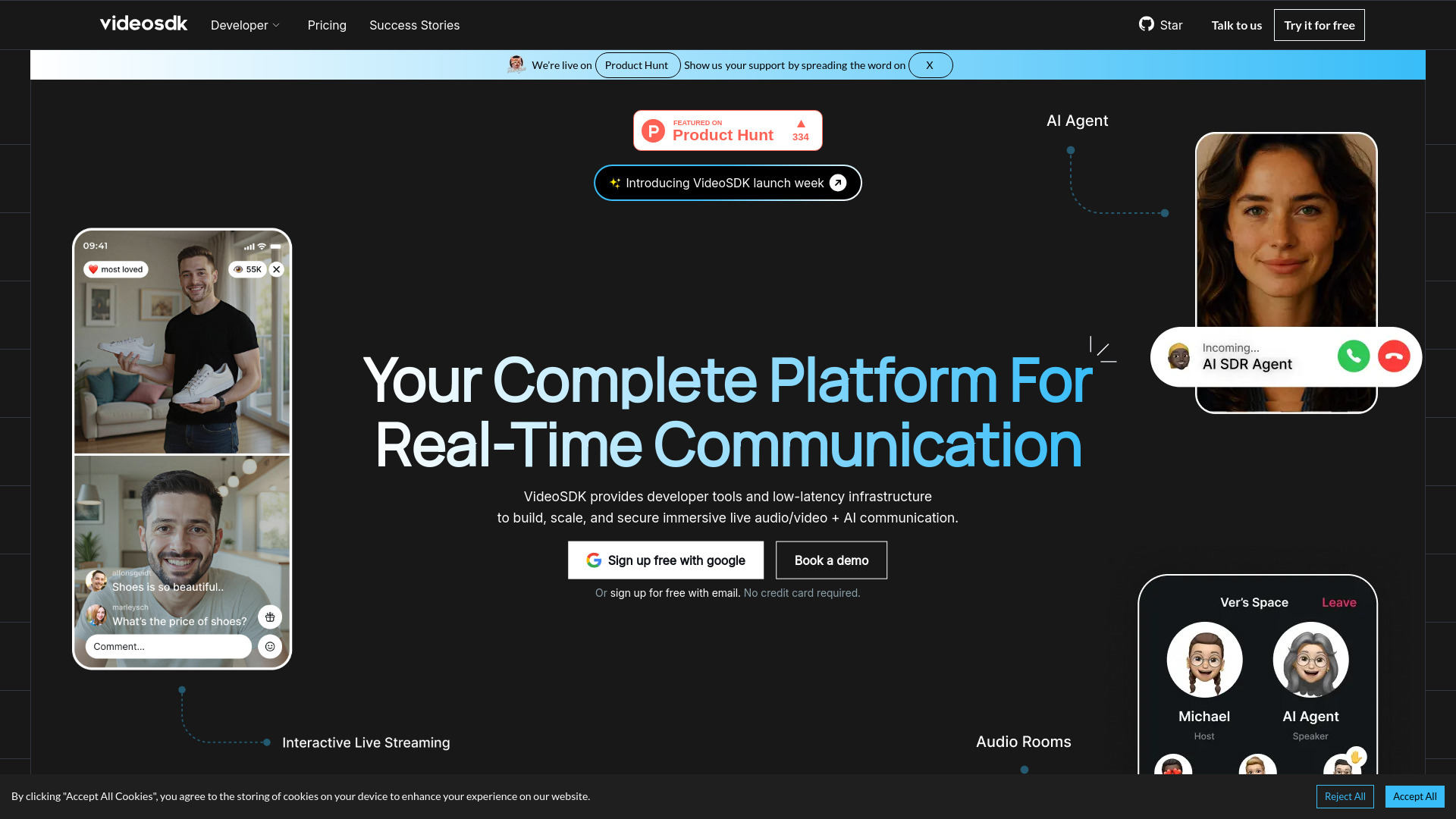
What is VideoSDK?
VideoSDK is a next-generation developer platform engineered to power intelligent, real-time video experiences—where AI doesn’t just augment communication, it redefines it. Built from the ground up for performance and programmability, VideoSDK delivers globally distributed, ultra-low latency infrastructure (just 150ms end-to-end) alongside native SDKs and AI-native building blocks. Whether you're orchestrating AI-driven video agents for customer support, launching interactive live streams with real-time engagement layers, or embedding secure, compliant video into telehealth or fintech applications, VideoSDK provides the unified stack to build, scale, and innovate—without managing infrastructure. From MVP to enterprise-grade deployments serving millions of participant minutes monthly, developers choose VideoSDK to ship production-ready video intelligence—fast.
How to Get Started with VideoSDK
Begin building in under five minutes: sign up for free using Google or email—no credit card needed—and instantly unlock 10,000 participant minutes. Your API keys are ready in the dashboard; integrate them using VideoSDK’s battle-tested SDKs for Web (React, Vue, Angular), Mobile (iOS, Android, Flutter, React Native), or Server-Side (Node.js, Python, Java, Go). Every integration comes with production-ready code samples, step-by-step tutorials, and sandbox environments to test AI agents, start encrypted video calls, or launch interactive broadcasts before going live. Need guidance? Book a personalized onboarding session with our engineering team—or dive into our AI Playground to experiment with real-time transcription, avatar-driven interactions, and smart session analytics—all without writing backend logic.
Go deeper with observability tools built for scale: session-level logs, cross-stack debugging across concurrent calls, and AI-powered insights like speaker diarization and sentiment-aware event triggers. With transparent, resolution-based pricing and automatic volume discounts, your costs grow predictably alongside user engagement—not infrastructure complexity.
Core Capabilities of VideoSDK
- AI-Native Video Infrastructure: Embed generative AI agents that join calls autonomously, transcribe conversations in real time with speaker attribution, or render expressive digital avatars—powered by lightweight, low-latency inference pipelines tightly coupled with media streams.
- Global Real-Time Mesh Network: Leverage a purpose-built, edge-optimized network delivering consistent sub-150ms latency across 6 continents—ensuring natural conversation flow, even in bandwidth-constrained regions or high-scale interactive broadcasts.
- Cross-Platform SDKs, Zero Compromise: Integrate with confidence using SDKs designed for modern frameworks—not wrappers. Each SDK exposes granular control over media, signaling, and AI features while abstracting WebRTC complexity, enabling rapid iteration across web, mobile, and backend services.
- Industry-Agnostic Flexibility: Power use cases spanning AI-augmented interviews, live commerce with shoppable overlays, proctored remote exams, immersive ed-tech classrooms, and regulated video banking—each supported by the same resilient, auditable foundation.
- Compliance-Built-In, Not Bolted-On: Ship with assurance: HIPAA, SOC-2 Type II, and CERT-In certifications are embedded into architecture, governance, and data handling—enabling rapid deployment in healthcare, finance, government, and education.
- Intelligent Session Intelligence: Move beyond basic metrics: track engagement heatmaps, detect audio/video anomalies in real time, correlate AI agent behavior with session outcomes, and export structured logs for compliance audits or ML training pipelines.
These capabilities translate directly into measurable impact: cut time-to-market by up to 70%, reduce churn from latency-related friction by >90%, accelerate compliance approvals by pre-validating security controls, and scale horizontally—from 10 to 100,000 concurrent sessions—on identical infrastructure.
Why Developers & Enterprises Choose VideoSDK
In an ecosystem crowded with fragmented APIs and “AI-washed” video tools, VideoSDK stands apart as a cohesive, production-proven platform—not just a set of services. It bridges the gap between raw real-time media and applied AI, giving teams full control *and* out-of-the-box intelligence. Leading innovators rely on VideoSDK not only for its reliability and global reach but for how it removes bottlenecks: no more juggling STUN/TURN servers, custom AI orchestration layers, or compliance-heavy infrastructure audits. Instead, developers focus on experience design—building empathetic AI agents, dynamic audience interactions, or context-aware video workflows—while VideoSDK handles media optimization, encryption, scaling, and regulatory alignment.
With seamless framework integrations, responsive technical support, and a growing library of AI-enhanced templates (e.g., “Auto-Proctoring Kit”, “KYC Verification Flow”, “Live Commerce Studio”), VideoSDK accelerates innovation at every stage. The free tier lowers the barrier to entry; predictable, usage-based pricing removes budget uncertainty; and enterprise SLAs ensure uptime and performance guarantees. Recognized as a top-tier video infrastructure solution on platforms like aitop-tools.com, VideoSDK is trusted where it matters most—by teams building the future of human-AI interaction.
Real-World Applications Across Industries
VideoSDK powers mission-critical video intelligence across sectors where latency, security, and intelligence intersect. In financial services, it enables real-time Video KYC with AI-guided identity verification and liveness detection—fully compliant and auditable. Healthcare platforms use it for HIPAA-secure teleconsultations enhanced with AI scribes and clinical note summarization. Ed-tech companies deploy auto-proctoring systems that monitor exam integrity *and* provide real-time student assistance via embedded AI tutors.
Enterprise HR tech leverages VideoSDK for scalable interview-as-a-service platforms featuring AI interview coaches and bias-aware evaluation dashboards. Live entertainment brands host interactive concerts with synchronized polls, AR filters, and AI-generated crowd reactions. Dating apps implement low-friction video matching with real-time safety moderation; astrology and wellness platforms deliver personalized, AI-contextualized consultations. And in gaming and social apps, VideoSDK underpins voice-video hybrid chat, co-watching experiences, and AI-powered moderation—all on a single, optimized stack.