Table of contents
Urbalytics : Real-Time Market Analysis, Smart Insights, Valuations
Urbalytics: Japan’s AI-powered real estate tool—real-time market analysis, smart investment insights & accurate property valuations. Start investing smarter today!
Directory : Text&Writing, AI Tools, Business Intelligence, Real Estate Analytics, Investment Analysis
What is Urbalytics?
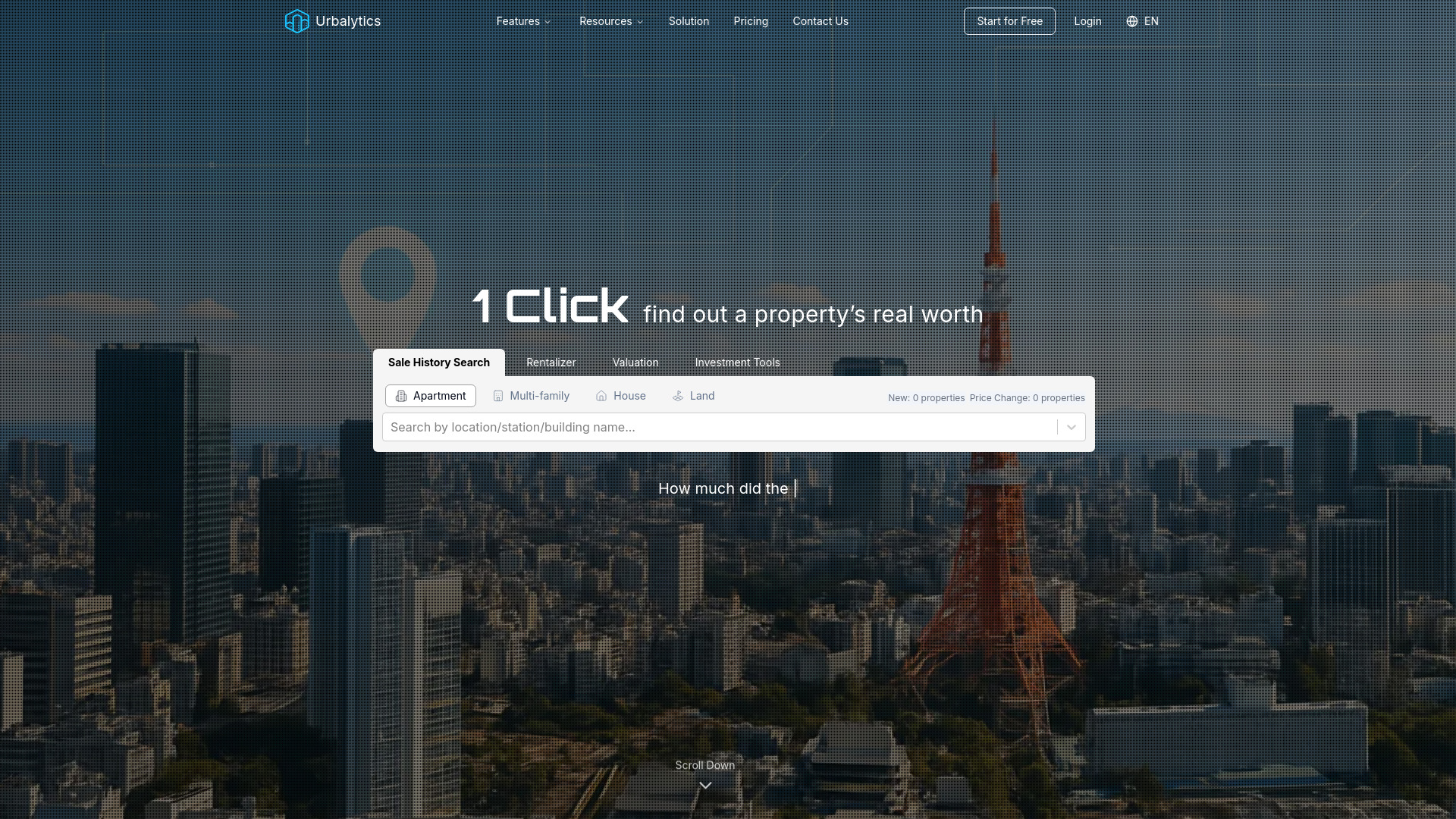
Urbalytics is Japan’s next-generation real-time real estate intelligence platform—engineered for precision, speed, and strategic foresight. Built on proprietary AI models trained on decades of Japanese property data, it transforms fragmented market signals into unified, actionable intelligence. More than a database or valuation tool, Urbalytics is an integrated decision engine: it synthesizes live transaction feeds, hyperlocal station-level dynamics, rental yield indicators, and macroeconomic signals to generate forward-looking valuations, risk-adjusted opportunity scores, and scenario-aware investment forecasts—all updated minute-by-minute.
How to Use Urbalytics
Urbalytics delivers enterprise-grade analytics through an interface designed for speed and intuition. Begin with a single search—by train station (e.g., “Shibuya Station”), neighborhood (e.g., “Nakano-ku”), or building name—and instantly surface comparable listings, price velocity metrics, and liquidity indicators. The Live Market Pulse dashboard surfaces real-time shifts: new listings entering the market, recent price revisions, and emerging demand clusters across Tokyo, Osaka, Fukuoka, and beyond. Use the Smart Valuation Wizard to generate instant, audit-ready appraisals via URL import, structured form input, or AI-powered photo analysis that interprets floor plans, façade condition, and spatial layout. Then deepen your analysis: run multi-year cash flow simulations with adjustable vacancy rates, capex timing, and loan amortization; overlay rental upside heatmaps to identify neighborhoods where short-term rental premiums outpace long-term lease growth; or benchmark portfolio assets against peer cohorts using dynamic, algorithmically curated comparables.
Every workflow—from first-time investor to institutional asset manager—is supported by contextual guidance: tooltips explain valuation methodology, interactive charts highlight inflection points in supply-demand balance, and automated alerts notify you when a target area crosses key thresholds (e.g., rent-to-price ratio > 5.2%, inventory days falling below 45). Urbalytics doesn’t just show data—it reveals *why* it matters, and *what to do next*.
Key Features of Urbalytics
- Real-Time Market Analysis: Access Japan’s only continuously refreshed real estate data layer—sourced from MLS feeds, municipal registries, listing portals, and verified broker submissions—with latency under 90 seconds. Visualize micro-market momentum, absorption rates, and competitive saturation without manual aggregation.
- Smart Insights Engine: Go beyond static reports with AI-generated insights: “This property’s rental yield is 17% above district median—but occupancy risk has risen 23% YoY due to new supply”; “Station A’s 3-year price appreciation is decelerating, while Station B’s foot traffic growth now exceeds its rental index—suggesting latent upside.” Insights adapt to your role, goals, and portfolio context.
- Valuations with Contextual Confidence: Receive not just a number—but a valuation spectrum anchored in probabilistic modeling. Each appraisal includes confidence scoring, sensitivity analysis (e.g., “±¥8.2M impact per 1% interest rate change”), and comparative benchmarks across three tiers of market similarity—ensuring transparency, defensibility, and strategic nuance.
- Station-Centric Intelligence: Leverage Japan’s unique transit-driven real estate logic. Analyze catchment radius performance, walk-time decay curves, station renovation timelines, and line extension schedules—all mapped directly to property-level ROI projections.
- Portfolio Intelligence Dashboard: Aggregate, compare, and stress-test multiple assets in one view. Track KPIs like net operating income (NOI) volatility, cap rate compression risk, and renovation payback windows—then simulate portfolio-wide impacts of macro events (e.g., consumption tax changes, immigration policy shifts).
- Regulatory & Compliance Signals: Automatically flag properties impacted by new regulations—such as Airbnb licensing requirements, seismic retrofit mandates, or upcoming zoning revisions—so compliance risks surface alongside financial opportunities.
Why Choose Urbalytics?
In Japan’s fast-moving, information-asymmetric real estate market, advantage belongs to those who see first—and understand deepest. Urbalytics is trusted by top-tier REITs, cross-border funds, boutique acquisition firms, and high-net-worth investors precisely because it closes the gap between raw data and decisive action. Unlike legacy tools reliant on quarterly snapshots or generic national indices, Urbalytics operates at the speed of the market—delivering granular, predictive, and prescriptive intelligence that reduces due diligence cycles by up to 75% and increases qualified deal flow by over 40%. Its architecture unifies what others silo: market discovery, financial engineering, valuation science, and regulatory foresight—all within a single, auditable, and scalable platform.
Whether evaluating a single apartment block in Sapporo or optimizing a 200-unit portfolio across five prefectures, Urbalytics adapts—not with feature bloat, but with intelligent layering. Your access level determines depth, not capability: the same AI models powering enterprise portfolio optimization also drive intuitive, guided workflows for individual investors. That’s not versatility—it’s architectural integrity.
Use Cases and Applications
Acquisition teams use Urbalytics’ Real-Time Opportunity Radar to detect off-market potential before listings go public—triggering alerts when transaction velocity spikes in a sub-district or when price-per-tsubo divergence exceeds statistical norms. Brokers deploy Smart Listing Cards: dynamically generated property profiles embedded with live valuation ranges, rental upside scores, and competitive positioning visuals—enhancing client trust and shortening sales cycles. Asset managers leverage Portfolio Health Scoring to auto-flag underperforming assets, simulate repositioning scenarios (e.g., “Convert to serviced apartments?”), and model capex ROI against projected rent uplift. Meanwhile, Airbnb operators rely on the Seasonal Demand Forecast module—integrating weather patterns, event calendars, and tourism data—to dynamically adjust pricing, staffing, and marketing spend month-by-month. From origination to exit, Urbalytics embeds intelligence at every stage.
Frequently Asked Questions About Urbalytics
What pricing plans does Urbalytics offer and is it free to use?
Urbalytics offers tiered subscriptions—Starter, Professional, and Enterprise—each calibrated to user scale, data depth, and integration needs. Starter includes core search, real-time dashboards, and single-property valuations; Professional adds portfolio analytics, API access, and custom alerting; Enterprise delivers white-label reporting, dedicated data pipelines, and SLA-backed uptime. While there is no permanent free plan, Urbalytics provides a fully functional 14-day trial with no credit card required—giving users hands-on experience with live data, AI insights, and valuation accuracy before committing. Pricing details and trial activation are available at urbalytics.jp.
How does the Urbalytics property appraisal system work?
Urbalytics’ valuation engine fuses econometric modeling with deep learning to interpret over 200 property-specific and environmental variables—including proximity-weighted station metrics, building age decay curves, floor-level premium algorithms, and neighborhood sentiment signals derived from local business registrations and social media trends. Appraisals are generated in three ways: (1) paste a listing URL for instant metadata extraction and cross-platform validation; (2) complete a streamlined form highlighting key differentiators (e.g., “renovated 2023”, “south-facing balcony”, “no management fee”); or (3) upload photos for AI to assess condition, layout efficiency, and visual appeal relative to market peers. Every output includes methodological transparency, margin-of-error bands, and supporting evidence—designed for due diligence, not just estimation.
Which areas and regions does Urbalytics support for real estate data?
Urbalytics provides granular, real-time coverage across all 47 Japanese prefectures—with highest fidelity in Greater Tokyo (23 wards + Chiba/Saitama/Kanagawa), Kansai (Osaka, Kyoto, Kobe), and major urban corridors including Nagoya, Fukuoka, Sapporo, and Sendai. Data resolution extends down to individual stations (with 500m and 1km catchment analytics), postal code clusters, and designated redevelopment zones. Coverage expands monthly based on data partner integrations and user demand. For precise availability in your target location—including historical depth and listing source diversity—explore the interactive Area Coverage Map on the platform or contact support at urbalytics.jp/contact-us.
Does Urbalytics provide professional investment advice?
No. Urbalytics is a technology platform delivering objective, data-derived intelligence—not personalized financial, legal, or tax advice. Its outputs inform decisions but do not replace professional judgment. Users are encouraged to consult licensed real estate advisors, certified tax accountants, and qualified attorneys when structuring transactions, assessing liability, or interpreting regulatory implications. Urbalytics maintains strict neutrality: no brokerage relationships, no referral fees, and no incentives tied to specific outcomes—ensuring analytical integrity remains uncompromised.
Is an API available for Urbalytics integration?
Yes. Urbalytics offers a secure, RESTful API with comprehensive documentation, rate-limiting controls, and sandbox environments for development. The API supports real-time property search, bulk valuation requests, market trend exports, and custom alert configuration—enabling seamless integration with internal CRM systems, portfolio management software, and proprietary analytics dashboards. Enterprise clients may request enhanced capabilities including private data ingestion, custom model training, and co-branded reporting. Technical specifications, authentication protocols, and onboarding support are available upon request via urbalytics.jp/contact-us.