Table of contents
Stackie.AI : AI Journaling, Health Tracking & Reflection Stacks
Stackie.AI: AI-powered journaling, health tracking & reflection—customizable “stacks” for your life. Log, track, reflect. Start free today!
Directory : Text&Writing, AI Tools, Productivity Tools, Health & Wellness, Personal Development
What Is Stackie.AI?
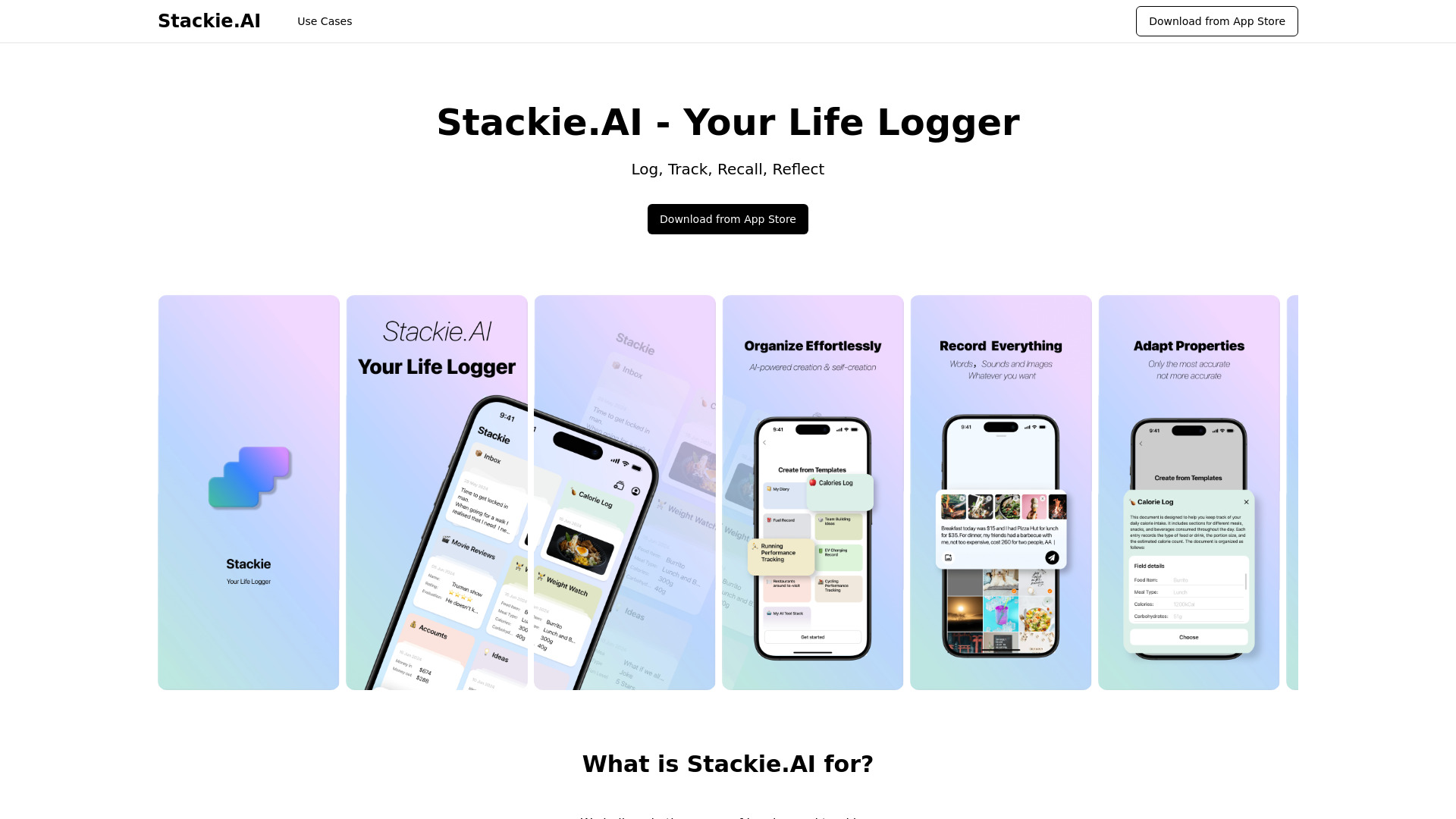
Stackie.AI is a next-generation reflection platform built for people who believe self-knowledge begins with intentional data—not just diary entries. It’s not another generic journal app or siloed health tracker. Instead, Stackie.AI unifies AI-powered journaling, holistic health monitoring, and structured personal reflection into one adaptive system: the Reflection Stack. Each stack acts as a living, learning module—custom-built to capture what matters most to you: mood shifts over time, post-workout recovery trends, learning retention curves, or even how your wardrobe choices correlate with confidence levels. Powered by contextual AI, Stackie.AI doesn’t just store your life—it interprets it, surfaces quiet patterns you’d miss, and turns daily fragments into durable insight.
How Stackie.AI Works
At its heart, Stackie.AI operates on a simple yet powerful principle: track once, reflect deeply. You begin by defining your first Reflection Stack—whether it’s “Energy & Sleep,” “Mindful Eating,” “Learning Momentum,” or something entirely your own. Then, log in seconds: type a quick note during your morning coffee, snap a photo of today’s lunch, or speak aloud a thought mid-commute using voice logging. No setup friction. No forced routines. Just intuitive, context-aware input that fits your rhythm.
Behind the scenes, Stackie.AI’s AI layer enriches every entry—auto-tagging emotions from journal text, estimating macronutrients from food photos, correlating caffeine timing with afternoon focus dips, or surfacing recurring themes across weeks of reflection. Your dashboard surfaces dynamic widgets: a “Mood Pulse” chart, a “Sleep Consistency Score,” or a “Gratitude Frequency Map”—all updated in real time. And because reflection deepens with continuity, the platform gently nudges—not reminds—with personalized prompts rooted in your actual data history, never generic defaults.
Core Capabilities of Stackie.AI
- Reflection Stacks: Modular, purpose-built tracking environments where journaling, health metrics, and behavioral insights converge. Create stacks for mental wellness, habit formation, academic growth, fitness progression—or blend domains (e.g., “Stress ↔ Nutrition ↔ Sleep”) to uncover cross-system relationships.
- Adaptive Journaling Engine: Go beyond static prompts. Stackie.AI learns your language, tone, and reflection style—then suggests evolving questions, highlights emotional arcs across entries, and surfaces “aha moments” you didn’t know you logged.
- Multi-Sensory Logging: Capture life as it happens: type concise notes, record voice reflections (transcribed + sentiment-analyzed), or upload images (food, workouts, environment) with AI-powered contextual tagging—no manual labels required.
- Holistic Health Intelligence: Track sleep duration *and* perceived restfulness, log meals *and* energy response, monitor mood *and* triggers—all within unified health stacks. Includes AI-calculated nutrition estimates, hydration trend alerts, and caffeine/sugar impact scoring.
- Insight-First Analytics: Skip the spreadsheet. Stackie.AI transforms raw logs into visual, narrative, and comparative insights—like “Your focus peaks 90 minutes after breakfast protein,” or “Weeks with 3+ gratitude entries show 22% lower reported stress.” Widgets are editable, shareable, and designed for action—not just observation.
- Micro-Reflection Architecture: Designed for sustainability. Log meaningful reflections in under 20 seconds. Templates auto-adapt based on time of day, recent activity, or biometric signals (when integrated)—so consistency feels effortless, not obligatory.
Every capability reinforces one mission: to make self-understanding measurable, meaningful, and continuously evolving—not a task, but a trusted dialogue between you and your own lived experience.
Why Stackie.AI Is Different
In a landscape crowded with fragmented tools—journal apps that ignore physiology, health trackers that miss psychology, and analytics dashboards that lack humanity—Stackie.AI stands apart by refusing compartmentalization. It treats your mental state, physical habits, learning rhythms, and emotional patterns as interconnected layers of a single system: you. That’s why professionals use it not just to debrief meetings, but to map decision fatigue against caffeine intake; why clinicians recommend it for patients building metacognitive awareness alongside symptom tracking; and why students deploy custom stacks to visualize vocabulary retention alongside sleep quality and study duration.
Its intelligence isn’t about replacing reflection—it’s about accelerating it. Where other tools ask “What did you do?” Stackie.AI asks “What does this reveal about how you thrive?” And because it’s built on flexible, user-owned stacks—not rigid categories—it grows with you: from managing burnout recovery to optimizing creative flow, from mastering a new language to sustaining long-term wellness. Featured on aitop-tools.com as a pioneer in applied personal AI, Stackie.AI represents a shift—from passive logging to active self-discovery.
Real-World Applications
A clinical psychologist uses Stackie.AI to co-create “Emotion Regulation Stacks” with clients—blending mood journaling, breathwork logs, and environmental notes to identify subtle antecedents to anxiety spikes. A remote software engineer builds a “Focus Flow Stack” tracking code commits, screen-time breaks, caffeine timing, and post-lunch energy crashes—revealing an unexpected link between hydration and debugging efficiency. A language learner deploys a “Speaking Confidence Stack,” recording voice snippets weekly, logging self-rated fluency, and correlating progress with sleep consistency and practice frequency. Meanwhile, a wellness coach leverages client-shared stacks to spot nutritional patterns influencing mood variability—turning subjective reports into objective, collaborative insights. Across roles and goals, Stackie.AI serves not as a mirror, but as a lens—sharpening perception, deepening agency, and grounding growth in evidence you collect and control.
Frequently Asked Questions About Stackie.AI
What Exactly Is a “Reflection Stack”?
A Reflection Stack is Stackie.AI’s foundational unit of insight—a customizable, goal-aligned workspace where journaling, health data, and behavioral observations live together. Unlike static templates, each stack evolves: fields adapt, prompts refine, and widgets learn based on your inputs. It’s your personal lab for exploring questions like “How does my energy shift when I move before noon?” or “What makes my writing sessions feel generative?”
Can I Build My Own Stack From Scratch?
Absolutely. Start with a blank canvas or adapt any pre-built stack (“Mindful Mornings,” “Recovery Tracker,” “Skill Sprint”). Define your metrics, choose input modes (text/voice/photo), assign AI analysis rules (e.g., “flag low-sugar days with high energy”), and design your dashboard view. No coding needed—just clarity about what you want to understand.
Is There a Free Tier?
Yes. Stackie.AI offers a robust free tier with unlimited stacks, core AI journaling, basic health tracking, and three customizable widgets. Premium unlocks advanced analytics, cross-stack correlation reports, priority AI support, and export-ready insights. For full details—including educational and team plans—visit the official Stackie.AI website or check the latest pricing on aitop-tools.com.
How Does AI Support Learning & Growth?
Stackie.AI treats learning as a physiological, psychological, and behavioral process—not just cognitive. Its AI analyzes patterns across study logs, retention quizzes, sleep data, and self-reflection to surface personalized recommendations: optimal review intervals, environmental tweaks for focus, or emotional barriers to persistence. Especially powerful for language acquisition, skill mastery, and academic goal-setting.
Can I Track Physical Health Metrics Effectively?
Yes—deeply and contextually. Stackie.AI integrates manual logs (symptoms, exercise, meals) with AI estimation (calories, macros, hydration), wearable sync (optional), and reflective context (“Felt sluggish after lunch—even though calories were balanced”). The result? Not just “what you did,” but “how your body and mind responded”—enabling truly informed health decisions.