Text&ampWriting

SiliconFlow - AI Model API & Deployment Platform

Access 200+ AI models for text, image, video, and audio. Deploy instantly with serverless inference or dedicated GPUs using SiliconFlow.

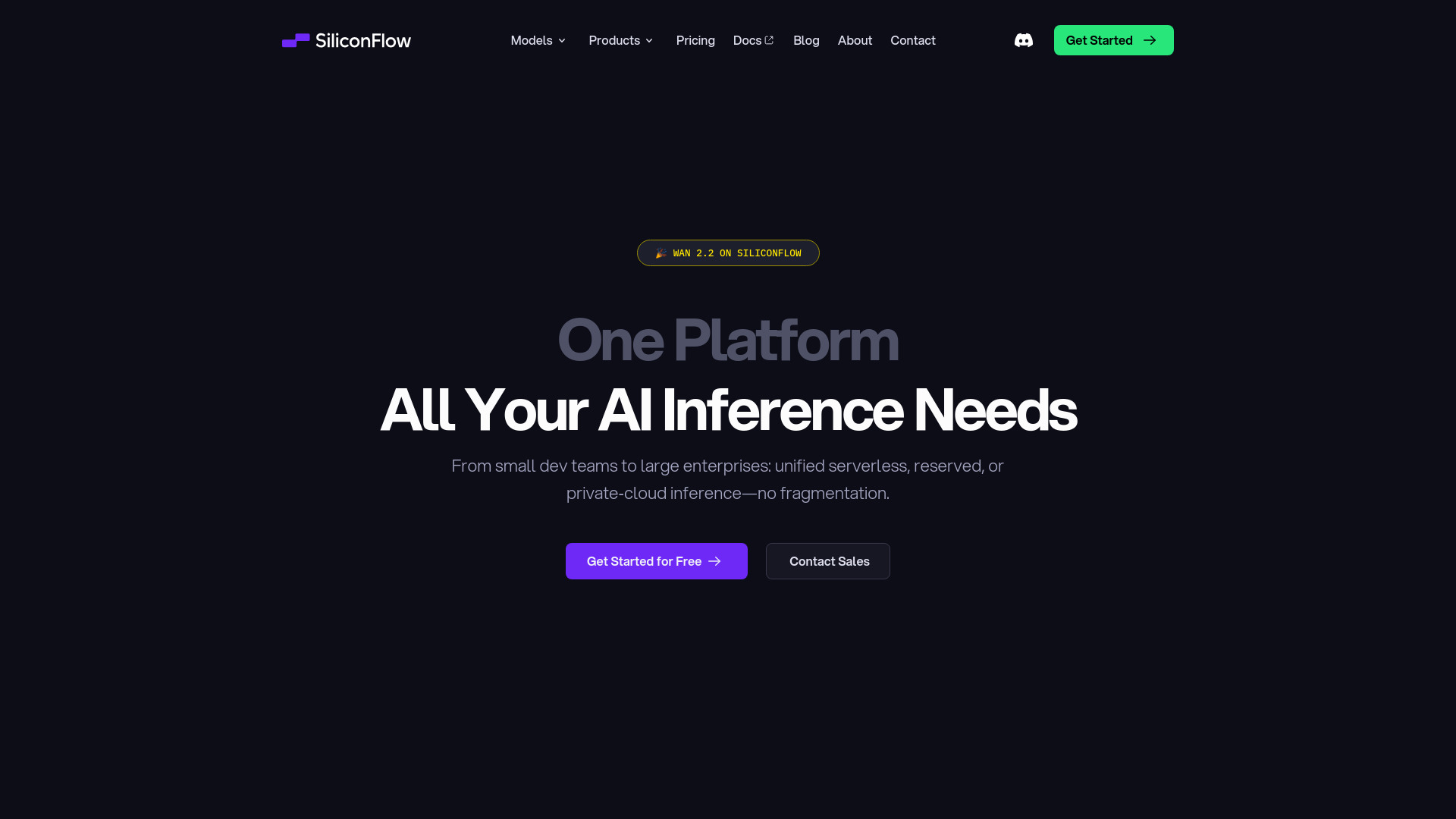
SiliconFlow - AI Model API & Deployment Platform website preview

What Is SiliconFlow?

SiliconFlow is an AI model API and deployment platform built to help developers, startups, and enterprises bring intelligent applications into production with less infrastructure work. Through one streamlined service, users can connect to more than 200 AI models for language generation, image creation, video production, speech processing, and other machine learning tasks. Instead of configuring separate hosting environments for every model, teams can use a unified platform to test different technologies, manage inference workloads, and scale applications as demand changes.

The platform is designed for a wide range of projects, from conversational assistants and automated writing tools to visual content systems and enterprise data workflows. SiliconFlow combines accessible APIs with high-performance computing resources, giving development teams a practical way to experiment with advanced models while maintaining the reliability required for production use. Its centralized approach also makes it easier to compare models, control usage, and adapt an application as new AI capabilities become available.

How to Use SiliconFlow

Using SiliconFlow begins with creating an account and generating an API key from the developer console. After authentication is configured, applications can send requests through the platform's REST API to generate text, create images, process audio, or perform other supported tasks. Developers can select a model according to the application's requirements and integrate the response into an existing product using familiar HTTP methods and software development tools.

SiliconFlow supports several ways to run AI workloads. Serverless inference is suitable for applications with changing usage levels because resources can adjust automatically. Dedicated deployments provide more predictable capacity for services that need stable response times, while reserved GPU resources are designed for sustained, resource-intensive workloads. Teams can move between these deployment approaches as a project develops without rebuilding the entire application architecture.

More advanced users can bring customized or fine-tuned models to the platform and use SiliconFlow's management tools to observe their behavior in production. Usage dashboards can help teams review request volume, response latency, resource consumption, and estimated costs. These insights support practical decisions about model selection, capacity planning, and optimization.

Key Features of SiliconFlow

  • Extensive AI Model Selection: SiliconFlow brings together more than 200 models for text, images, video, audio, and related AI tasks. Developers can evaluate different models from a single environment, reducing the effort involved in maintaining separate integrations and credentials across multiple services.
  • Optimized Inference Performance: The platform uses specialized acceleration and serving technologies to improve the speed and efficiency of model execution. Faster inference can support interactive products, high-volume automation, and applications where response time has a direct effect on user satisfaction.
  • Multiple Hosting Models: Users can choose serverless execution, dedicated endpoints, or reserved GPU capacity based on their traffic pattern, budget, and performance goals. This range of options makes the platform suitable for early experiments as well as established production systems.
  • Custom Model Deployment: Teams can deploy models adapted to their own data, domain, or business requirements. Custom deployments allow organizations to apply specialized AI capabilities while using the same operational environment for monitoring, scaling, and service management.
  • Centralized Observability: SiliconFlow provides operational information that helps teams understand how their AI services are performing. Metrics related to latency, throughput, requests, and resource usage can make it easier to identify bottlenecks and refine deployment settings.
  • Scalable Infrastructure: Elastic compute capacity allows applications to respond to changing workloads without requiring teams to manually provision hardware for every traffic increase. This supports more consistent service delivery and can help reduce wasted capacity during quieter periods.
  • Developer-Friendly Integration: Standard API access, documentation, and implementation examples allow developers to connect AI features to web applications, internal tools, mobile services, and automated business processes with familiar development patterns.

Why Choose SiliconFlow?

SiliconFlow gives organizations a single operational layer for exploring and serving a broad selection of AI models. Developers can compare model capabilities and performance without creating a new infrastructure setup for every experiment. This is especially useful for teams that need to assess several language, image, or multimedia models before selecting the best option for a specific product feature.

The platform also supports a smoother transition from proof of concept to production. A team may begin with serverless access while validating an idea, then move to dedicated resources when usage becomes more predictable. This progression helps reduce unnecessary infrastructure planning in the early stages while providing a path toward more controlled performance as the application grows.

SiliconFlow's unified API approach can simplify maintenance for products that use multiple AI capabilities. Teams can manage model requests through a consistent integration pattern and use platform-level metrics to review technical and financial performance. For organizations building several AI-powered services, this centralized workflow can improve visibility and reduce the operational burden of managing disconnected providers.

Use Cases and Applications

Software teams use SiliconFlow to add conversational features to customer support platforms, productivity tools, knowledge bases, and internal portals. Language models can assist with question answering, document summarization, classification, translation, content drafting, and structured data extraction. Because these capabilities are available through APIs, developers can add AI functions to existing products without building an entire model-serving system themselves.

Creative and marketing departments can use image and video models to produce campaign concepts, product visuals, social media assets, and other digital materials. Automated generation workflows can help teams create multiple variations for testing or personalize content for different audiences. Audio models can support transcription, voice interfaces, media indexing, and analysis of recorded conversations.

Online retailers can connect AI models to recommendation engines, product search, shopping assistants, and automated service tools. Media companies can apply models to caption generation, content tagging, scene analysis, and editorial workflows. Financial, healthcare, and research organizations may deploy specialized models for document processing, domain-specific analysis, or knowledge discovery while applying the access controls and infrastructure practices required by their internal systems.

SiliconFlow can also support data and engineering teams that need to process large volumes of requests. Elastic computing resources are useful for batch jobs, evaluation pipelines, model comparisons, and other workloads that may fluctuate substantially over time. Custom deployment capabilities provide additional flexibility for organizations whose use cases depend on proprietary data or specialized model behavior.

Product source: SiliconFlow - AI Model API & Deployment Platform official website. Check the provider for current plans, limits and availability.

FAQ

SiliconFlow - AI Model API & Deployment Platform questions and answers

Product context and practical checks for evaluating SiliconFlow - AI Model API & Deployment Platform.

What is SiliconFlow - AI Model API & Deployment Platform used for?

Access 200+ AI models for text, image, video, and audio. Deploy instantly with serverless inference or dedicated GPUs using SiliconFlow.

How do I get started with SiliconFlow - AI Model API & Deployment Platform?

Using SiliconFlow begins with creating an account and generating an API key from the developer console. After authentication is configured, applications can send requests through the platform's REST API to generate text, create images, process audio, or perform other supported tasks. Developers can select a model according to the application's requirements and integrate the response into an existing product using familiar HTTP methods and software development tools.SiliconFlow supports several ways to run AI workloads. Serverless inference is suitable for applications with changing usage levels because resources can adjust automatically. Dedicated deployments provide more predictable capacity for services that need stable response times, while reserved GPU resources are designed for sustained, resource-intensive workloads. Teams can move between these deployment approaches as a project develops without rebuilding the entire application architecture.More advanced users can bring customized or fine-tuned models to the platform and use SiliconFlow's management tools to observe their behavior in production. Usage dashboards can help teams review request volume, response latency, resource consumption, and estimated costs. These insights support practical decisions about model selection, capacity planning, and optimization.

Which capabilities are described for SiliconFlow - AI Model API & Deployment Platform?

Extensive AI Model Selection: SiliconFlow brings together more than 200 models for text, images, video, audio, and related AI tasks. Developers can evaluate different models from a single environment, reducing the effort involved in maintaining separate integrations and credentials across multiple services. Optimized Inference Performance: The platform uses specialized acceleration and serving technologies to improve the speed and efficiency of model execution. Faster inference can support interactive products, high-volume automation, and applications where response time has a direct effect on user satisfaction. Multiple Hosting Models: Users can choose serverless execution, dedicated endpoints, or reserved GPU capacity based on their traffic pattern, budget, and performance goals. This range of options makes the platform suitable for early experiments as well as established production systems. Custom Model Deployment: Teams can deploy models adapted to their own data, domain, or business requirements. Custom deployments allow organizations to apply specialized AI capabilities while using the same operational environment for monitoring, scaling, and service management. Centralized Observability: SiliconFlow provides operational information that helps teams understand how their AI services are performing. Metrics related to latency, throughput, requests, and resource usage can make it easier to identify bottlenecks and refine deployment settings. Scalable Infrastructure: Elastic compute capacity allows applications to respond to changing workloads without requiring teams to manually provision hardware for every traffic increase. This supports more consistent service delivery and can help reduce wasted capacity during quieter periods. Developer-Friendly Integration: Standard API access, documentation, and implementation examples allow developers to connect AI features to web applications, internal tools, mobile services, and automated business processes with familiar development patterns.

What projects can I evaluate SiliconFlow - AI Model API & Deployment Platform for?

Software teams use SiliconFlow to add conversational features to customer support platforms, productivity tools, knowledge bases, and internal portals. Language models can assist with question answering, document summarization, classification, translation, content drafting, and structured data extraction. Because these capabilities are available through APIs, developers can add AI functions to existing products without building an entire model-serving system themselves.Creative and marketing departments can use image and video models to produce campaign concepts, product visuals, social media assets, and other digital materials. Automated generation workflows can help teams create multiple variations for testing or personalize content for different audiences. Audio models can support transcription, voice interfaces, media indexing, and analysis of recorded conversations.Online retailers can connect AI models to recommendation engines, product search, shopping assistants, and automated service tools. Media companies can apply models to caption generation, content tagging, scene analysis, and editorial workflows. Financial, healthcare, and research organizations may deploy specialized models for document processing, domain-specific analysis, or knowledge discovery while applying the access controls and infrastructure practices required by their internal systems.SiliconFlow can also support data and engineering teams that need to process large volumes of requests. Elastic computing resources are useful for batch jobs, evaluation pipelines, model comparisons, and other workloads that may fluctuate substantially over time. Custom deployment capabilities provide additional flexibility for organizations whose use cases depend on proprietary data or specialized model behavior.

How does SiliconFlow - AI Model API & Deployment Platform handle extensive ai model selection?

Extensive AI Model Selection: SiliconFlow brings together more than 200 models for text, images, video, audio, and related AI tasks. Developers can evaluate different models from a single environment, reducing the effort involved in maintaining separate integrations and credentials across multiple services.

How does SiliconFlow - AI Model API & Deployment Platform handle optimized inference performance?

Optimized Inference Performance: The platform uses specialized acceleration and serving technologies to improve the speed and efficiency of model execution. Faster inference can support interactive products, high-volume automation, and applications where response time has a direct effect on user satisfaction.

What should I compare before choosing a SiliconFlow - AI Model API & Deployment Platform plan?

Check SiliconFlow - AI Model API & Deployment Platform’s current pricing page for included usage, renewal terms and any credit charges. Compare the cost of a usable result, including retries, rather than assuming that account registration includes free usage.

What inputs should I prepare for a SiliconFlow - AI Model API & Deployment Platform trial?

Compare text prompts, reference frames, source footage and audio support. Check duration, aspect ratio and whether the tool lets you keep a subject consistent between shots.

How can I check the quality of a SiliconFlow - AI Model API & Deployment Platform result?

Watch the entire clip for motion errors, distorted objects, changing identities, lip-sync problems and abrupt transitions. Inspect the downloaded file as well as the preview.

Where is the official SiliconFlow - AI Model API & Deployment Platform website?

The website linked from this profile is https://www.siliconflow.com. Use the provider’s own documentation, account area and support channels to confirm current product details.

Visit SiliconFlow - AI Model API & Deployment Platform