Text&ampWriting

Seele AI

Turn text into playable 3D worlds with Seele AI. Instantly create racing games, parkour levels, and interactive environments with AI.

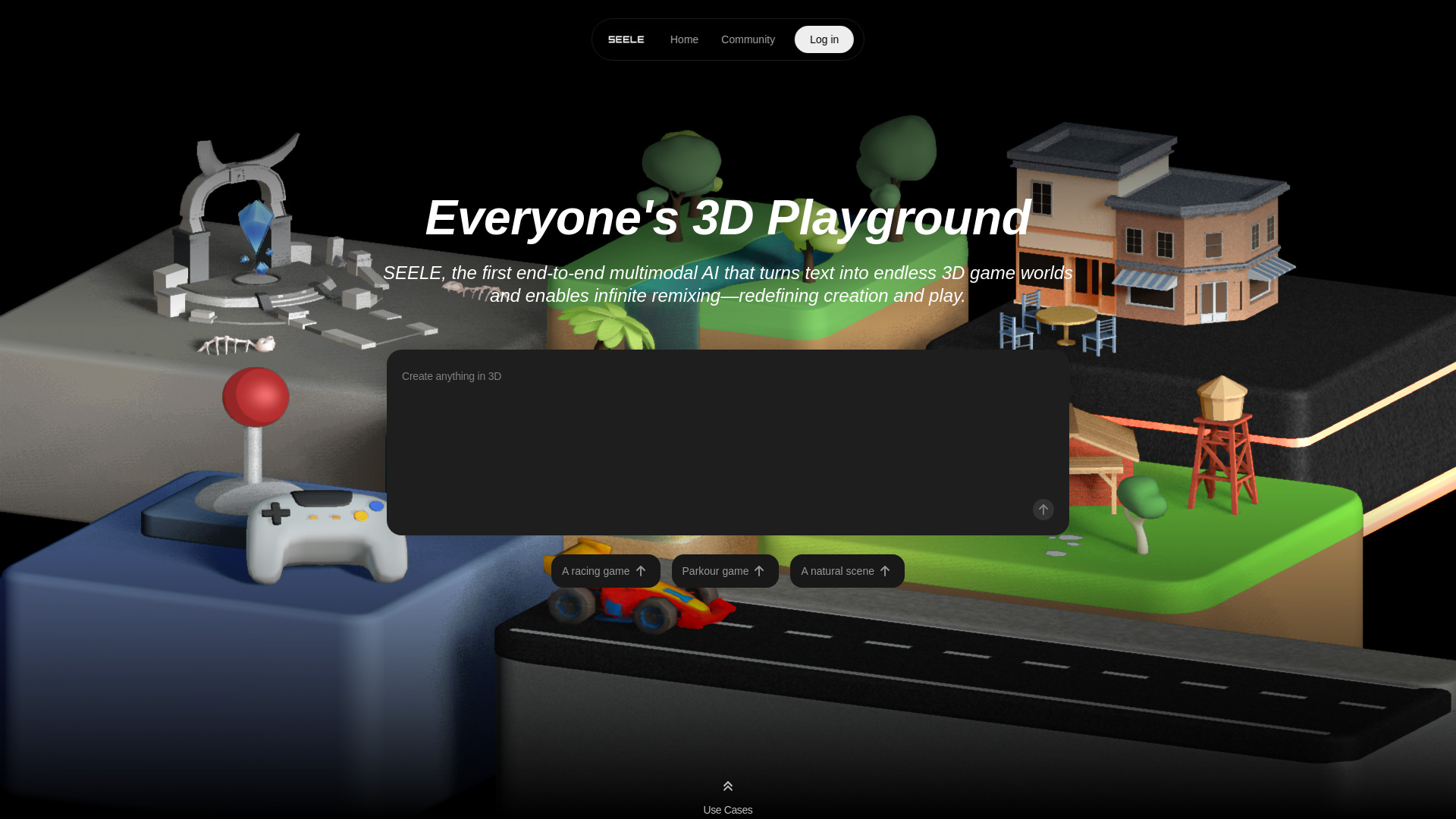
Seele AI website preview

What is Seele AI?

Seele AI is an AI-powered creation platform that turns written ideas into playable 3D worlds, racing maps, and interactive environments. Creators can describe a setting, outline a challenge, or suggest a visual theme, then use the generated world as a starting point for exploration and refinement. By bringing text-based creation and 3D world building into one workflow, Seele AI helps users develop game concepts with less manual modeling and coding.

The platform supports a range of creative directions, including neon-lit racing circuits, parkour courses, fantasy campuses, outdoor landscapes, and furnished interiors. Its appeal lies in making spatial ideas easier to experience: instead of leaving a concept as a written description, creators can explore an interactive version and decide what to change next.

How to Use Seele AI

Start with a text prompt that explains the world you want to create. Include the environment, visual style, and main activity to give the generation a clear direction. For a racing map, you might describe “a coastal circuit with sweeping turns, cliffside tunnels, and a sunset finish line.” For a platforming experience, specify rooftop paths, elevated platforms, or a sequence of obstacles. Clear descriptions help connect the appearance of a world with its intended gameplay.

Once the environment is generated, explore its layout and review how the different elements work together. Consider whether a route is easy to follow, whether obstacles suit the intended challenge, and whether the setting supports your concept. Use Seele AI’s remixing capabilities to revise scenery, replace characters, change objects, or explore alternative arrangements. This process lets you develop an initial idea through successive versions while keeping attention on the player’s experience.

Key Features of Seele AI

  • Text-to-3D World Creation: Describe a location in natural language and generate a three-dimensional environment around that idea. This approach helps creators move from a written concept to an explorable space without constructing every element individually.
  • Playable Racing Maps and Game Environments: Build concepts around driving, movement, exploration, and obstacle-based challenges. Racing tracks, parkour routes, and themed game spaces provide opportunities to investigate how environmental design affects play.
  • Flexible World Remixing: Rework generated content by changing characters, replacing scenery, and adjusting parts of the environment. Remixing supports creative experimentation, allowing one starting concept to develop into several different experiences.
  • On-Demand 3D Asset Generation: Create props, furnishings, characters, and other world elements within the broader building process. Contextual asset generation helps populate scenes and gives creators more material to work with as they refine their environments.
  • Spatial Layout Generation: Use AI-assisted world building to explore the placement of objects, routes, rooms, and interactive areas. Generated layouts offer a foundation for assessing scale, movement, and connections between different parts of a scene.
  • Integrated Creation Workflow: Bring text prompts, environment generation, and playable exploration together in a single process. This reduces the number of separate steps needed to begin testing a 3D concept and makes early iteration more accessible.

Why Choose Seele AI?

Seele AI is useful for creators who want to explore a game idea while it is still taking shape. Building an environment manually can require substantial preparation before there is anything to navigate or test. A prompt-based workflow offers an earlier opportunity to examine the idea in three dimensions, identify promising features, and reconsider elements that do not support the intended experience.

For independent developers and small teams, that can make concept development more manageable. Designers can compare different settings, investigate possible routes, or communicate a proposed level through an interactive environment. Creators with limited technical experience can also participate more directly in world building by describing the spaces they imagine and refining the resulting scenes.

The combination of generation and remixing is particularly relevant to iterative design. A racing concept might begin as a mountain road, then develop into a tighter circuit with additional landmarks and different scenery. Each version gives the creator another opportunity to assess the relationship between visual design, navigation, and gameplay.

Use Cases and Applications

Racing map design is a natural application for Seele AI’s text-to-world workflow. A creator can describe an urban night race, a desert route, or a winding forest circuit, then explore how the generated setting supports the driving concept. Variations in turns, scenery, obstacles, and route structure can help inform further design decisions. The same process can support parkour courses and other movement-focused environments where spacing and navigation shape the experience.

Game designers can also use Seele AI to develop locations for exploration and storytelling. A secluded academy, an abandoned research station, or a woodland settlement can provide the foundation for an interactive scene. By revising characters, objects, and environmental details, creators can investigate how a setting communicates its purpose and encourages players to explore.

Beyond game concepts, generated interiors and outdoor spaces can support early visualization. Designers may explore room arrangements or communicate an environmental idea through a navigable scene, while educators can investigate settings for discovery-based learning. These applications benefit from the ability to experience a space and revise it as ideas develop.

Product source: Seele AI official website. Check the provider for current plans, limits and availability.

FAQ

Seele AI questions and answers

Product context and practical checks for evaluating Seele AI.

What is Seele AI used for?

Turn text into playable 3D worlds with Seele AI. Instantly create racing games, parkour levels, and interactive environments with AI.

How do I get started with Seele AI?

Start with a text prompt that explains the world you want to create. Include the environment, visual style, and main activity to give the generation a clear direction. For a racing map, you might describe “a coastal circuit with sweeping turns, cliffside tunnels, and a sunset finish line.” For a platforming experience, specify rooftop paths, elevated platforms, or a sequence of obstacles. Clear descriptions help connect the appearance of a world with its intended gameplay.Once the environment is generated, explore its layout and review how the different elements work together. Consider whether a route is easy to follow, whether obstacles suit the intended challenge, and whether the setting supports your concept. Use Seele AI’s remixing capabilities to revise scenery, replace characters, change objects, or explore alternative arrangements. This process lets you develop an initial idea through successive versions while keeping attention on the player’s experience.

Which capabilities are described for Seele AI?

Text-to-3D World Creation: Describe a location in natural language and generate a three-dimensional environment around that idea. This approach helps creators move from a written concept to an explorable space without constructing every element individually. Playable Racing Maps and Game Environments: Build concepts around driving, movement, exploration, and obstacle-based challenges. Racing tracks, parkour routes, and themed game spaces provide opportunities to investigate how environmental design affects play. Flexible World Remixing: Rework generated content by changing characters, replacing scenery, and adjusting parts of the environment. Remixing supports creative experimentation, allowing one starting concept to develop into several different experiences. On-Demand 3D Asset Generation: Create props, furnishings, characters, and other world elements within the broader building process. Contextual asset generation helps populate scenes and gives creators more material to work with as they refine their environments. Spatial Layout Generation: Use AI-assisted world building to explore the placement of objects, routes, rooms, and interactive areas. Generated layouts offer a foundation for assessing scale, movement, and connections between different parts of a scene. Integrated Creation Workflow: Bring text prompts, environment generation, and playable exploration together in a single process. This reduces the number of separate steps needed to begin testing a 3D concept and makes early iteration more accessible.

What projects can I evaluate Seele AI for?

Racing map design is a natural application for Seele AI’s text-to-world workflow. A creator can describe an urban night race, a desert route, or a winding forest circuit, then explore how the generated setting supports the driving concept. Variations in turns, scenery, obstacles, and route structure can help inform further design decisions. The same process can support parkour courses and other movement-focused environments where spacing and navigation shape the experience.Game designers can also use Seele AI to develop locations for exploration and storytelling. A secluded academy, an abandoned research station, or a woodland settlement can provide the foundation for an interactive scene. By revising characters, objects, and environmental details, creators can investigate how a setting communicates its purpose and encourages players to explore.Beyond game concepts, generated interiors and outdoor spaces can support early visualization. Designers may explore room arrangements or communicate an environmental idea through a navigable scene, while educators can investigate settings for discovery-based learning. These applications benefit from the ability to experience a space and revise it as ideas develop.

How does Seele AI handle text-to-3d world creation?

Text-to-3D World Creation: Describe a location in natural language and generate a three-dimensional environment around that idea. This approach helps creators move from a written concept to an explorable space without constructing every element individually.

How does Seele AI handle playable racing maps and game environments?

Playable Racing Maps and Game Environments: Build concepts around driving, movement, exploration, and obstacle-based challenges. Racing tracks, parkour routes, and themed game spaces provide opportunities to investigate how environmental design affects play.

What should I compare before choosing a Seele AI plan?

Check Seele AI’s current pricing page for included usage, renewal terms and any credit charges. Compare the cost of a usable result, including retries, rather than assuming that account registration includes free usage.

What inputs should I prepare for a Seele AI trial?

Look for text prompts, image references, masks or sketches as appropriate. Compare composition control, supported upload types and the ability to revise a selected area.

How can I check the quality of a Seele AI result?

Inspect text, hands, edges, reflections and repeated objects at full size. Check that important product or brand details survive editing.

Where is the official Seele AI website?

The website linked from this profile is https://www.seeles.ai. Use the provider’s own documentation, account area and support channels to confirm current product details.

Visit Seele AI