Table of contents
SampleApp.ai : Interactive Sandboxes, Custom Apps, AI Onboarding
SampleApp.ai: Turn API docs into interactive sandboxes & custom sample apps in seconds. Onboard devs in <60 sec. AI-powered. Free trial!
What is SampleApp.ai?
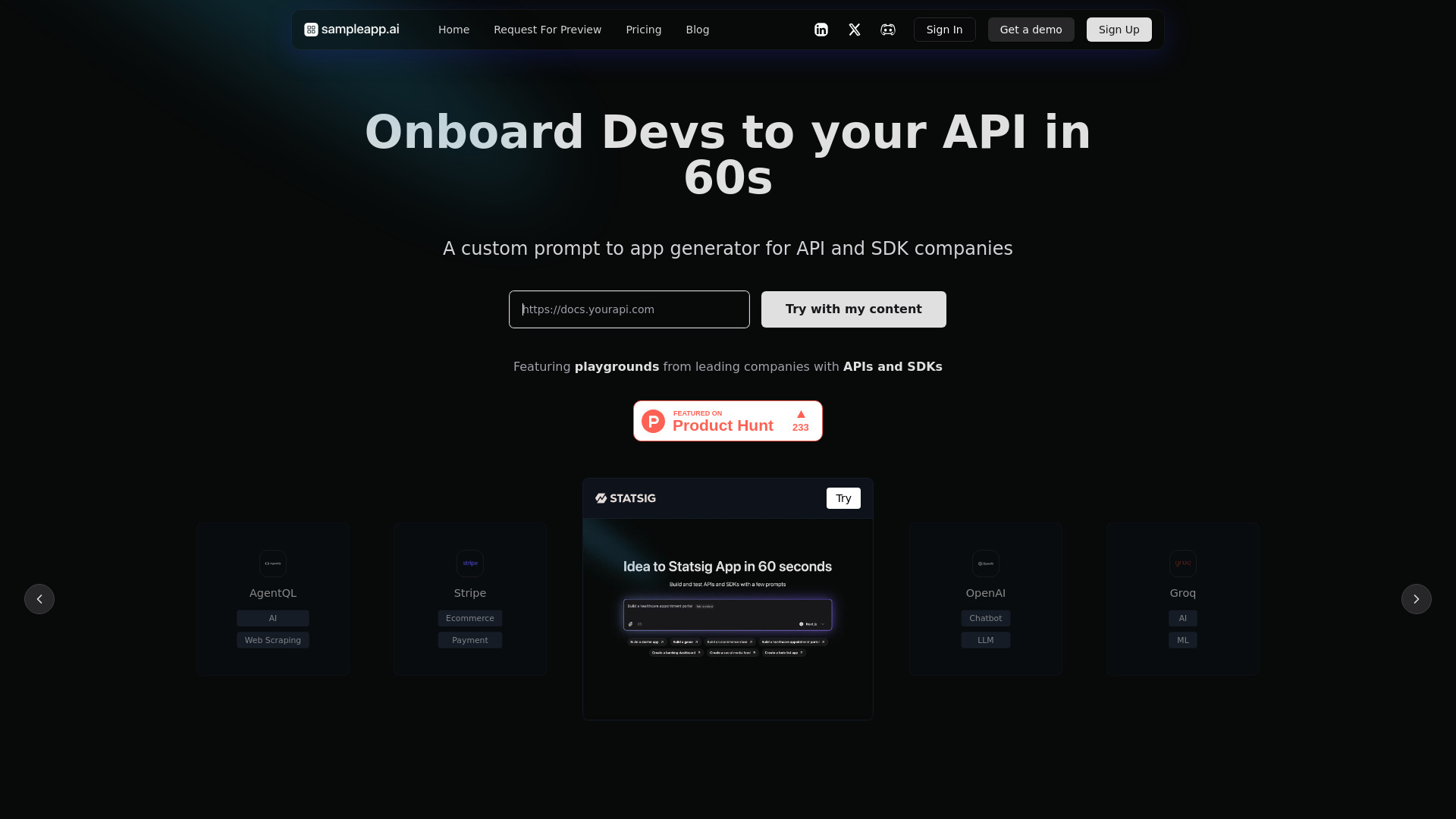
SampleApp.ai is a next-generation AI developer experience platform engineered to reinvent how APIs meet developers. Instead of static docs and fragmented tutorials, it delivers *instantly executable* onboarding: interactive sandboxes where APIs come alive, custom-built sample applications generated from plain-language prompts, and intelligent AI onboarding that adapts in real time to developer context. With SampleApp.ai, teams slash “time to first working integration” from hours—or even days—to under 60 seconds. Purpose-built for API-first companies, cloud platforms, fintech infrastructures, and SaaS innovators, it transforms documentation into dynamic developer journeys—trusted by category-defining startups and Fortune 500 engineering teams alike.
How to Use SampleApp.ai
Getting started takes one sentence—and less than a minute. Describe your goal in natural language (e.g., “Create a Slack bot that posts weather alerts using OpenWeather API”). SampleApp.ai instantly provisions an authenticated API key, interprets your intent, selects optimal endpoints and patterns, and deploys a runnable, framework-native application—complete with inline comments, error handling, and environment-ready configuration. No setup. No boilerplate. Just working code, live in-browser or ready to clone.
Go deeper with the interactive sandbox suite: fork apps, swap languages (Python, Node.js, Go, TypeScript), toggle between frontend frameworks (React, Vue, Next.js), and test API calls without local dependencies. Built-in Git sync keeps documentation, SDK versions, and sample apps in lockstep—while role-based access control, SSO, and custom domains ensure seamless alignment with internal security and branding standards. Whether embedded in your developer portal or deployed as a standalone onboarding hub, SampleApp.ai scales from MVP trials to enterprise-grade integration ecosystems.
Key Features of SampleApp.ai
- Prompt-to-Running-App Engine: Go from idea to execution in seconds—not lines of code. Our proprietary AI understands nuanced developer intent, selects appropriate authentication flows, handles rate-limiting logic, and generates idiomatic, production-aware applications across 15+ languages and 30+ frameworks—fully editable and exportable.
- Zero-Setup Interactive Sandboxes: Embed live, browser-based playgrounds directly into your docs. Developers execute API calls, inspect responses, modify payloads, and visualize request/response cycles—all without installing SDKs, configuring environments, or managing tokens. Each sandbox is versioned, shareable, and tied to specific API versions.
- Developer Journey Analytics: Move beyond pageviews. Track meaningful metrics: sandbox engagement depth, fork-to-deploy conversion, common error patterns, framework preferences, and time-to-success per use case. Turn behavioral insights into smarter docs, targeted onboarding flows, and proactive support triggers.
- White-Label Enterprise Readiness: Fully brand the experience—from logo and color scheme to custom domain (api.yourcompany.com) and CSS overrides. Add SAML/SSO, granular RBAC, audit logs, SOC 2-compliant hosting, and optional on-premise or VPC deployment. Remove all SampleApp.ai branding—your developers see only your product, your voice, your standards.
- Git-Native Version Orchestration: Sync sample apps and sandbox configurations directly with your GitHub, GitLab, or Bitbucket repos. Every API version update auto-generates corresponding sample apps; deprecated endpoints trigger deprecation notices in sandboxes; PR-based review gates ensure quality before publishing.
Why Choose SampleApp.ai?
In today’s competitive API economy, developer friction is churn. SampleApp.ai eliminates it—not as a feature, but as a philosophy. It’s the difference between asking developers to *read about* your API and letting them *experience* it—immediately, intuitively, and independently. Unlike static SDK generators or generic playgrounds, SampleApp.ai contextualizes every output: your auth method, your error schema, your pagination style, your webhook verification flow—all reflected accurately in generated code and interactive demos. That fidelity drives faster adoption, fewer support tickets, higher NPS scores, and measurable uplift in partner integrations and third-party ecosystem growth.
It’s also built for evolution. Whether you’re launching your first public API or managing 200+ microservices across hybrid clouds, SampleApp.ai grows with your architecture—supporting REST, GraphQL, Webhooks, gRPC, and event-driven patterns. Recognized by leading dev tool aggregators like aitop-tools.com and featured in Gartner’s “Emerging Tools for Developer Experience,” it bridges the gap between technical capability and human understanding—making it the strategic foundation for any company serious about developer-led growth.
Use Cases and Applications
SampleApp.ai powers high-impact workflows across the product lifecycle. For external developer onboarding, it replaces passive documentation with active discovery—boosting sign-up-to-integration conversion by up to 7x and cutting time-to-value from weeks to minutes. B2B integration partners deploy pre-validated, co-branded sandbox templates that accelerate joint go-to-market, reducing implementation scoping from months to sprint cycles. Sales engineering teams embed live, parameterized playgrounds into pitch decks and trial environments—turning abstract features into tangible, memorable demos. Meanwhile, DevRel programs leverage the app gallery to highlight reference architectures, compliance patterns (e.g., HIPAA-ready auth flows), and community-contributed extensions—while internal platform teams use SampleApp.ai to onboard new engineers onto internal APIs with zero tribal knowledge dependency.
Frequently Asked Questions About SampleApp.ai
How does SampleApp.ai achieve sub-minute onboarding?
By collapsing three traditionally siloed steps—API key provisioning, code scaffolding, and environment setup—into a single AI-driven workflow. The platform infers required scopes from your prompt, auto-generates secure credentials, writes syntactically correct, tested code with realistic error states, and hosts it in a ready-to-run sandbox. No manual copy-paste. No “curl this, then run that.” Just instant, contextual, working integration.
Which industries and company stages benefit most?
Any organization whose growth depends on external developers building *on* or *with* its platform. This includes payment gateways, identity providers, IoT cloud services, DevOps toolchains, healthtech APIs, and embedded finance infrastructure. From seed-stage API startups validating product-market fit to global enterprises standardizing partner onboarding across regions, SampleApp.ai delivers ROI at every scale—measured in reduced support load, accelerated sales cycles, and enriched ecosystem telemetry.
Is deep customization possible for regulated or highly branded environments?
Absolutely. Beyond UI theming and domain mapping, SampleApp.ai supports full white-label deployment—including private cloud hosting, data residency controls (EU/US/APAC), custom TLS certificates, audit trail exports, and compliance-ready configurations (HIPAA, SOC 2, ISO 27001). Enterprise contracts include dedicated success engineering, SLA-backed uptime (99.95%), and roadmap co-design to align with your long-term DX strategy.
What languages, frameworks, and API styles are supported?
SampleApp.ai natively supports REST, GraphQL, Webhook-triggered flows, and async event patterns—with growing coverage for gRPC and OpenAPI 3.x extensions. Code generation spans JavaScript (ESM/CJS), TypeScript, Python (3.8+), Go (1.19+), Java (17+), Ruby, PHP, and C#. Frontend frameworks include React, Vue 3, Svelte, Next.js, and Remix—with backend options like Express, FastAPI, Flask, Spring Boot, and Laravel. New stacks are added quarterly based on developer demand and ecosystem maturity.
How does the AI understand complex API requirements accurately?
Our model is fine-tuned exclusively on real-world API specifications (OpenAPI, AsyncAPI, Postman Collections), SDK source code, and millions of documented integration patterns—not generic web text. It cross-references your prompt against your API’s actual schema, security definitions, example payloads, and known usage anti-patterns. The result? Context-aware generation that respects your business logic, avoids hardcoded secrets, implements retry/backoff correctly, and surfaces edge cases—so developers learn *your* API, not just generic abstractions.
`, ``, `
`, `
- `, `