Table of contents
Pythagora: AI-Powered Full-Stack Dev, Zero Boilerplate
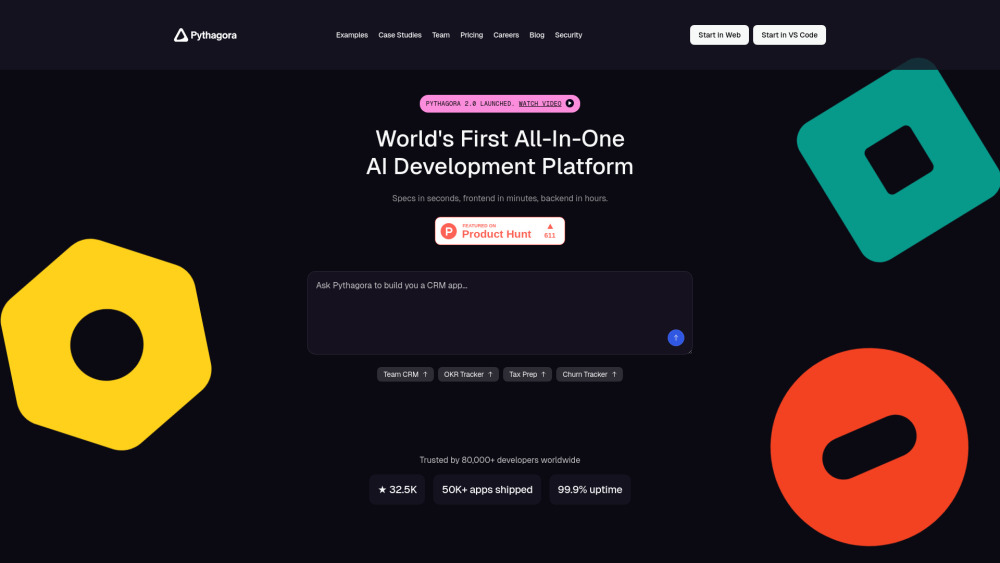
Pythagora: Build full-stack web apps in minutes—not months. AI-powered development, end-to-end automation, zero boilerplate. Start coding smarter today.
Directory : AI Code Assistant, AI Code Generator, AI Developer Tools, AI Builder, AI Agent, AI Copilot
Introducing Pythagora: AI-Powered Full-Stack Dev, Zero Boilerplate
Pythagora redefines full-stack development—not as a sequence of manual steps, but as a collaborative, intelligent workflow. It’s not just an AI code generator; it’s a fully autonomous dev team embedded directly into your editor (VS Code or Cursor), built from the ground up to eliminate boilerplate, accelerate iteration, and deliver production-grade applications—end to end—without hand-holding or abstraction layers. Powered by 14 purpose-built AI agents, Pythagora handles architecture design, frontend/backend generation, database modeling, API contracts, test scaffolding, CI-ready deployment pipelines, and even post-launch debugging—all while keeping you in full control.
How Pythagora Works: From Idea to AWS in Minutes
Start with plain-language goals—“Build a real-time inventory dashboard for my e-commerce team”—and Pythagora initiates a requirements-first dialogue. It co-designs the system architecture, generates clean, idiomatic React and Node.js code with TypeScript, configures MongoDB schemas and RESTful endpoints, writes unit and integration tests, and spins up infrastructure via AWS CloudFormation. Every line is yours: editable, version-controlled, and debuggable using native VS Code tools—no black-box wrappers or proprietary runtimes. One click deploys a secure, scalable, observability-ready stack—zero configuration, zero vendor lock-in.
Why Developers Choose Pythagora
True full-stack autonomy—React + Node.js + MongoDB, generated and maintained as one cohesive system
Real-time, IDE-native debugging: breakpoints, console logs, stack traces, and live variable inspection—no simulated environments
One-click, infrastructure-as-code AWS deployment—with Terraform-backed reproducibility and rollback safety
100% open, editable source: no obfuscated layers, no locked templates, full Git history and IDE compatibility
Architecture-first prompting: define business logic and data flows before writing a single line of code
Seamless editor integration: operates natively inside VS Code or Cursor—no context switching or external dashboards
Real-World Applications, Built Faster
Launch MVP web apps in under 24 hours—dashboards, admin panels, SaaS prototypes
Build internal productivity tools: HR portals, project trackers, compliance checklists, or financial calculators
Deliver client-facing custom software—without bloated timelines or scope creep
Modernize legacy systems incrementally—generate microservices or UI replacements alongside existing stacks
Create developer-centric utilities: LLM evaluation suites, schema validators, or database query optimizers
Frequently Asked Questions
-
What makes Pythagora “zero boilerplate”?
-
Which frameworks and services does Pythagora generate for?
-
Do I retain full legal and technical ownership of my code?
-
How does debugging work when AI-generated code fails?
-
Why not use Copilot or other AI pair programmers?
-
Get Support & Contact Pythagora
For help, feedback, or refunds: visit our dedicated support page.
-
About Pythagora
Pythagora is developed by Pythagora, a team of engineers and AI researchers focused on sustainable, human-centered automation for software development.
-
Log In to Pythagora
Access your workspace: https://www.pythagora.ai/
-
Start Building with Pythagora
Sign up for free—no credit card required: https://www.pythagora.ai/
-
Watch Tutorials & Demos
See Pythagora in action: YouTube Channel
-
Connect on LinkedIn
Follow our engineering insights: LinkedIn Page
-
Explore Open Source Components
View our core agent framework on GitHub: GPT-Pilot Repository
FAQ from Pythagora
What is Pythagora?
Pythagora is an AI-native full-stack development platform that acts as your integrated engineering teammate—orchestrating planning, coding, testing, debugging, and deployment inside VS Code or Cursor. It eliminates boilerplate by generating complete, production-ready applications—not snippets—and empowers developers to ship faster without sacrificing control or clarity.
How to use Pythagora?
Describe what you want to build in natural language. Pythagora engages in iterative refinement, then autonomously builds a full-stack app (React frontend, Node.js backend, MongoDB, REST APIs, tests, and AWS infrastructure)—all editable, debuggable, and deployable within your familiar IDE. No CLI gymnastics. No YAML templating. Just working software—fast.
What makes Pythagora “zero boilerplate”?
Boilerplate isn’t just repetitive code—it’s duplicated configs, glue logic, scaffolding scripts, and infrastructure stubs. Pythagora generates *only* what’s needed for your specific use case, with consistent patterns, proper abstractions, and zero redundant files—so you write business logic, not setup.
Which frameworks and services does Pythagora generate for?
Today: production-grade React (Vite), Node.js (Express + TypeScript), MongoDB (with Mongoose), REST APIs, and AWS (EC2, RDS, S3, CloudFront). Python backend support and Next.js are in active development—and all new stacks follow the same zero-boilerplate, full-ownership philosophy.
Do I retain full legal and technical ownership of my code?
Absolutely. Every line belongs to you—from generated components to deployment scripts. Pythagora produces standard, well-documented, Git-friendly code—no proprietary runtime, no hidden dependencies, no subscription-based execution layer. You own it. You host it. You extend it.
How does debugging work when AI-generated code fails?
Exactly like debugging any other code: set breakpoints in VS Code, inspect variables, step through functions, read real error logs, and modify logic directly. Pythagora doesn’t hide complexity—it surfaces it transparently so you understand and evolve the system confidently.
Why not use Copilot or other AI pair programmers?
Copilot assists *you*. Pythagora *replaces* the tedious, repetitive parts of the dev cycle—planning, scaffolding, wiring, testing, and deployment—so you focus on what matters: solving real problems. It’s not autocomplete—it’s autonomous, end-to-end application synthesis.