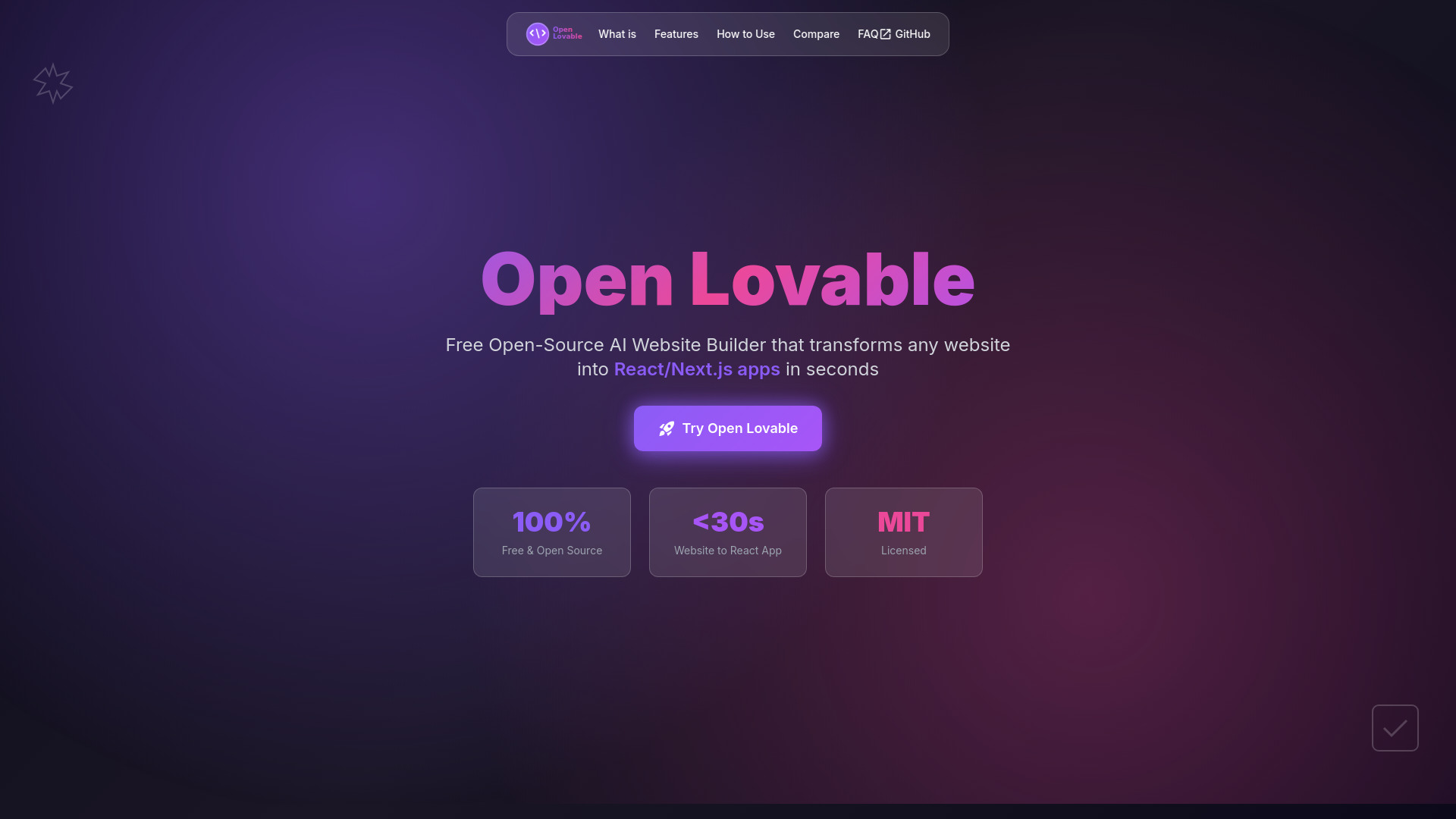
What is Open Lovable?
Open Lovable is a free, open-source AI website development tool that helps turn existing web pages into editable React interfaces. Built by Mendable AI, it combines website scraping with AI-assisted code generation to give developers a starting point for new applications. Its workflow brings together Firecrawl for gathering website content, AI providers such as Anthropic, OpenAI, and Groq for generating code, and E2B for running projects in a sandbox environment. For anyone exploring website-to-React tools or planning a Next.js project, Open Lovable offers a practical way to move from visual inspiration to a working interface while retaining access to the underlying source code.
How to Use Open Lovable
Start by cloning the Open Lovable GitHub repository and following its installation instructions. Install the required dependencies, check the supported Node.js version, and configure the environment variables described in the project documentation. A typical setup requires credentials for Firecrawl, E2B, and a supported AI provider. Once those services are connected, launch the development server and open the local interface in your browser. Although the application is open source, connected services may charge for API requests or sandbox usage, so review their pricing before running larger projects.
To begin building, enter the URL of a website you own or have permission to reproduce. Open Lovable uses the available page information to generate a React-based version of the interface. You can then describe changes through the chat interface, such as updating colors, reorganizing sections, simplifying navigation, or adding a contact form. Review the preview after each change and inspect the generated files as needed. If your destination is Next.js, check how the generated components, styles, and assets fit your application's routing and rendering requirements.
Key Features of Open Lovable
- AI-Assisted Website Recreation: Use an existing web page as a reference for generating a new interface. Open Lovable helps translate visible content and layout patterns into React components, reducing the repetitive work involved in assembling an initial design. Results depend on the source page's accessibility and complexity.
- Editable React and TypeScript Output: Work with generated code that you can inspect, extend, and maintain in your development environment. React components, TypeScript, and Tailwind CSS provide a familiar foundation for further development. Before release, review the output for accessibility, responsiveness, security, and project-specific coding standards.
- Free and Open-Source Application: Access the project source code to explore how the tool works, modify its behavior, or contribute improvements. The software is available without a proprietary application subscription, while external AI, scraping, and execution services remain subject to their own pricing and usage limits.
- Sandbox-Based Development: E2B integration provides an isolated environment for running and previewing generated applications. This supports experimentation as you test interface changes and refine your project. A working preview helps you assess progress, although it does not replace testing before deployment.
- Flexible Code Customization: Shape the generated interface through conversational requests or direct code edits. Adjust spacing, typography, component structure, and page content to suit your requirements. Access to the source files makes it easier to continue development beyond the initial AI-assisted workflow.
- Conversational Design Iteration: Describe the changes you want in plain language and use the resulting preview to guide the next step. This approach can help developers explore alternatives quickly and give less technical collaborators a clearer way to communicate interface requirements.
Together, these features make Open Lovable useful for producing an initial implementation and exploring design ideas. The time saved will vary with the project, the chosen model, and the amount of refinement required. Readers browsing aitop-tools.com can consider it alongside other AI development tools based on setup effort, output quality, and operating costs.
Why Choose Open Lovable?
Open Lovable appeals to developers who want an AI-assisted website builder with access to the code behind both the tool and its output. Its open-source approach gives teams room to adapt the workflow to their own practices. You can study generated components, make manual improvements, and bring suitable code into an existing application. That flexibility is useful when a quick prototype needs to evolve into a project with specific design, integration, or maintenance requirements.
Support for multiple AI providers also gives users options when balancing response quality, speed, and cost. Developers can experiment with supported models to find an approach that suits their pages and prompts. Open Lovable is especially relevant when the goal is to establish a React interface from a website reference, then refine it through normal development. For Next.js projects, assess any framework-specific work separately, including routing, server rendering, data access, and deployment configuration. Explore more AI website development tools on aitop-tools.com to compare workflows and find the right fit.
Use Cases and Applications
Founders and product teams can use Open Lovable to create early interface prototypes before committing to a larger build. A website reference can help communicate a proposed layout, while conversational editing makes it easier to explore different versions. Freelancers and agencies can apply a similar process when rebuilding client-owned pages or preparing concepts for review. In educational settings, generated React components can serve as examples for discussing layout, styling, and component organization, provided students also evaluate the code and understand its limitations.
Development teams may find the tool useful for exploring how an older website could look within a modern React application. It can provide a starting point for page layouts and reusable interface elements, with developers handling application logic and integrations afterward. Marketers can also prototype campaign pages and test content arrangements before production work begins. Across these uses, distinguish the visible interface from the services behind it: accounts, payments, databases, and other backend functions require their own implementation and validation.