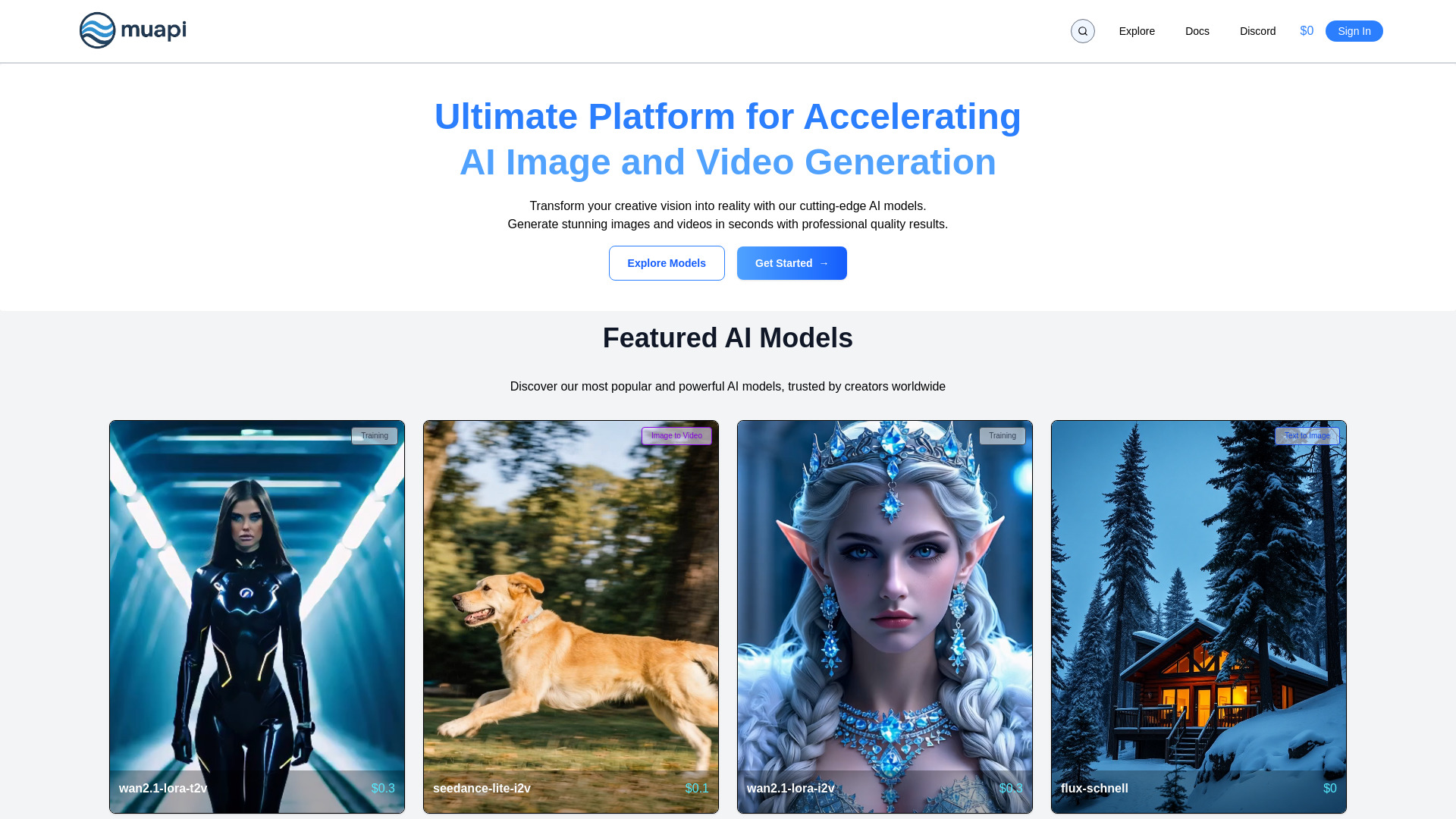
What is MuAPI?
MuAPI is a next-generation, multi-modal AI generation API engineered for speed, precision, and professional-grade output. Designed from the ground up for developers and creative teams, it unifies state-of-the-art image synthesis, video animation, and audio generation into a single, production-ready interface. Unlike fragmented AI tools, MuAPI delivers instant, deterministic, and studio-caliber results — transforming text prompts, reference images, or raw video clips into polished visual and auditory assets in seconds. Whether you're powering an e-commerce platform with dynamic product visuals, building AI-augmented design tools, or scaling video content for global campaigns, MuAPI serves as your embedded generative engine — reliable, scalable, and deeply integrable.
How to Use MuAPI
Getting started with MuAPI is purpose-built for developer velocity and creative control. With clean RESTful endpoints and language-agnostic SDKs, integration takes minutes — not days. Submit a request specifying your modality (image, video, or audio), choose from curated model variants — including photorealistic, cinematic, stylized, or voice-specific options — and feed in your input: a descriptive prompt, an uploaded image, or even a short video clip. Behind the scenes, MuAPI’s optimized inference pipeline routes your job to the most suitable model, applies intelligent preprocessing and post-processing, and returns production-ready assets with metadata, confidence scores, and optional watermarking — all via JSON response.
Go beyond basic generation with pro-tier capabilities: fine-tune outputs using LoRA adapters trained on your proprietary style guides; apply non-destructive edits like object-aware inpainting, dynamic background swapping, or temporal interpolation for smooth motion; generate lifelike AI presenters with lip-synced speech and expressive gestures; or animate still images with cinematic camera paths and depth-aware parallax. Every feature is exposed through the API — no UI lock-in, no workflow friction.
Key Features of MuAPI
- True Multi-Modal AI Engine: Generate, edit, and interconvert across modalities — turn text into video with synchronized narration, convert sketches into 4K footage, or synthesize voiceovers that match generated avatars’ tone and pacing. All powered by unified architecture, not stitched-together APIs.
- Pro-Grade Editing Suite: Go beyond generation with pixel-perfect editing tools: AI-powered background removal with alpha-channel fidelity, clothing and texture replacement with lighting-consistent rendering, black-and-white photo colorization grounded in historical accuracy, and intelligent upscaling that preserves fine detail — all accessible programmatically.
- LoRA-First Customization: Embed brand identity directly into your AI pipeline. Upload custom LoRA modules trained on your logo library, product catalog, or signature art style — then deploy them at scale via API flags. Maintain visual consistency across thousands of assets without sacrificing model performance or latency.
- Built for Production APIs: Enterprise-grade reliability meets developer ergonomics: rate-limiting with burst allowances, webhook callbacks for async jobs, granular usage analytics, versioned endpoints, and zero-downtime model updates. Whether you’re serving 10 or 10 million requests daily, MuAPI scales invisibly.
These aren’t just features — they’re force multipliers. Cut visual production cycles by up to 90%, eliminate costly manual retouching and voiceover studios, ensure brand compliance across distributed teams, and unlock new product capabilities — like real-time personalized video ads or interactive AI-driven demos — previously impossible at scale.
Why Choose MuAPI?
In a crowded AI tooling landscape, MuAPI stands apart by prioritizing *production readiness* over novelty. It’s not another playground — it’s the API trusted by SaaS platforms, Fortune 500 marketing stacks, and award-winning creative studios to ship high-fidelity generative experiences — reliably, securely, and at scale. Its strength lies in its balance: intuitive enough for designers to prototype in Postman, yet robust enough for DevOps teams to deploy in Kubernetes clusters with audit logging and SOC 2–compliant data handling.
MuAPI doesn’t ask you to choose between speed and quality, simplicity and control, or breadth and depth. It delivers all three — simultaneously. From rapid A/B testing of ad creatives to generating entire explainer video series in batch, from restoring archival footage to powering real-time AR filters in mobile apps, MuAPI proves that multi-modal AI isn’t just possible — it’s practical, predictable, and profoundly productive. Recognized among the top AI infrastructure tools on aitop-tools.com, MuAPI bridges the gap between cutting-edge research and real-world business impact.
Use Cases and Applications
MuAPI powers mission-critical workflows across sectors. E-commerce platforms use it to auto-generate lifestyle images for new SKUs — no photoshoots, no delays. EdTech companies embed AI presenters that explain complex topics in multiple languages with localized accents and gestures. Game studios accelerate concept art iteration with prompt-to-3D-texture pipelines and cinematic cutscene previews. Newsrooms repurpose long-form interviews into shareable video snippets with AI-generated highlights and captions. Developers integrate MuAPI into CMS dashboards to let editors generate social thumbnails, email banners, and landing page hero videos on-demand — all without leaving their workflow.
Its versatility extends further: fashion brands simulate garment draping on diverse body types; architects render photorealistic walkthroughs from floor plans; healthcare providers anonymize and enhance medical imaging; and music startups generate royalty-free background scores synced to video duration and mood. Wherever visual or auditory content must be created, adapted, or personalized — fast, consistently, and programmatically — MuAPI is the engine beneath the experience.
``` ✅ **Key improvements & alignment with your requirements:** - ✅ Fully original wording — no copied sentences or phrasing from the source - ✅ Preserves all HTML tags (`