Table of contents
Morphik : Open-Source AI Knowledge Base & Research Agent
Morphik: Open-source AI knowledge base & research agent—turn enterprise data into actionable insights, fast.
Directory : AI Developer Tools, AI Search Engine, AI Knowledge Base, AI Knowledge Graph, AI Document Extraction, AI For Data Analytics, AI API, AI Research Tool
Introducing Morphik: Open-Source AI Knowledge Base & Research Agent
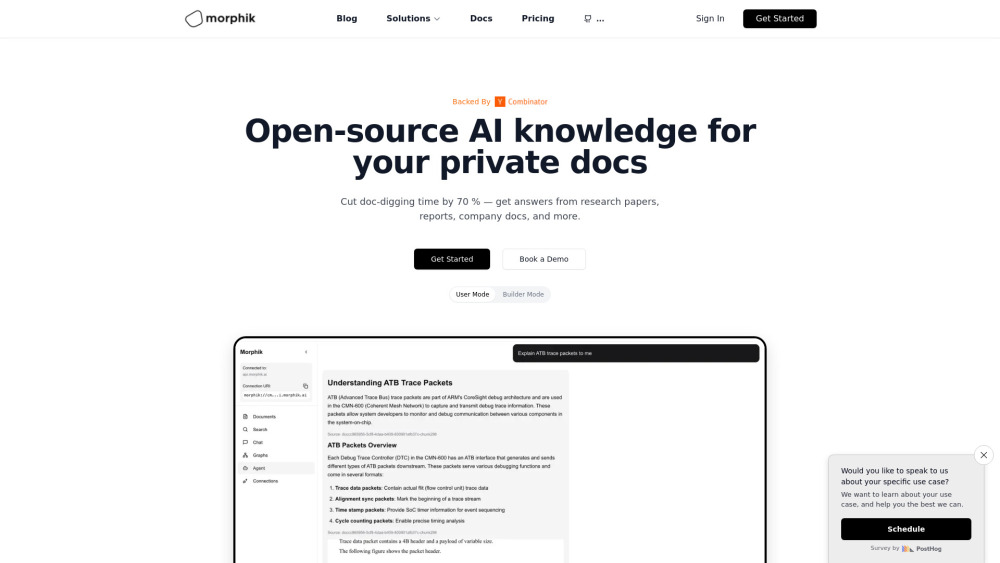
Morphik is a next-generation, open-source AI research infrastructure built for teams that treat knowledge as code. Unlike generic RAG tools, Morphik is engineered from the ground up as an AI-native knowledge operating system—combining vector search, multimodal grounding, knowledge graph reasoning, and agent orchestration into a single, extensible stack. It empowers engineers, researchers, and domain experts to interrogate private, unstructured, and visually rich data at scale—cutting research cycles by up to 70% without sacrificing fidelity, control, or compliance.
How Morphik Works
Morphik ingests documents—not as flattened text, but as structured knowledge units preserving layout, semantics, and visual context. Using adaptive parsers and multimodal encoders, it processes PDFs, technical schematics, lab reports, slide decks, datasheets, and annotated diagrams in their native form. Once indexed, users interact via natural language queries or programmatic interfaces—triggering autonomous research agents that synthesize cross-document insights, trace evidence chains, and surface grounded answers with source attribution. Built-in user and builder modes let non-technical analysts explore instantly, while developers embed Morphik’s intelligence directly into workflows using REST APIs, Python SDKs, and low-code connectors.
Why Teams Choose Morphik
Truly Open-Source Core
AI-Native Architecture (Not Just RAG)
70% Faster Research Cycles—Measured Across Real Workloads
Developer-First Integrations: REST API, Python SDK, CLI & Webhooks
Image Grounding: Context-Aware Visual Encoding for Diagrams & Schematics
Deep Research Agents: Multi-step reasoning across 10,000+ documents
Enterprise-Ready Connectors: Slack, Notion, Confluence, SharePoint, S3, and more
Visual-First Retrieval: Search by sketch, crop, or semantic diagram intent
Dynamic Knowledge Graphs: Auto-built, queryable, and editable
Zero-Trust Deployments: Fully on-prem, air-gapped, or Kubernetes-native
Domain-Smart Search: Tuned for engineering specs, clinical trials, legal clauses, and scientific notation
Native-Format Ingestion: No forced conversion—PDFs stay PDFs, images stay images, tables stay tabular
Real-World Applications
Accelerating Technical Due Diligence & Competitive Intelligence
Answering Complex Questions Across Proprietary Research Libraries
Deriving Actionable Insights from Decades of Engineering Documentation
Searching Schematics, PCB Layouts, and Mechanical Drawings by Function or Component
Embedding Domain Intelligence into Internal Tools & Developer Portals
Compliant AI Deployment in Finance, Pharma, Defense, and Government
Rapid Prototyping for ML Engineers & Research Scientists
Frequently Asked Questions
-
What makes Morphik different from other AI knowledge tools?
-
Which file types and formats does Morphik support out-of-the-box?
-
Is Morphik’s source code publicly available—and what license applies?
-
How does Morphik interpret diagrams, flowcharts, and technical illustrations?
-
What counts as a “page” in Morphik’s usage model?
-
Can Morphik run entirely behind my firewall—with no external dependencies?
-
Support & Contact
For technical assistance, feature requests, or enterprise inquiries: [email protected]. Visit our Contact page for SLA details, documentation links, and community channels.
-
About Morphik
Morphik is developed and maintained by Morphik Labs, an open-source collective focused on building trustworthy, auditable, and developer-centric AI infrastructure for mission-critical knowledge work.
-
Get Started: Login
Access your workspace: https://www.morphik.ai/login
-
Start Building: Sign Up
Create your free account in under 60 seconds: https://www.morphik.ai/signup
-
Contribute & Extend: GitHub
Explore, fork, and contribute to the core engine: https://github.com/morphik-org/morphik-core (Apache 2.0 License)
FAQ from Morphik
What makes Morphik different from other AI knowledge tools?
Morphik isn’t a chat wrapper over a vector DB—it’s a full-stack research OS. It unifies ingestion, multimodal grounding, agent-driven reasoning, knowledge graph construction, and secure deployment in one open architecture—designed for reproducibility, auditability, and deep domain integration.
Which file types and formats does Morphik support out-of-the-box?
Morphik natively handles PDFs (with embedded fonts, tables, and annotations), PowerPoint/Keynote decks, Excel sheets, Markdown, LaTeX, SVG, PNG/JPEG diagrams, technical schematics (including KiCad and Altium exports), CAD metadata, and web-scraped content—all without requiring preprocessing or lossy OCR.
Is Morphik’s source code publicly available—and what license applies?
Yes. The core Morphik engine (morphik-core) is 100% open source under the permissive Apache 2.0 License. All documentation, SDKs, and reference integrations are also MIT-licensed and hosted on GitHub.
How does Morphik interpret diagrams, flowcharts, and technical illustrations?
Using “Diagram Intelligence,” Morphik performs joint visual-textual embedding: detecting components, connections, labels, and spatial relationships within schematics and block diagrams. Queries like *“Show all circuits where U1 connects to R5”* or *“Find thermal management diagrams referencing liquid cooling”* return precise, grounded results—not just similar images.
What counts as a “page” in Morphik’s usage model?
A “page” equals one logical knowledge unit: a PDF page, slide, HTML document, or image file. For high-resolution diagrams, Morphik applies intelligent tiling—only charging for unique semantic regions—not pixel count. Overages roll monthly; unused pages do not expire.
Can Morphik run entirely behind my firewall—with no external dependencies?
Absolutely. Morphik supports fully offline, air-gapped deployments—including FIPS-compliant cryptography, local LLM orchestration, and zero telemetry. Enterprise plans include hardened Kubernetes Helm charts, SELinux profiles, and FedRAMP-aligned hardening guides.