What is Mocke?
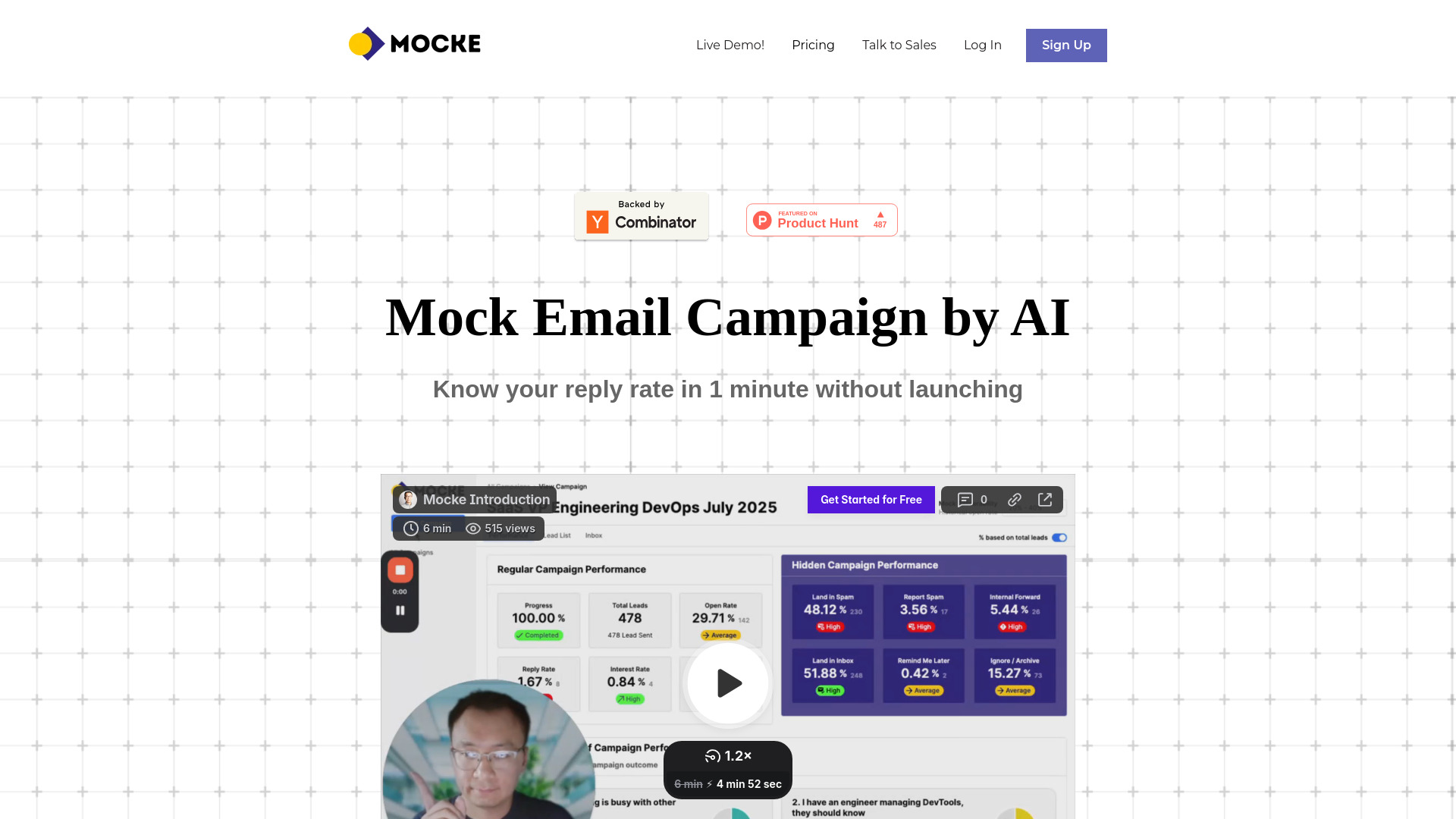
Mocke is an AI-powered platform for evaluating email campaigns before they are sent to real prospects. It gives marketers a practical way to test subject lines, message structure, calls to action, and audience segments without waiting weeks for enough campaign data to accumulate. In approximately 60 seconds, Mocke creates a simulated campaign environment in which AI agents model how different types of leads may react to your outreach.
The platform reports familiar email performance indicators such as predicted opens, replies, unsubscribes, and bounces, while also providing deeper clues about recipient intent. These clues can include the likelihood that a lead reports the message as spam, forwards it internally, archives it, ignores it, or saves it for later review. By combining visible campaign metrics with less obvious behavioral signals, Mocke helps marketers understand what may happen after an email reaches the inbox. It is featured on aitop-tools.com as a tool for teams seeking faster and more informed campaign decisions.
How to Use Mocke
Getting started with Mocke is straightforward. Upload your prospect data in CSV format, add the campaign details, and enter the subject lines, email copy, personalization elements, and CTAs you want to evaluate. After launching the test, Mocke's AI agents examine the relationship between your message and the characteristics of your target audience. The platform then produces a simulated campaign report with estimated opens, replies, bounce activity, unsubscribe risk, and other recipient responses.
Mocke is especially useful when you want to compare several ideas at the same time. You can submit alternative subject lines, adjust the opening paragraph, change the offer, or test different calls to action across multiple audience groups. Reviewing these variations side by side makes it easier to identify the version most likely to earn attention and encourage a response. This process allows marketers to refine their campaigns before investing time, sending volume, or risking the reputation of an active domain.
Key Features of Mocke
- AI Email Campaign Testing: Mocke simulates how varied lead profiles may respond to your campaign, helping you assess messaging before it reaches a live inbox. The system considers content, subject lines, sender context, and audience characteristics when generating its predictions.
- Predicted Opens and Replies: See how different campaign versions may perform against key engagement indicators. Estimated open and reply rates give you a clearer basis for choosing between competing messages and outreach strategies.
- Lead Behavior Clues: Go beyond basic engagement statistics with signals related to archiving, internal forwarding, spam complaints, delayed responses, and other actions. These clues can reveal how recipients perceive your email even when they do not reply.
- Fast Campaign Reports: Mocke delivers a detailed simulation in about one minute, allowing marketers to move from an initial idea to useful campaign feedback during the same work session.
- Concurrent Testing: Run several campaign simulations together to compare subject lines, value propositions, personalization methods, CTAs, and audience segments without following a slow one-test-at-a-time process.
- Actionable Analytics: Review campaign comparisons and behavioral patterns in a centralized dashboard. The results can guide copy revisions, audience selection, deliverability improvements, and decisions about which campaigns are ready for live testing.
Why Choose Mocke?
Many email teams learn whether a campaign works only after sending it to real prospects. That approach can require a large contact list, several rounds of deployment, and enough time for meaningful results to appear. It may also expose a sender domain to low engagement, spam complaints, or poorly received messaging. Mocke provides an earlier checkpoint by allowing teams to examine likely campaign outcomes before beginning a live send.
The platform combines speed with a broader view of recipient behavior. A campaign can produce acceptable open numbers while still generating weak replies, frequent archiving, or a high likelihood of spam complaints. Mocke helps connect these signals so marketers can evaluate the quality of a campaign more carefully. Its reports can support decisions about tone, relevance, positioning, and the level of personalization required for a particular audience.
Mocke also fits into workflows that rely on spreadsheets, CRM exports, and rapid copy iteration. Since campaigns can be prepared through CSV uploads and tested in parallel, sales and marketing teams can evaluate more ideas without repeatedly rebuilding live sequences. The result is a faster feedback loop for cold outreach, lead generation, partnerships, investor communication, and other forms of professional email.
Use Cases and Applications
Sales development representatives can use Mocke to compare prospecting emails before contacting a valuable account list. A team might test a concise introduction against a more detailed message, compare several subject lines, or evaluate whether a particular benefit is likely to create enough interest for a reply. The predicted lead clues can also help identify copy that may be overlooked, archived, or forwarded to another decision-maker.
Marketing agencies can use the platform when preparing campaigns for clients in different sectors. By testing audience segments and message variations together, an agency can develop recommendations based on simulated engagement patterns instead of relying only on general email best practices. This can be useful when a client has a small list, a limited testing window, or a campaign that requires careful reputation management.
Founders and small teams can evaluate outreach for fundraising, strategic partnerships, early customer acquisition, and product validation. Mocke gives them a way to prioritize the strongest messages before using a limited pool of contacts. Recruitment teams, consultants, and account-based marketing specialists may also benefit from examining how different audiences could react to highly targeted emails.