Table of contents
Minicule: AI-Powered Research App for Dynamic Knowledge Graphs
Minicule: AI-powered research web app that transforms papers into dynamic scientific knowledge graphs—discover, connect, and accelerate insights.
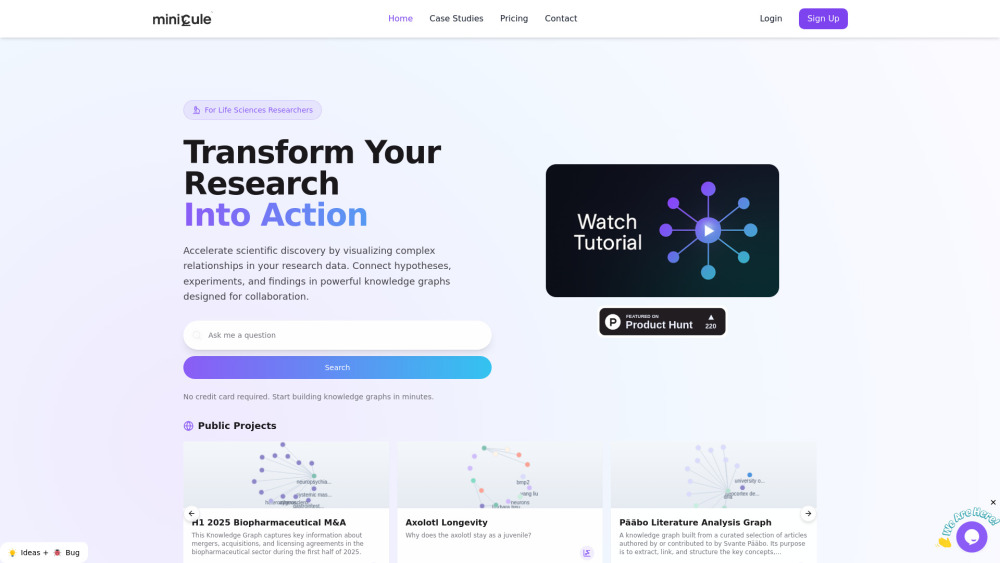
Introducing Minicule: Where AI Meets Dynamic Knowledge Graphs
Minicule is a next-generation AI research platform engineered specifically for life sciences professionals who need to navigate, synthesize, and interrogate rapidly expanding scientific literature. Unlike static search tools or generic graph builders, Minicule constructs *dynamic knowledge graphs* — living, evolving representations of scientific insight that continuously update as new evidence emerges. By ingesting structured and unstructured data from PubMed, OpenAlex, and USPTO in real time, it transforms fragmented publications, patents, and experimental records into interconnected, hypothesis-aware networks — enabling researchers to trace causal pathways, detect latent associations, and validate mechanistic claims with unprecedented speed and rigor.
Getting Started with Dynamic Knowledge Mapping
Launching a Minicule workflow begins with defining a research question — whether it’s validating a biomarker hypothesis, benchmarking gene therapy vectors, or mapping intellectual property landscapes. With one-click integrations, users pull in citation networks, patent citations, and open scholarly metadata. The AI then auto-generates contextualized knowledge graphs: nodes represent entities (genes, drugs, diseases, methods), edges encode relationship types (regulates, inhibits, correlates with, cited in), and temporal layers track evidence evolution over time. Researchers refine graphs interactively — pruning noise, adding domain constraints, annotating confidence scores — then export visualizations, share editable workspaces, or embed live graphs into lab notebooks and grant applications.
Core Capabilities: Beyond Static Graphs
Dynamic, Self-Updating Knowledge Graphs
Real-Time Integration with PubMed, OpenAlex & USPTO APIs
Temporal Graph Analytics — Track Evidence Trajectories Over Time
Collaborative Graph Curation — Version-Controlled, Role-Based Sharing
End-to-End Data Governance — GDPR- and HIPAA-aligned Privacy Controls
Evidence Confidence Scoring — AI-assisted Assessment of Citation Strength & Reproducibility
Team Workspaces with Custom Permissions & Audit Logs
Domain-Optimized Templates: Biotech IP Mapping, Genomic Pathway Inference, Clinical Trial Correlation
Advanced Graph Navigation: Subgraph Isolation, Pathfinding Algorithms, Anomaly Detection
Unlimited Cross-Database Querying — No Paywall Restrictions on Publication Access
Private Project Mode — Zero-Data-Residency for Sensitive Pre-Publication Work
Enterprise Collaboration Suite — Shared Graph Repositories & Cross-Team Discovery Feeds
On-Premise & Air-Gapped Deployment via Docker Containerization
Bring Your Own LLM — Full Control Over Model Selection, Prompt Engineering & Token Budgeting
Scalable AI Agent Orchestration — Parallel Hypothesis Testing Across Thousands of Literature Nodes
Real-World Applications in Life Sciences Research
Accelerating Target Validation by Visualizing Multi-Omics Evidence Convergence
Identifying Off-Target Effects Through Cross-Domain Graph Intersections (e.g., Drug–Gene–Phenotype)
Supporting Cross-Institutional Consortia with Shared, Synchronized Knowledge Graphs
Linking Preclinical Mechanism Models to Clinical Outcome Data in Real Time
Mapping Regulatory Pathways in Single-Cell Genomics Using Context-Aware Edge Weighting
Focused Exploration of Emerging Topics: Axolotl Regeneration Signaling Networks, Svante Pääbo’s Ancient DNA Legacy Analysis, AAV Vector Biodistribution in CNS Disorders, Rifaximin’s Immunomodulatory Role in ALS Progression, Predictive Biomarkers for Immune Checkpoint Response, and Next-Gen Parkinson’s Disease Intervention Pathways
Frequently Asked Questions
-
What makes Minicule different from traditional literature search tools?
-
Which scientific databases does Minicule integrate with natively?
-
Is there a free tier for individual researchers?
-
Do academic institutions receive special licensing terms?
-
How does team collaboration function within Minicule?
-
What do “Tokens” represent in Minicule’s usage model?
-
Can Minicule be deployed behind an institutional firewall?
-
Support & Contact Information
For technical assistance, billing inquiries, or refund requests, please visit our dedicated support portal (https://minicule.com/contact).
-
About Minicule
Minicule is developed by Minicule, an Ottawa-based AI infrastructure company advancing computational reproducibility in life sciences.
Registered address: 310 Hunt Club, Suite 200, Ottawa, Canada, K1V 1C1.
Learn more about our mission, team, and technology roadmap at https://minicule.com/about.
-
Access Your Account
Log in to your workspace: https://minicule.com/auth
-
Join the Research Revolution
Start building dynamic knowledge graphs today: https://minicule.com/auth?mode=signup
-
Connect With Us
Follow our latest product updates and scientific insights on LinkedIn.
-
Stay Updated
Join the conversation on research acceleration: Twitter (@minicule)
-
Explore Our Open Tools
Access documentation, SDKs, and community plugins: GitHub (github.com/minicule)
FAQ Answers
What makes Minicule different from traditional literature search tools?
Minicule doesn’t just retrieve papers — it constructs *reasoning-ready knowledge graphs*. Its AI interprets semantic relationships across heterogeneous sources, dynamically infers connections not explicitly stated, and surfaces high-value hypotheses grounded in multi-source evidence — turning passive search into active discovery.
Which scientific databases does Minicule integrate with natively?
Minicule maintains certified, rate-optimized integrations with PubMed (MEDLINE/PubMed Central), OpenAlex (open scholarly metadata), and USPTO (patent full-text and image databases). Additional connectors for clinicaltrials.gov, EGA, and UniProt are available in Enterprise plans.
Is there a free tier for individual researchers?
Yes. The Free plan includes 1 million monthly tokens, access to core graph-building features, 1 GB of private storage, and unlimited public dataset queries — ideal for exploratory research and academic prototyping.
Do academic institutions receive special licensing terms?
Affiliated academic users qualify for a 50% discount across Pro, Team, and Enterprise plans — verified via institutional email and intended for non-commercial, education- or grant-funded research use.
How does team collaboration function within Minicule?
The Team plan enables shared workspaces with granular permissions (view/edit/admin), real-time co-editing of graphs, change history tracking, and integrated commenting — supporting seamless collaboration across labs, departments, or global consortia.
What do “Tokens” represent in Minicule’s usage model?
Tokens measure computational effort: each AI inference (e.g., entity extraction, relationship classification, graph expansion) consumes tokens proportional to input size and complexity. This ensures fair, transparent, and scalable resource allocation — no hidden fees or surprise overages.
Can Minicule be deployed behind an institutional firewall?
Absolutely. The Enterprise offering includes Docker-based private deployment, FIPS-compliant encryption, offline mode support, and optional integration with institutional identity providers (SAML/OIDC) — meeting strict regulatory and security requirements.