AI Email Marketing

Linked API

Linked API: Secure, compliant LinkedIn integration for recruiting, sales, analytics & more—no rate limits, full auth control.

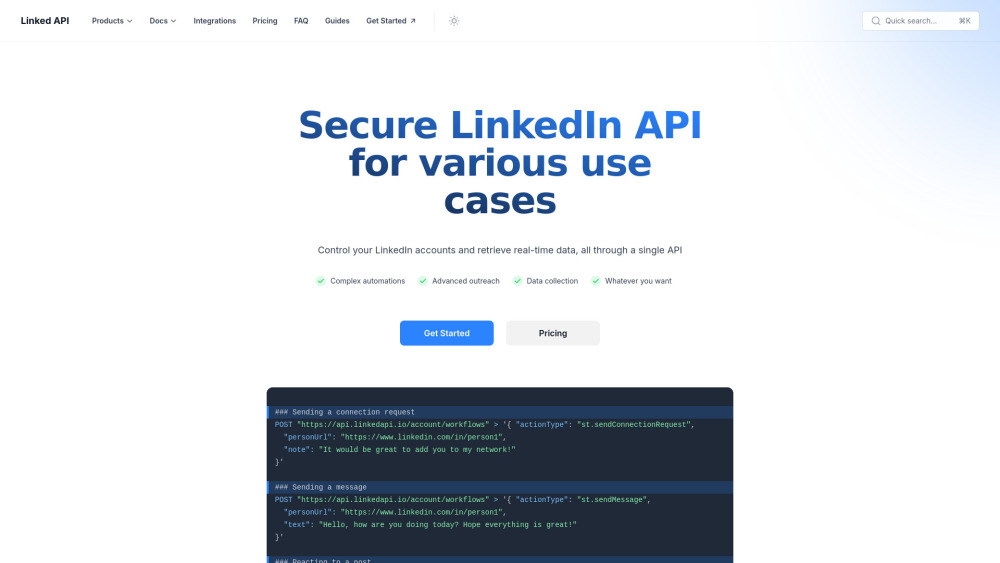
Linked API website preview

Linked API Website screenshot

Introducing Linked API: Enterprise-Grade LinkedIn Integration, Built for Scale & Security

Linked API delivers secure, authenticated, and fully compliant programmatic access to LinkedIn—without rate limits, session throttling, or data staleness. Engineered for AI-native workflows and mission-critical automation, it bridges the gap between LinkedIn’s UI-only constraints and modern infrastructure needs via a robust MCP-compatible architecture.

How Linked API Works

Linked API operates through two tightly integrated, purpose-built layers—designed to decouple control from insight while maintaining end-to-end security and fidelity: 1. Account API: A zero-trust, browser-automation-powered interface that replicates human behavior at scale—managing profiles, connections, messages, reactions, and profile updates with persistent session integrity and dynamic fingerprinting. 2. Data API: A real-time, query-first data layer that surfaces live LinkedIn signals—people, companies, jobs, posts, and engagement metrics—without requiring account linkage, credential sharing, or platform login. All data is fetched live, not cached or scraped.

Why Teams Choose Linked API

No Rate Limits. No Compromises.

Unlike legacy scrapers or deprecated OAuth flows, Linked API uses adaptive, fingerprint-aware automation that respects LinkedIn’s behavioral patterns—enabling sustained, high-volume operations without bans, blocks, or artificial caps.

Full Auth. Zero Credential Exposure.

Authentication happens entirely client-side via secure, ephemeral browser sessions. Your credentials never touch our servers—and never leave your infrastructure. SSO, MFA, and enterprise SAML are natively supported.

AI-Ready Integration Architecture.

Built from the ground up for AI agents and LLM orchestration, Linked API exposes structured, semantic endpoints (e.g., /v1/contacts/suggest, /v1/posts/engage) with deterministic responses, retry-safe semantics, and full webhook support—no parsing, no guesswork.

Real-Time Data, Not Historical Snapshots.

While competitors rely on stale databases updated weekly—or worse, monthly—Linked API fetches live, context-aware data on demand: job postings as they’re published, profile edits as they occur, and post engagements within seconds of action.

Enterprise Control, Developer Flexibility.

Granular permissions, audit logs, role-based access control (RBAC), and SOC 2-aligned infrastructure ensure compliance-ready deployment—while RESTful design, OpenAPI specs, and SDKs in Python, Node.js, and Go empower rapid iteration.

Product source: Linked API official website. Check the provider for current plans, limits and availability.

FAQ

Linked API questions and answers

Product context and practical checks for evaluating Linked API.

What is Linked API used for?

Linked API: Secure, compliant LinkedIn integration for recruiting, sales, analytics & more—no rate limits, full auth control.

How do I get started with Linked API?

Linked API operates through two tightly integrated, purpose-built layers—designed to decouple control from insight while maintaining end-to-end security and fidelity: 1. Account API: A zero-trust, browser-automation-powered interface that replicates human behavior at scale—managing profiles, connections, messages, reactions, and profile updates with persistent session integrity and dynamic fingerprinting. 2. Data API: A real-time, query-first data layer that surfaces live LinkedIn signals—people, companies, jobs, posts, and engagement metrics—without requiring account linkage, credential sharing, or platform login. All data is fetched live, not cached or scraped.

What should I compare before choosing a Linked API plan?

Check Linked API’s current pricing page for included usage, renewal terms and any credit charges. Compare the cost of a usable result, including retries, rather than assuming that account registration includes free usage.

What inputs should I prepare for a Linked API trial?

Compare repository access, context limits, supported languages and tool permissions. Check whether the assistant can read relevant files and run your existing checks.

How can I check the quality of a Linked API result?

Review the diff, run tests and inspect error handling and dependency changes. Generated code should meet the same review standard as a human contribution.

Which export options should I check in Linked API?

Prefer changes you can inspect and keep in version control. Check whether code, tests and configuration can be exported without depending on a hosted preview.

What is a practical way to test Linked API against alternatives?

Choose a small reproducible bug with an existing failing check. Measure whether the tool fixes the cause, preserves behavior and produces a reviewable change.

What should I review before uploading material to Linked API?

Read the provider’s rules on access, retention, deletion and use of uploaded material. Start with a non-confidential sample that you have permission to use.

How can I check whether Linked API fits my existing workflow?

List the steps before and after using Linked API, including preparation, review and export. Test that complete sequence and check whether handoffs require manual conversion or another paid service.

Where is the official Linked API website?

The website linked from this profile is https://linkedapi.io. Use the provider’s own documentation, account area and support channels to confirm current product details.

Visit Linked API