Table of contents
Immuta: Secure Data Access, Compliance, Governance & Marketplace
Immuta: Accelerate secure, compliant data access governance & marketplace—empower teams, enforce policies, and unlock trusted data faster.
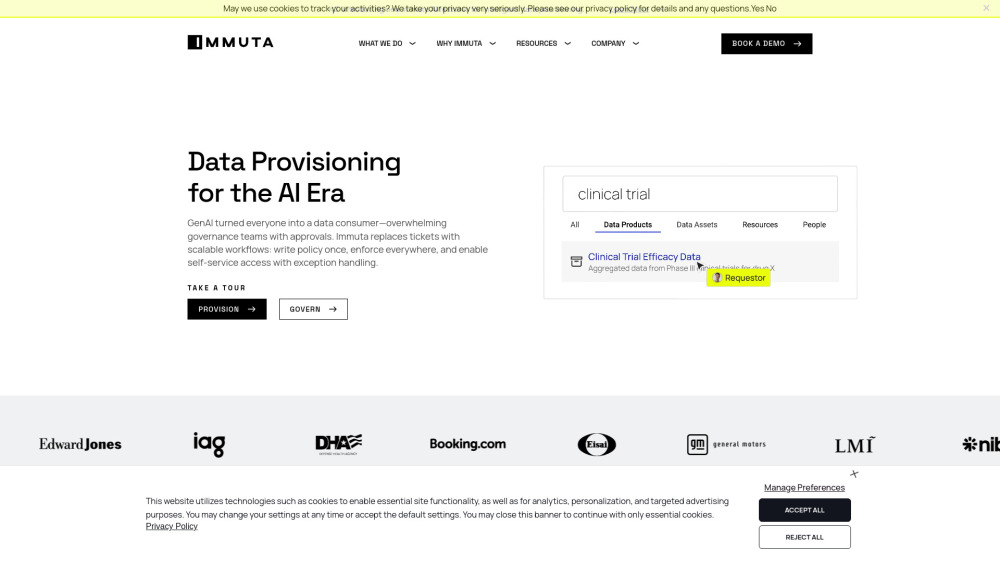
What Is Immuta?
Immuta is an enterprise-grade data governance platform engineered to unify secure data access, automated compliance enforcement, intelligent data governance, and a scalable data marketplace—all within one cohesive system. Built for modern data stacks, it empowers organizations to break down data silos while maintaining strict control, auditability, and regulatory alignment. By embedding policy logic directly into data infrastructure—not just at the application layer—Immuta enables governed, self-service access across cloud data warehouses, lakes, and lakehouses. Its architecture supports real-time policy evaluation, AI-augmented classification, and collaborative governance workflows—turning data governance from a bottleneck into a strategic accelerator.
How to Use Immuta
Getting started with Immuta is designed for speed and scalability. New users can begin with interactive product tours focused on Secure Access Control and Marketplace Enablement, request a personalized demo tailored to their compliance goals (e.g., HIPAA, GDPR, FedRAMP), or deploy prebuilt governance templates via the Immuta QuickStart Library. Implementation follows a phased approach: first connecting to source systems (Snowflake, Databricks, BigQuery, etc.), then ingesting metadata, defining attribute-based policies, publishing curated data products, and finally enabling governed discovery for analysts, data scientists, and business teams—all without requiring deep infrastructure changes.
Immuta’s Core Capabilities
Secure Data Access
Compliance Automation
Unified Data Governance
Enterprise Data Marketplace
Policy-as-Code Engine
Intelligent Metadata & Classification
AI-Driven Data Provisioning
Real-World Immuta Use Cases
Enforce zero-trust access across hybrid and multi-cloud environments.
Automate compliance evidence collection for audits and certifications.
Govern sensitive data (PII, PHI, PCI) with dynamic masking and row-level security.
Build internal data catalogs where producers publish and consumers discover—governed by policy, not permissions.
Reduce time-to-data for ML teams with trusted, compliant datasets—pre-approved and ready for training.
Standardize cross-departmental governance using centralized, version-controlled policies.
Accelerate innovation by letting business users safely explore high-value data—no tickets, no delays.
Frequently Asked Questions
-
What makes Immuta different from traditional data governance tools?
-
How does Immuta ensure regulatory compliance out of the box?
-
Can Immuta support both technical and non-technical data stakeholders?
-
Which data platforms does Immuta integrate with natively?
-
How does Immuta handle data lineage and impact analysis?
-
Contact Immuta Support
For technical assistance, billing inquiries, or refund requests, visit Immuta’s official contact page.
-
About Immuta
Company Name: Immuta, Inc.
Headquarters: Boston, MA, USA
Learn more about our mission, leadership, and values at Immuta’s About page. -
Immuta Login
Access your Immuta environment: https://app.immuta.com/login
-
Immuta Sign Up
Start a free trial or request a customized demo: https://www.immuta.com/demo/
-
Immuta on YouTube
Watch tutorials, customer stories, and product updates: https://www.youtube.com/c/Immuta
-
Immuta on LinkedIn
Follow for industry insights and governance best practices: https://www.linkedin.com/company/immuta/
-
Immuta on X (Twitter)
Get real-time announcements and thought leadership: https://x.com/immuta
FAQ from Immuta
What is Immuta?
Immuta is a purpose-built platform that converges secure data access, automated compliance, proactive governance, and a self-serve data marketplace—enabling enterprises to unlock data value without compromising control, trust, or regulatory standing.
How to use Immuta?
Teams start by connecting Immuta to their data sources, automatically discovering and classifying assets, then collaboratively building attribute-based policies. Once published, those policies enforce access in real time—and data products become discoverable, consumable, and auditable through the integrated marketplace.
What makes Immuta different from traditional data governance tools?
Unlike legacy tools that rely on manual tagging or perimeter-based controls, Immuta embeds governance *where data lives*, applying dynamic policies at query time. It unifies policy definition, enforcement, discovery, and auditing—eliminating tool sprawl and governance debt.
How does Immuta ensure regulatory compliance out of the box?
Immuta ships with prebuilt compliance packs (GDPR, CCPA, HIPAA, SOC 2, etc.) that auto-generate audit-ready reports, enforce data subject rights, classify regulated fields, and maintain immutable usage logs—reducing compliance cycles from months to days.
Can Immuta support both technical and non-technical data stakeholders?
Absolutely. Data engineers configure integrations and policies; data stewards define business rules in plain language; analysts and business users discover and access data via intuitive search and previews—all governed consistently behind the scenes.
Which data platforms does Immuta integrate with natively?
Immuta offers certified, low-friction connectors for Snowflake, Databricks SQL/Unity Catalog, Amazon Redshift & Athena, Google BigQuery, Starburst Galaxy, Microsoft Fabric, and Azure Synapse—plus robust REST APIs for custom environments.
How does Immuta handle data lineage and impact analysis?
Leveraging its metadata registry and query-level policy engine, Immuta maps end-to-end lineage—from source tables to downstream dashboards—and simulates policy changes to assess risk before deployment—ensuring safe, informed governance evolution.