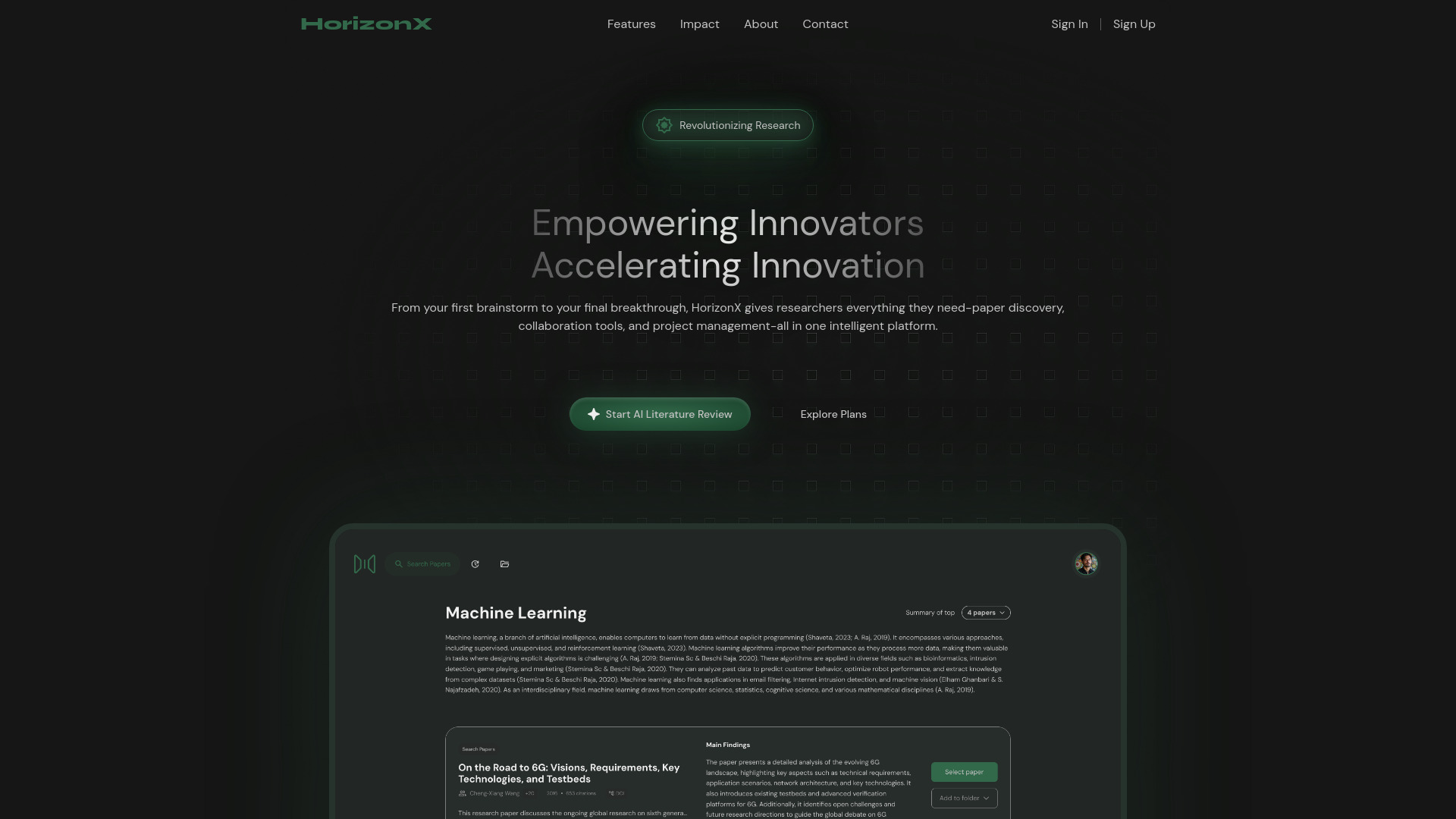
What is HorizonX?
HorizonX is an intelligent, end-to-end AI research platform engineered specifically for the modern scholar—designed not just to assist, but to *think alongside* researchers at every stage of discovery. More than a suite of tools, it’s a cohesive cognitive infrastructure: a unified digital workspace where brainstorming, evidence synthesis, analytical exploration, and collaborative authorship converge. Built on adaptive AI models trained across multidisciplinary scholarly corpora, HorizonX interprets research intent—not just keywords—and responds with contextual precision. It replaces disjointed workflows with a living research environment: one that learns from your domain, anticipates your next step, and safeguards rigor while accelerating output.
How to Use HorizonX
Getting started with HorizonX is purposefully frictionless—no setup overhead, no steep learning curve. Begin by activating the Generative Insight Hub, where you describe a challenge, curiosity, or preliminary finding in plain language—and receive refined research questions, testable hypotheses, and cross-disciplinary analogies grounded in current literature. Next, engage the Semantic Discovery Layer: a literature engine that maps conceptual proximity rather than keyword matches, surfaces overlooked seminal works through citation lineage tracing, and delivers concise, field-tuned summaries with confidence-weighted relevance scores. For analysis, the Visual Logic Canvas lets you drag, drop, and chain statistical operations, model assumptions, or qualitative coding schemes—generating reproducible pipelines and publication-ready figures in real time. As writing progresses, HorizonX’s Adaptive Citation Fabric auto-synchronizes references across drafts, detects style drift mid-document, and dynamically restructures bibliographies when journals change formatting guidelines. Team-based projects thrive via Live Co-Research Spaces, where version-aware editing, inline hypothesis tagging, and contribution heatmaps make collaboration transparent and traceable. For high-complexity work, on-demand access to cloud-orchestrated HPC clusters enables scalable modeling—without leaving the interface. And before submission, the Integrity Assurance Scan performs layered validation: checking methodological alignment, statistical reporting norms (e.g., CONSORT, PRISMA), citation integrity, and journal-specific structural requirements—turning pre-submission review from a chore into a strategic advantage.
This tightly integrated architecture cuts average research cycle duration by up to 40%, while simultaneously raising the bar for transparency, reproducibility, and scholarly impact.
Key Features of HorizonX
- Generative Insight Hub: An AI co-thinker that transforms vague ideas into focused, field-grounded research questions—identifying underexplored intersections, surfacing latent contradictions in existing literature, and proposing methodologically appropriate pathways forward.
- Semantic Discovery Layer: A context-sensitive literature navigator that understands how concepts evolve across disciplines and time. It reveals foundational papers, emerging trends, and “hidden” connections—then generates annotated reading paths tailored to your expertise level and project goals.
- Visual Logic Canvas: A low-code, logic-driven analytics interface that bridges the gap between intuition and formal analysis. Whether building regression models, performing thematic coding, or simulating system dynamics, users construct auditable workflows with zero coding—each step documented, exportable, and peer-review ready.
- Live Co-Research Spaces: Real-time, role-aware collaboration environments with built-in epistemic scaffolding—supporting shared annotation, hypothesis versioning, automated contribution attribution, and synchronized feedback loops across geographies and time zones.
- Adaptive Citation Fabric: A dynamic reference management layer that maintains semantic consistency across evolving drafts, resolves ambiguous citations using full-text context, and auto-adapts formatting as submission targets change—ensuring every footnote and bibliography reflects current standards.
- Integrity Assurance Scan: A multi-layered pre-submission audit that evaluates not only grammar and formatting, but also statistical reporting fidelity, ethical compliance markers (e.g., IRB mentions, data availability statements), and alignment between claims and supporting evidence—flagging subtle inconsistencies invisible to manual review.
Why Choose HorizonX?
HorizonX is built for researchers who refuse to choose between speed and scholarship. While many tools optimize for efficiency *or* rigor, HorizonX embeds methodological guardrails directly into its AI architecture—ensuring acceleration never comes at the cost of credibility. Its architecture is informed by active researchers, validated through peer-reviewed usability studies, and hardened by institutional-grade security protocols. Users consistently report measurable gains: literature reviews completed 40% faster *with higher recall*, citation-related revisions reduced by over 30%, and manuscript formatting time cut by half—without sacrificing nuance or compliance. Unlike generic AI assistants, HorizonX speaks the language of research: it recognizes the difference between a systematic review protocol and a theoretical framework, understands discipline-specific conventions, and respects the weight of scholarly provenance.
Recognized on aitop-tools.com as a paradigm shift in research infrastructure, HorizonX interoperates natively with university LMS systems, institutional repositories (DSpace, Figshare), reference managers (Zotero, Mendeley), and major publishing platforms (Elsevier Editorial System, ScholarOne). Its modular design scales effortlessly—from a graduate student drafting their first thesis chapter to a global consortium coordinating a multi-year clinical trial meta-analysis. At its core, HorizonX isn’t just about doing research *faster*. It’s about doing research *deeper*, *together*, and with unwavering fidelity to the principles of open, rigorous, and ethically grounded inquiry.
Use Cases and Applications
In social science labs, HorizonX accelerates mixed-methods design—helping teams align survey instruments with emergent themes from interview transcripts using real-time semantic clustering. In computational biology, researchers leverage the Visual Logic Canvas to prototype machine learning pipelines for variant prioritization, then deploy them at scale via integrated HPC—while the Integrity Assurance Scan verifies adherence to FAIR data principles before deposition. Humanities scholars use the Semantic Discovery Layer to reconstruct intellectual genealogies across centuries of texts, identifying forgotten influences and tracing conceptual migration across languages and editions. Graduate students rely on HorizonX’s scaffolded workflow to navigate thesis milestones: generating proposal outlines, auto-generating annotated bibliographies, tracking advisor feedback across draft versions, and ensuring final submissions meet strict university formatting mandates. Meanwhile, independent researchers and early-career academics discover HorizonX on aitop-tools.com as a professional-grade alternative—gaining access to capabilities previously reserved for well-funded labs, all without subscription lock-in or vendor dependency.