Text&ampWriting

GPT OSS

Explore GPT OSS by OpenAI: free 120B & 20B open-source AI models with powerful reasoning, MoE architecture, and Apache 2.0 licensing. Download now!

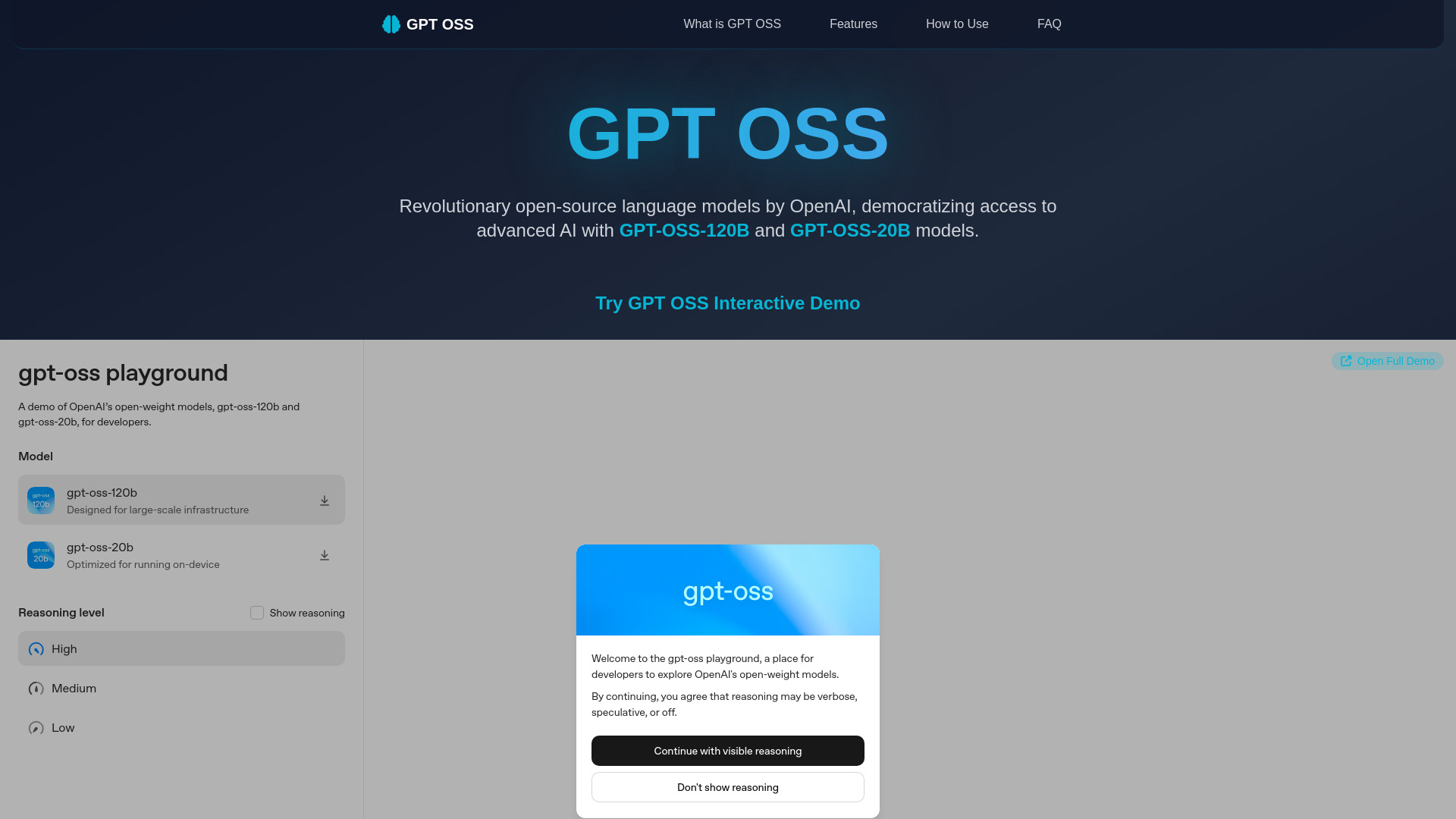
GPT OSS website preview

What Is GPT OSS?

GPT OSS is OpenAI’s family of open-weight language models built for advanced reasoning, coding, and tool-assisted workflows. Released in August 2025, the family includes two models: gpt-oss-120b and gpt-oss-20b. Both use a Mixture-of-Experts (MoE) architecture to combine substantial model capacity with more efficient inference. Available under the Apache 2.0 license, these models give developers the flexibility to download, customize, and deploy AI on infrastructure they control.

For teams exploring free OpenAI models, GPT OSS offers an alternative to relying entirely on hosted AI services. The model weights are freely available, although hardware, hosting, and operational costs still apply. From local experimentation to production applications, GPT OSS brings powerful reasoning capabilities to developers who want greater control over deployment, customization, and data handling.

How to Use GPT OSS

Start by choosing the model that matches your workload and available hardware. GPT-OSS-20B is the more accessible option for local development, while GPT-OSS-120B targets more demanding applications. Download the model from an official distribution channel, such as OpenAI’s Hugging Face repositories, and select a compatible inference runtime. Options include supported versions of Transformers, vLLM, Ollama, and llama.cpp, although hardware support and configuration requirements vary.

Before deployment, check memory capacity, quantization support, and the model’s required conversation format. GPT OSS uses OpenAI’s Harmony format to represent messages, reasoning channels, and tool interactions. A compatible runtime can help manage these details. Test the model on representative prompts, then configure generation settings, context limits, and tool access around your application’s needs.

For more specialized workflows, connect GPT OSS to approved tools, document retrieval systems, or business APIs. Fine-tuning can further adapt the models to domain terminology and preferred response styles, provided you use suitable training software and sufficient compute. Whether running locally or in the cloud, evaluate accuracy, latency, and security before opening access to end users.

Key Features of GPT OSS

  • Open Weights With Apache 2.0 Licensing: GPT OSS allows commercial use, modification, and redistribution under the license’s terms. This gives organizations more deployment flexibility without per-token model licensing charges, while retaining applicable attribution and other obligations.
  • Powerful Reasoning Capabilities: The models are designed for multi-step problem-solving, programming, and analytical tasks. OpenAI reports competitive results against selected proprietary reasoning models on certain benchmarks, though real-world performance depends on the task and deployment setup.
  • Efficient Mixture-of-Experts Architecture: MoE activates only a subset of model parameters for each token. This reduces active computation compared with a similarly sized dense model, helping balance reasoning capability and inference efficiency.
  • Two Practical Deployment Sizes: With native MXFP4 quantization, GPT-OSS-120B can fit on a single 80 GB GPU, while GPT-OSS-20B can run in approximately 16 GB of memory in supported configurations. Longer contexts and concurrent requests can increase memory requirements.
  • Developer-Oriented Functionality: Support for tool use, function calling, structured response workflows, and a context window of approximately 128,000 tokens makes GPT OSS suitable for assistants, automation systems, and document-heavy applications. Exact feature behavior depends on the serving stack.
  • Adjustable Reasoning Effort: Developers can configure reasoning effort to balance response speed against problem-solving depth. This helps tailor the models to quick interactions or more demanding analytical workflows.

Why Choose GPT OSS?

GPT OSS is worth considering when control matters as much as capability. Self-hosting lets organizations decide where inference happens, how models connect to internal systems, and which access policies apply. This can support privacy-conscious architectures and reduce dependence on a single hosted provider. However, keeping data private still requires secure infrastructure, careful logging policies, and appropriate operational controls.

The combination of open weights, reasoning-focused training, and MoE efficiency also creates room for experimentation. Developers can compare model variants, test quantization options, and adapt deployment settings without being limited to one provider’s interface. For sustained workloads, self-hosting may offer cost advantages, although savings depend on utilization, hardware prices, and maintenance requirements.

It is important to distinguish open-weight availability from complete transparency into model development. Access to downloadable weights does not mean every training dataset or training component is available. Even so, GPT OSS provides meaningful freedom to inspect model behavior, build custom applications, and manage deployment on your own terms.

Use Cases and Applications

GPT OSS can support coding assistants that explain unfamiliar code, suggest fixes, generate tests, and help developers investigate technical problems. Its reasoning capabilities also make it useful for analytical assistants that break down questions, work with retrieved information, and call external tools when calculations or current data are needed.

Businesses can use the models for internal knowledge assistants, document classification, report drafting, and workflow automation. Connecting GPT OSS to a retrieval system can help ground responses in company documentation, while carefully scoped tool permissions can support actions such as searching records or preparing support tickets. These applications still need validation, monitoring, and safeguards against incorrect outputs.

Researchers and educators can explore local AI tutoring, benchmark evaluation, and specialized model adaptation. Organizations in finance, healthcare, and legal services may also evaluate domain-specific applications, but sensitive or high-stakes uses require expert oversight. Model availability and safety testing do not, by themselves, establish regulatory compliance or guarantee reliable professional advice.

Product source: GPT OSS official website. Check the provider for current plans, limits and availability.

FAQ

GPT OSS questions and answers

Product context and practical checks for evaluating GPT OSS.

What is GPT OSS used for?

Explore GPT OSS by OpenAI: free 120B & 20B open-source AI models with powerful reasoning, MoE architecture, and Apache 2.0 licensing. Download now!

How do I get started with GPT OSS?

Start by choosing the model that matches your workload and available hardware. GPT-OSS-20B is the more accessible option for local development, while GPT-OSS-120B targets more demanding applications. Download the model from an official distribution channel, such as OpenAI’s Hugging Face repositories, and select a compatible inference runtime. Options include supported versions of Transformers, vLLM, Ollama, and llama.cpp, although hardware support and configuration requirements vary.Before deployment, check memory capacity, quantization support, and the model’s required conversation format. GPT OSS uses OpenAI’s Harmony format to represent messages, reasoning channels, and tool interactions. A compatible runtime can help manage these details. Test the model on representative prompts, then configure generation settings, context limits, and tool access around your application’s needs.For more specialized workflows, connect GPT OSS to approved tools, document retrieval systems, or business APIs. Fine-tuning can further adapt the models to domain terminology and preferred response styles, provided you use suitable training software and sufficient compute. Whether running locally or in the cloud, evaluate accuracy, latency, and security before opening access to end users.

Which capabilities are described for GPT OSS?

Open Weights With Apache 2.0 Licensing: GPT OSS allows commercial use, modification, and redistribution under the license’s terms. This gives organizations more deployment flexibility without per-token model licensing charges, while retaining applicable attribution and other obligations. Powerful Reasoning Capabilities: The models are designed for multi-step problem-solving, programming, and analytical tasks. OpenAI reports competitive results against selected proprietary reasoning models on certain benchmarks, though real-world performance depends on the task and deployment setup. Efficient Mixture-of-Experts Architecture: MoE activates only a subset of model parameters for each token. This reduces active computation compared with a similarly sized dense model, helping balance reasoning capability and inference efficiency. Two Practical Deployment Sizes: With native MXFP4 quantization, GPT-OSS-120B can fit on a single 80 GB GPU, while GPT-OSS-20B can run in approximately 16 GB of memory in supported configurations. Longer contexts and concurrent requests can increase memory requirements. Developer-Oriented Functionality: Support for tool use, function calling, structured response workflows, and a context window of approximately 128,000 tokens makes GPT OSS suitable for assistants, automation systems, and document-heavy applications. Exact feature behavior depends on the serving stack. Adjustable Reasoning Effort: Developers can configure reasoning effort to balance response speed against problem-solving depth. This helps tailor the models to quick interactions or more demanding analytical workflows.

What projects can I evaluate GPT OSS for?

GPT OSS can support coding assistants that explain unfamiliar code, suggest fixes, generate tests, and help developers investigate technical problems. Its reasoning capabilities also make it useful for analytical assistants that break down questions, work with retrieved information, and call external tools when calculations or current data are needed.Businesses can use the models for internal knowledge assistants, document classification, report drafting, and workflow automation. Connecting GPT OSS to a retrieval system can help ground responses in company documentation, while carefully scoped tool permissions can support actions such as searching records or preparing support tickets. These applications still need validation, monitoring, and safeguards against incorrect outputs.Researchers and educators can explore local AI tutoring, benchmark evaluation, and specialized model adaptation. Organizations in finance, healthcare, and legal services may also evaluate domain-specific applications, but sensitive or high-stakes uses require expert oversight. Model availability and safety testing do not, by themselves, establish regulatory compliance or guarantee reliable professional advice.

How does GPT OSS handle open weights with apache 2.0 licensing?

Open Weights With Apache 2.0 Licensing: GPT OSS allows commercial use, modification, and redistribution under the license’s terms. This gives organizations more deployment flexibility without per-token model licensing charges, while retaining applicable attribution and other obligations.

How does GPT OSS handle powerful reasoning capabilities?

Powerful Reasoning Capabilities: The models are designed for multi-step problem-solving, programming, and analytical tasks. OpenAI reports competitive results against selected proprietary reasoning models on certain benchmarks, though real-world performance depends on the task and deployment setup.

What should I compare before choosing a GPT OSS plan?

Check GPT OSS’s current pricing page for included usage, renewal terms and any credit charges. Compare the cost of a usable result, including retries, rather than assuming that account registration includes free usage.

What inputs should I prepare for a GPT OSS trial?

Identify the files, text or account connections your task needs. Confirm that the product accepts those inputs and offers controls for reviewing its work.

How can I check the quality of a GPT OSS result?

Test one representative task and inspect the result for accuracy and completeness. Record where manual corrections or extra tools are needed.

Where is the official GPT OSS website?

The website linked from this profile is https://gpt-oss.free. Use the provider’s own documentation, account area and support channels to confirm current product details.

Visit GPT OSS