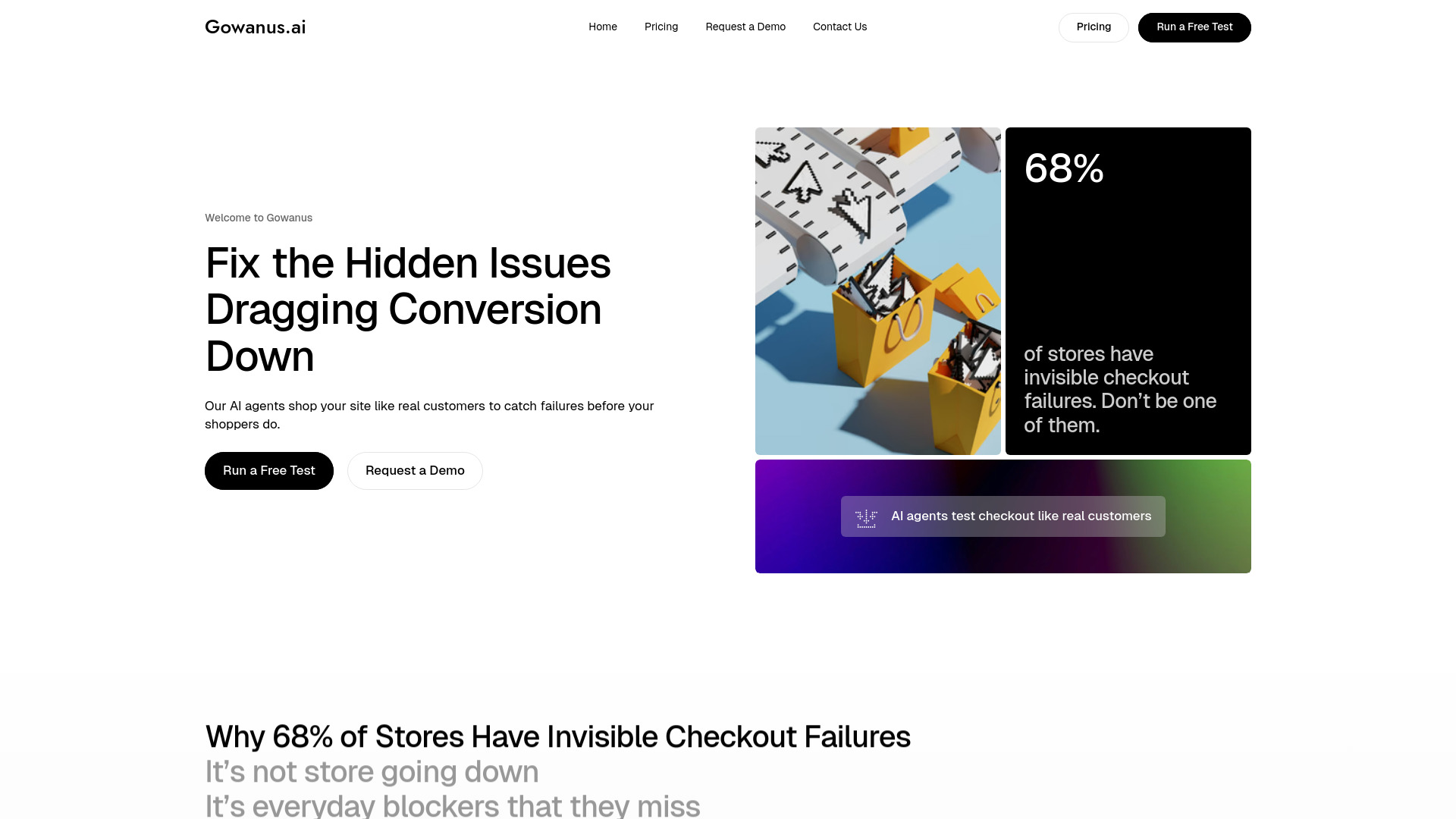
What is Gowanus.ai?
Gowanus.ai is an AI-driven checkout and billing observability platform designed to identify revenue leaks before they affect a large number of customers. Instead of checking only whether a website or application is online, it evaluates whether shoppers can successfully move through important revenue journeys, including product checkout, payment authorization, subscription renewal, and account billing updates. The platform uses autonomous agents to perform realistic transaction checks around the clock, helping digital businesses discover broken payment experiences while they are still recoverable.
By continuously examining the paths that generate revenue, Gowanus.ai gives product, engineering, and revenue teams a clearer view of checkout health. The platform can monitor flows across different payment providers, customer segments, and geographic regions, then send real-time notifications when a transaction step begins to fail. Whether a business is operating an online store, a subscription service, or a large marketplace, Gowanus.ai helps connect technical incidents with their possible financial consequences.
How to Use Gowanus.ai
Setting up a monitoring scenario in Gowanus.ai begins with identifying the customer journeys that are most important to the business. Teams can describe a flow in everyday language, such as “complete a purchase using Stripe,” “renew a monthly subscription,” or “change the card on an existing account.” The platform then uses an AI agent to navigate the designated experience in a real browser environment, allowing teams to review each action and confirm that the scenario represents a genuine customer interaction.
After a flow has been created, users can refine its instructions, add validation points, and configure the payment methods or account states that need coverage. This makes it possible to check more than a page load. A monitoring run can verify that a product can be added to a cart, shipping details are accepted, discounts are applied correctly, the payment is authorized, and the expected confirmation appears at the end of the journey.
Once the scenario is ready, it can be scheduled for continuous execution. Gowanus.ai runs the selected checks at regular intervals and reports failures through channels such as Slack, PagerDuty, or SMS. Alerts can include the failed step, supporting run details, and an estimate of the revenue exposure, giving teams useful context when deciding how quickly to respond.
Key Features of Gowanus.ai
- 24/7 Checkout Validation: AI agents repeatedly perform important purchase and billing journeys to verify that customers can reach a successful transaction. This helps reveal issues that ordinary uptime checks and synthetic page monitoring may overlook.
- Real-Time Billing Leak Alerts: When a monitored flow breaks, Gowanus.ai can notify the responsible team quickly through configured communication and incident-management tools. Faster awareness can reduce the time a payment problem remains active.
- End-to-End Transaction Testing: Monitoring can cover the full customer path, from product selection and cart creation to payment authorization, confirmation, renewal, or account changes. Each stage can include checks for the result the customer should see.
- AI-Assisted Flow Creation: Natural-language instructions make it easier to create and maintain monitoring scenarios without building every test from scratch. Teams can explain the desired customer action and review how the agent carries it out.
- Revenue Exposure Analysis: Gowanus.ai connects transaction failures with business impact by estimating the value associated with an affected checkout or billing path. This helps teams rank incidents according to potential commercial importance.
- Payment Provider Coverage: Businesses can create scenarios for multiple gateways and payment methods, including card payments, digital wallets, and alternative checkout options. Comparing these paths can expose provider-specific failures.
- Subscription and Recurring Billing Checks: The platform can monitor signup, trial conversion, renewal, failed-payment recovery, plan changes, and payment-method updates. These checks help protect recurring revenue after the original purchase has been completed.
- Flexible Notifications and Integrations: Alerts can be routed to the tools teams already use for collaboration and incident response. Integration options support a workflow in which the right people receive actionable information without manually checking dashboards.
Why Choose Gowanus.ai?
Many monitoring systems are effective at identifying server outages, slow responses, and application errors. Those signals are useful, but they do not always show whether a customer can actually pay. A checkout page may load normally while a payment button fails, a promotional code produces an invalid total, or a subscription renewal silently rejects a valid card. Gowanus.ai focuses on the transaction itself, giving teams visibility into the customer experience that directly produces revenue.
The platform also helps connect technical events to commercial outcomes. A failed checkout during a low-volume period may require a different response from the same failure during a major product launch or seasonal promotion. By showing which revenue flow is affected and how much activity may be exposed, Gowanus.ai gives engineering and operations teams more practical information for triage and prioritization.
Continuous monitoring is especially useful for businesses with frequent releases, complex billing rules, and multiple payment integrations. Changes to frontend components, tax calculations, authentication, pricing logic, or third-party services can unintentionally affect the final purchase step. Automated checks provide a recurring layer of verification after deployments and throughout normal operation, helping teams detect issues that might otherwise be reported by customers.
Use Cases and Applications
Online retailers can use Gowanus.ai to check the complete purchase experience across desktop and mobile storefronts. A scenario may confirm that a shopper can search for an item, add it to the cart, apply a promotion, select delivery options, and finish payment. Retailers can create separate checks for card payments, digital wallets, buy-now-pay-later services, and regional gateways, making it easier to identify failures that affect only one part of the checkout mix.
These checks are valuable during traffic spikes, promotional campaigns, and product launches. A small problem in inventory synchronization, shipping calculation, tax handling, or discount logic can prevent otherwise ready-to-buy customers from completing an order. Continuous alerts give the commerce team an opportunity to investigate while the campaign is still active and the potential impact is still limited.
Subscription businesses can apply the same approach to recurring revenue processes. Gowanus.ai can simulate a new customer moving from registration to trial activation, paid conversion, and ongoing renewal. It can also check whether customers can update an expired card, change plans, add a new payment method, or recover from a failed charge. These scenarios help expose billing problems that may lead to involuntary churn even when the core product remains available.
Marketplaces and platforms with multiple sellers can monitor payment, commission, refund, and payout workflows. Financial technology teams can use transaction scenarios to observe important account and funding paths across different environments. In each case, the goal is to confirm that the actions customers and businesses depend on continue to work after code changes, provider updates, configuration edits, or unexpected third-party incidents.