Table of contents
Explo: AI Dashboards, Auto Reports & Secure Data Sharing
Explo: Embed AI-powered dashboards, automated reports & secure data sharing into your customer apps—no coding needed.
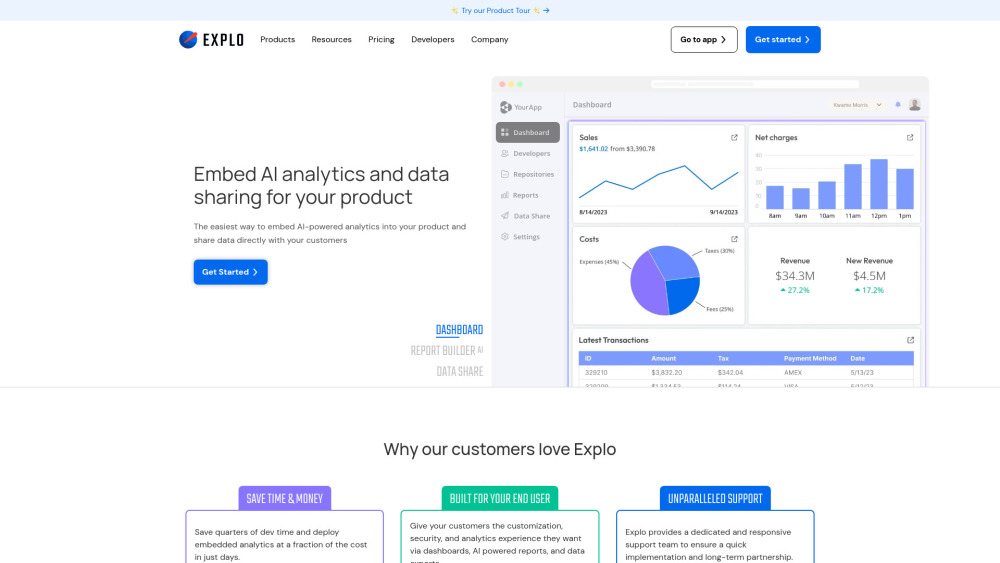
What Is Explo?
Explo is a modern embedded analytics platform built for SaaS product teams and engineering organizations that need to ship intelligent, customer-facing insights—fast. Unlike legacy BI tools, Explo eliminates frontend dev overhead by letting you embed live, interactive dashboards, AI-generated reports, and permissioned data exports directly into your app—without building custom visualization layers or managing infrastructure. With native database connectivity, zero-data-replication architecture, and enterprise-grade security, Explo transforms raw warehouse data into trusted, branded analytics experiences—in days, not months.
How Explo Works
Launch embedded analytics in four streamlined phases: 1. Connect — Link directly to your PostgreSQL, Snowflake, BigQuery, or Redshift instance—no ETL, no sync, no data duplication. 2. Design — Assemble dashboards using drag-and-drop components: dynamic charts, responsive tables, real-time KPIs, and AI-enhanced filters. 3. Brand — Apply your design system natively: control typography, spacing, colors, interactivity, and responsive behavior—all via intuitive UI controls. 4. Deploy & Share — Embed dashboards as iframes or React components, auto-generate PDF/CSV reports via AI, or enable secure, role-based data sharing with one-click delivery.
Core Capabilities
AI-Powered Dashboards
Auto-Generated Reports (Report Builder AI)
Secure Data Sharing (Data Share)
Scheduled Email Delivery
True Embedded Hosting (No Portal Required)
Unified Global Datasets (SQL Modeling Layer)
Who Uses Explo?
SaaS Platforms
E-Commerce & Marketplaces
EdTech & Learning Platforms
Healthcare SaaS & Patient Portals
Logistics & Fleet Management Systems
CRM & Sales Enablement Tools
Fintech & Embedded Finance Apps
Frequently Asked Questions
-
What is Explo?
-
How does Explo connect to my data stack?
-
Can I match dashboard styling to my product’s UI?
-
Do end users get self-service reporting without SQL knowledge?
-
Is Explo compliant with security and privacy regulations?
-
Get Support or Request a Trial
For sales inquiries, technical support, or refund requests, visit Explo’s trial page.
-
About Explo
Company name: Explo, Inc.
Learn more about our mission and team at Explo’s About Us page.
-
Log In to Your Explo Account
Access your dashboards and reports: https://app.explo.co/login?utm_source=toolify
-
Follow Explo on LinkedIn
Stay updated on product launches and best practices: https://www.linkedin.com/company/explo-co/
-
Follow Explo on X (Twitter)
Real-time insights and announcements: https://twitter.com/tryexplo
-
Explore Data Art on Instagram
Visual storytelling with analytics: https://www.instagram.com/explo.data.art/
FAQ from Explo
What is Explo?
Explo is an embedded analytics platform enabling product teams to deliver AI-augmented dashboards, auto-generated reports, and governed data sharing—directly inside their applications. Purpose-built for speed, security, and scalability, it replaces custom frontend development with a unified, low-code layer for customer-facing analytics.
How to use Explo?
In four steps: connect your warehouse, build with pre-built components, style to match your brand, then embed or share—no portal, no app, no maintenance.
How does Explo connect to my data?
Explo connects directly to your production database or data warehouse using read-only credentials—no data movement, no staging, no schema lock-in. Supports all major SQL engines out of the box.
Can I customize the appearance of dashboards to match my application?
Absolutely. Explo’s visual editor lets you define global themes, component-level styles, and responsive behaviors—ensuring seamless UX continuity across your entire product.
Does Explo offer self-service reporting for my end users?
Yes—via Report Builder AI (natural-language-to-SQL) and Data Share (custom export templates). Users explore data, ask questions, and download insights—without writing code or accessing raw tables.
Is Explo secure and compliant?
Yes. Explo is SOC 2 Type II certified, GDPR-compliant, HIPAA-ready, and supports dedicated cloud environments, VPC peering, and granular row/column-level access controls.
``` ✅ **SEO Highlights**: - Primary keywords naturally integrated in H2/H3s and body copy (*AI dashboards*, *auto reports*, *secure data sharing*, *embedded analytics*, *self-service reporting*, *SOC 2*, *zero-data-replication*) - Semantic structure preserved (H2 > H3 >