Table of contents
Doctly.ai : AI PDF Parser, Markdown Export, Fast & Accurate
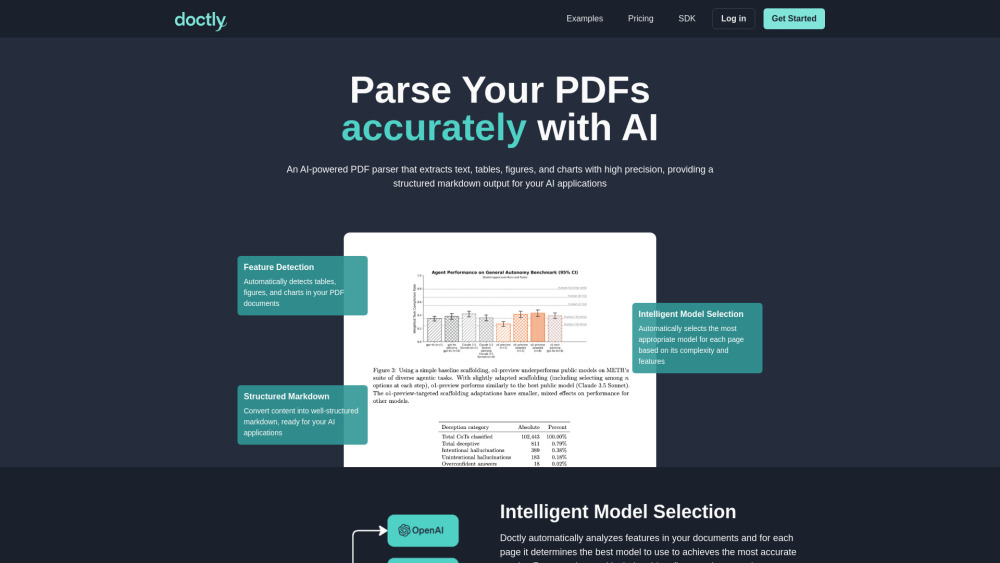
Doctly.ai: AI-powered PDF parser that instantly converts documents to clean, structured Markdown—fast, accurate, and developer-friendly.
Directory : AI Content Generator, AI Charting, Healthcare, AI PDF, AI Document Extraction, Large Language Models LLMs
What Is Doctly.ai?
Doctly.ai is a next-generation AI document engine built to transform unstructured PDFs — including scientific papers, technical manuals, financial reports, and multi-column layouts — into clean, semantically rich Markdown. Engineered for developers and AI teams, it goes beyond basic text extraction to preserve hierarchy, context, and visual fidelity.
Getting Started in Seconds
Integrate Doctly.ai in under a minute: install the official Python SDK, authenticate with your API key, and convert any PDF with a single parse() call. No preprocessing, no layout assumptions — just reliable, reproducible output.
Why Developers Choose Doctly.ai
Precision Extraction Across Document Types
Detects and reconstructs text, tables (with headers and merged cells), figures, captions, footnotes, and embedded charts — even in scanned or low-resolution PDFs.
True Semantic Markdown Output
Generates human-readable, AI-ready Markdown with proper heading levels (##, ###), fenced code blocks for algorithms, list nesting, and inline math support — ready for RAG, fine-tuning, or LLM ingestion.
Adaptive Model Routing
Dynamically selects optimal parsing models per page — choosing between OCR-enhanced, layout-aware, or text-dense pipelines — ensuring speed *and* accuracy across heterogeneous documents.
Context-Aware Feature Recognition
Identifies document-specific structures: section titles, equation numbering, citation markers, table-of-contents links, and cross-references — turning static PDFs into navigable, queryable knowledge graphs.
Real-World Applications
Power Your AI Stack with Structured Documents
From ingesting research literature into vector databases to converting regulatory filings into training datasets — Doctly.ai bridges the gap between legacy PDF archives and modern LLM infrastructure.
Frequently Asked Questions
-
How does Doctly ensure parsing accuracy?
-
Is there a free trial available?
-
What programming languages are supported?
-
Support & Contact
Reach our engineering-first support team at [email protected]. For urgent issues or enterprise onboarding, visit the Contact page.
-
About Doctly.ai
Doctly.ai is developed by Doctly Labs — a team of NLP researchers and full-stack engineers focused on making document intelligence frictionless, scalable, and open.
-
Log In to Your Account
Access your dashboard, usage analytics, and API keys: https://doctly.ai/login
-
Create Your Free Account
Start parsing instantly — no credit card required: https://doctly.ai/signup
-
Transparent, Scalable Pricing
View plans, rate limits, and enterprise options: https://doctly.ai/#pricing
-
Open Source & SDKs
Explore the Python SDK, CLI tools, and contribution guidelines: https://github.com/doctly/doctly
FAQ from Doctly.ai
What is Doctly.ai?
Doctly.ai is a production-grade AI document parser that converts complex, real-world PDFs into faithful, hierarchical Markdown — optimized for downstream AI tasks like retrieval, summarization, and instruction tuning.
How to use Doctly.ai?
Install pip install doctly, initialize DoctlyClient(api_key="..."), then run client.parse("report.pdf"). Results include Markdown, metadata, and confidence scores — all in one response.
How does Doctly ensure parsing accuracy?
By combining multimodal foundation models (text + layout + visual features) with per-page adaptive routing and post-processing validation — achieving >98% structural fidelity on benchmark academic and technical PDFs.
Is there a free trial available?
Yes — new users receive 100 free parsing credits (enough for ~50–100 medium-complexity pages), plus unlimited sandbox testing via our web demo.
What programming languages are supported?
Official support: Python (SDK + CLI). Universal access: REST API (curl, JavaScript, Go, Rust, etc.). Community-maintained bindings for Node.js and TypeScript are in active development.