Table of contents
Claude Code Router : Smart Model Routing & Real-Time Cost Optimization
Claude Code Router: Streamline AI coding with smart model routing & real-time cost optimization—boost productivity, cut expenses.
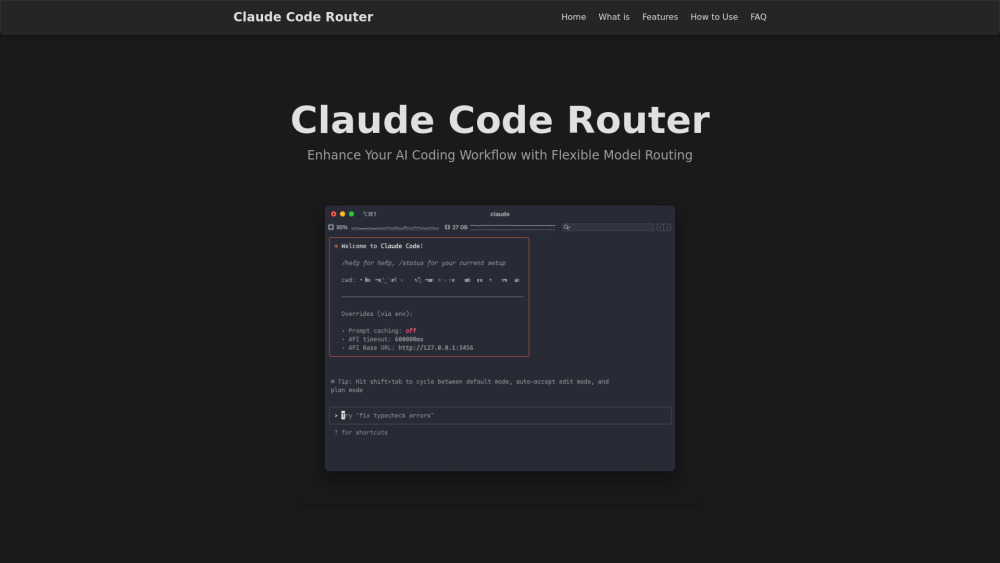
Introducing Claude Code Router: Smart Model Routing & Real-Time Cost Optimization
Claude Code Router redefines AI-powered development by intelligently orchestrating coding requests across a diverse ecosystem of large language models. Built as an open-source, production-ready Node.js CLI extension to Anthropic’s Claude Code, it transforms static model usage into a dynamic, context-aware routing engine. Rather than locking developers into a single LLM—regardless of task complexity, latency tolerance, or budget constraints—the router evaluates each coding request in real time and dispatches it to the optimal model based on purpose, performance profile, and cost efficiency. Supported providers include OpenRouter, DeepSeek, Ollama (for local inference), Google Gemini, and Volcengine—enabling seamless hybrid workflows that blend cloud scalability with on-device privacy and affordability.
Getting Started in Minutes
Installation is streamlined and developer-first. With Node.js and npm already installed, run npm install -g @anthropic-ai/claude-code to set up the base CLI, then add intelligent routing with npm install -g @musistudio/claude-code-router. This registers the ccr command globally. Launch your enhanced coding assistant with ccr code. For granular control, create or edit ~/.claude-code-router/config.json to define provider credentials, model availability, and role-based routing policies—including defaults for everyday tasks, dedicated “think” models for complex reasoning, lightweight “background” models for low-priority automation, and long-context specialists for repository-scale analysis. Once configured, all interactions remain intuitive: type as usual in Claude Code—and behind the scenes, the router makes intelligent, real-time decisions about where—and how—to execute each request.
Intelligent Capabilities, Engineered for Impact
Adaptive Model Routing: Automatically or manually route prompts using natural-language commands like /model openrouter,google/gemini-2.5-pro-preview, with support for fallback chains and load-aware balancing.
Role-Aware Model Assignment: Assign models not just by capability—but by *intent*: background workers for linting and scaffolding, high-reasoning models for architecture design, and long-context engines for full-stack debugging across massive codebases.
Real-Time Cost Intelligence: Monitor token usage, API pricing tiers, and latency metrics per provider—and dynamically prioritize lower-cost alternatives when quality thresholds are met (e.g., swapping Claude 3.5 Sonnet for DeepSeek-V3 on routine refactoring).
Extensible Ecosystem: Plug in multimodal tools (image understanding, web search), export structured logs for observability, and trigger CI/CD pipelines via GitHub Actions—using any configured model as your automated engineering co-pilot.
Zero-Lock-in Configuration: Full declarative control via JSON—no hidden abstractions. Define custom routing logic, rate-limiting rules, retry strategies, and even model-specific prompt wrappers—all within a single, version-controllable config file.
Where Smart Routing Delivers Real Value
Engineering teams scaling AI-assisted development without scaling cloud bills—routing simple PR summaries to economical models while reserving premium LLMs only for critical design decisions.
Open-source maintainers automating triage, documentation generation, and security scanning—leveraging local Ollama models for privacy-sensitive repos and cloud models for cross-platform compatibility checks.
DevOps engineers embedding AI into CI pipelines—dynamically selecting models based on job type (e.g., fast-response models for test feedback, high-context models for root-cause analysis of flaky builds).
Solo developers maximizing utility from limited API budgets—automatically downgrading to free-tier models during exploration mode, then upgrading on-demand for deep reasoning sessions.
AI research labs benchmarking model performance across coding tasks—routing identical prompts to multiple backends simultaneously and comparing outputs, latency, and cost per operation.
Frequently Asked Questions
-
What makes Claude Code Router “smart”—beyond basic model switching?
-
How does real-time cost optimization actually work in practice?
-
Can I enforce cost caps or budget alerts?
-
Does routing introduce noticeable latency?
-
How are model roles enforced—automatically or manually?
-
Is there support for fine-tuned or private models?
-
How does Claude Code Router handle authentication and credential security?
-
Are usage analytics and cost reporting built-in?
-
What license governs Claude Code Router?
-
Where can I contribute or report issues?
-
Does it support streaming, function calling, or tool use across providers?
-
Support & Contact
For technical assistance, feature requests, or billing inquiries, visit our dedicated support portal.
-
About Musistudio
Claude Code Router is developed and maintained by Musistudio—a team passionate about democratizing intelligent, sustainable AI tooling for developers.
Learn more about our mission and open-source philosophy on the About Us page.
-
Access & Authentication
Claude Code Router operates entirely client-side—no login or account required. All configuration and execution happen locally on your machine.
-
Community & Development
Explore the source, submit pull requests, or join discussions on GitHub: https://github.com/musistudio/claude-code-router
FAQ from Claude Code Router
What is Claude Code Router?
Claude Code Router is an open-source, MIT-licensed CLI extension that adds intelligent, policy-driven model routing to Anthropic’s Claude Code. It enables developers to treat LLMs as interchangeable, purpose-built components—selecting the right model, at the right time, for the right task—while continuously optimizing for speed, accuracy, and cost.
How does real-time cost optimization work?
The router integrates live pricing data from supported providers (e.g., per-token rates from OpenRouter, tiered costs from Volcengine) and correlates them with historical performance metrics. When a request matches predefined criteria—such as low-complexity code generation or non-critical documentation—it automatically selects the most cost-efficient model that meets minimum quality benchmarks—without user intervention.
Can I enforce cost caps or budget alerts?
Yes. Through advanced configuration, you can define daily or session-level spending limits, set automatic model downgrade thresholds, and enable console notifications—or even halt routing—when projected costs exceed configured budgets.
Does routing introduce noticeable latency?
No. The routing decision engine executes in under 5ms on modern hardware. For most workflows, latency is dominated by the selected LLM’s inference time—not the router itself. Optional caching and connection pooling further minimize overhead.
How are model roles enforced?
Roles are enforced through both automatic heuristics (e.g., detecting “explain this algorithm” triggers think-mode routing) and explicit user commands (/think, /bg, /long). You retain full control—override defaults anytime, or lock roles per project via config profiles.
Is support available for fine-tuned or private models?
Absolutely. Any model accessible via standard LLM APIs—including self-hosted Llama 3 variants on Ollama, custom fine-tunes on Volcengine, or enterprise-deployed Gemini instances—can be registered and routed with full parameter control.
How are credentials secured?
All API keys are stored locally in encrypted, user-owned config files (~/.claude-code-router/config.json) with strict filesystem permissions. No credentials ever leave your device or touch external servers.
Are usage analytics built-in?
Yes—opt-in, local-only telemetry provides detailed breakdowns: tokens consumed per model, cost per session, average latency by role, and routing success/failure rates. Data never leaves your machine unless explicitly exported.
What license applies?
Claude Code Router is released under the permissive MIT License—free for commercial use, modification, and redistribution, with no royalties or restrictions.
Where can I contribute?
We welcome contributions! Visit GitHub to report bugs, propose enhancements, or submit documentation improvements. Our contribution guide and issue templates ensure smooth onboarding.
Does it support advanced LLM features?
Fully. Function calling, structured output, image input (via Gemini and OpenRouter-compatible endpoints), and tool-use orchestration are all preserved and normalized across providers—so your prompts and plugins work consistently, regardless of backend.