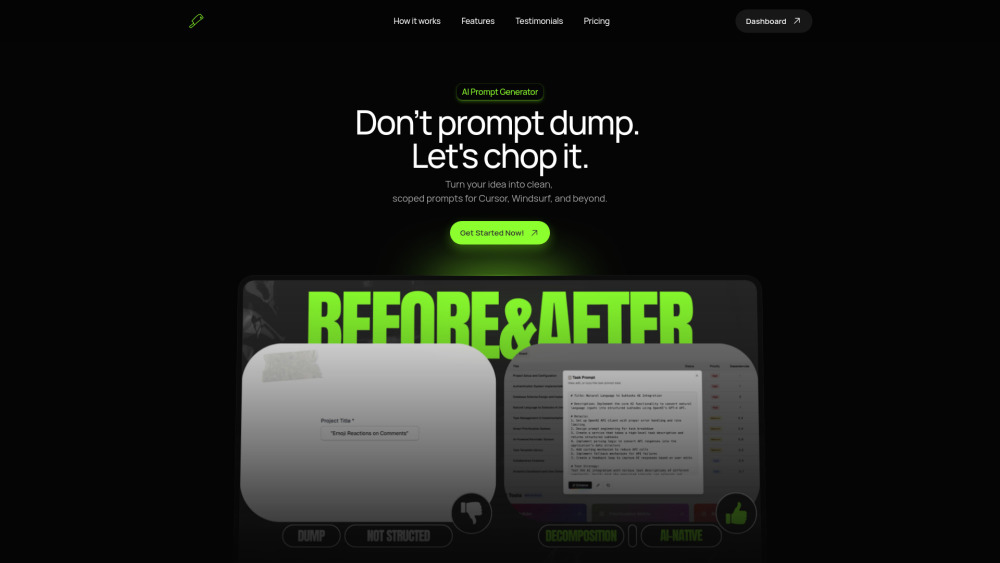
Introducing ChopTask: Where Ideas Meet Execution
ChopTask redefines how developers, product builders, and technical creators turn fuzzy concepts into shippable reality. It’s not just a task list—it’s an intelligent decomposition engine that transforms open-ended goals into granular, AI-ready subtasks with built-in context, sequencing logic, and precision-crafted prompts. Whether you're scoping a new feature, architecting an MVP, or onboarding a teammate, ChopTask delivers structure *before* you write a single line of code—accelerating clarity, reducing cognitive load, and aligning human intent with AI capability.
How ChopTask Works—In Practice
Think of ChopTask as your AI co-pilot for project inception:
1. Input Your Intent — Describe your vision in plain language: “Build a login flow with SSO and passwordless options,” or “Add real-time dashboard analytics to our React admin panel.”
2. Get Intelligent Decomposition — Instantly receive a prioritized, dependency-aware task tree—complete with effort estimates, risk flags, cross-task blockers, and logical execution order.
3. Deploy AI-Ready Prompts — Each subtask ships with tailored, editor-optimized prompts engineered for Cursor, Windsurf, GitHub Copilot, or any LLM-powered coding environment—ready to paste, refine, or run.
The ChopTask Advantage: Beyond Task Lists
Context-Aware Prompt Engineering
Smart Subtask Hierarchization
AI-Native Prompt Templating
Editor-Specific Prompt Tuning
Automated Dependency Mapping
MVP-Focused Feature Sequencing
Risk-Aware Priority Scoring
Visual Roadmap Builder
Effort Heatmap Visualization
Live Progress Synthesis
Interactive Task Graph Explorer
Cross-Feature Impact Analysis
Real-World Applications
Converting ambiguous product specs into developer-executable tickets—with ownership hints and test scaffolding suggestions.
Generating production-grade, context-rich prompts that reduce hallucination and boost first-run success in AI coding tools.
Rapidly defining and stress-testing MVP scope—identifying must-have vs. nice-to-have features using effort–impact scoring.
Translating sprint plans into visual timelines with auto-adjusted milestones based on interdependent task weight.
Surface high-complexity modules early via color-coded heatmaps—enabling proactive tech debt triage or pairing decisions.
Tracking progress not just by checkmarks—but by semantic completion signals (e.g., “API contract validated,” “UI component rendered”)
Navigating tangled dependencies with interactive graph views—click any node to reveal upstream/downstream ripple effects.
Optimizing solo dev workflows by recommending the most parallelizable, low-friction sequence to ship value fast.