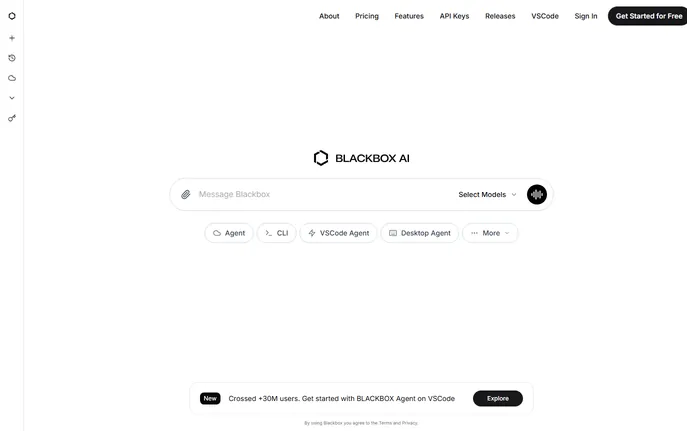
What Is Blackbox AI?
Blackbox AI is an advanced artificial intelligence platform built to help professionals automate everyday work, improve productivity, and write code more efficiently. It combines conversational AI, intelligent workflow support, and developer-focused tools in one accessible environment. Instead of switching between multiple applications for research, planning, coding, documentation, and task management, users can rely on Blackbox AI to assist with a wide range of professional activities.
Designed for both experienced developers and people with limited technical knowledge, Blackbox AI uses natural language to understand requests and provide practical results. Users can ask questions, describe a business process, generate software code, analyze information, or request help with a complex project. The platform is intended to function as an adaptable AI partner that supports faster execution, clearer decisions, and more consistent results across work and coding tasks.
How to Use Blackbox AI
Getting started with Blackbox AI is straightforward. Open the platform through your browser or use the relevant Blackbox AI application, then enter a request in ordinary language. You might ask the system to summarize a report, create a project outline, explain a programming concept, generate a database query, or identify an error in a code sample. The clearer the instructions and context, the more useful the resulting response will be.
For work automation, describe the desired outcome and include any relevant information, deadlines, formatting requirements, or business rules. Blackbox AI can then help break the objective into manageable steps, prepare draft materials, and suggest ways to reduce repetitive effort. Users can refine the output by adding instructions, correcting assumptions, or requesting a different format.
Developers can use Blackbox AI by providing a programming language, framework, existing code, and a description of the intended behavior. The platform can assist with code generation, debugging, refactoring, testing ideas, and technical explanations. Reviewing generated code before using it in a production environment remains essential, but the AI assistant can significantly reduce the time required to move from an idea to a working solution.
Core Features of Blackbox AI
- AI-Powered Work Assistance: Blackbox AI can support writing, research, planning, summarization, analysis, and other knowledge-based activities. It helps users organize information and produce useful first drafts more quickly.
- Automated Workflow Support: Repetitive processes can be planned and streamlined with AI assistance. The platform helps identify individual steps, prepare content, and create repeatable approaches for routine professional work.
- Natural Language Interaction: Users can communicate with Blackbox AI using everyday language. There is no need to learn complex commands before asking for an explanation, recommendation, document, or workflow improvement.
- Code Generation and Completion: Blackbox AI supports software developers with code suggestions, function creation, boilerplate generation, and examples across multiple programming languages and development environments.
- Debugging and Code Explanation: Developers can submit code and describe an issue to receive possible explanations, troubleshooting suggestions, and improvement ideas. The tool can also explain unfamiliar code in simpler language.
- Project and Documentation Support: Blackbox AI can assist with technical documentation, user stories, README files, release notes, task descriptions, and other materials required to keep projects organized.
- Flexible Professional Applications: The platform can be applied to marketing, operations, education, customer support, software development, analytics, and many other areas where people work with information and digital tools.
These capabilities can create practical benefits for individuals and teams. Employees may spend less time on repetitive preparation, developers can move through early implementation stages faster, and managers can use AI assistance to organize priorities and communicate information more clearly.
Why Choose Blackbox AI for Work and Coding?
Blackbox AI is particularly useful for users who want one AI platform to support both general productivity and software development. Many professionals divide their time between communication, research, planning, documentation, and technical tasks. A flexible assistant that can switch between these responsibilities helps reduce the friction caused by using separate tools for every part of the workday.
For developers, the coding features can support the full development process. Blackbox AI may help turn a project idea into an initial structure, create reusable components, explain an application programming interface, or suggest ways to resolve an error. It can also help nontechnical stakeholders understand technical concepts by translating complex implementation details into accessible language.
The platform is also suitable for teams with different levels of experience. A new employee can use it to learn unfamiliar terminology or understand an existing process, while an experienced professional can use it to accelerate routine tasks and explore possible solutions. This makes Blackbox AI a practical option for organizations that want to introduce AI assistance across multiple departments instead of limiting it to a single specialist group.
Blackbox AI for Workplace Automation
Workplace automation often begins with small tasks that consume time throughout the day. These may include preparing meeting summaries, converting notes into action items, drafting email responses, formatting reports, organizing research, or creating recurring project updates. Blackbox AI can help users prepare these materials from structured instructions and supplied information, allowing more time for judgment, collaboration, and strategic work.
Teams can also use the platform to standardize common processes. For example, a department may create a repeatable prompt for reviewing customer feedback, classifying incoming requests, or preparing a weekly performance summary. Consistent instructions make it easier for different team members to follow the same process while still allowing human review at important stages.
Blackbox AI can contribute to decision support as well. Users may ask it to compare options, identify missing information, summarize competing viewpoints, or organize a large set of notes. The quality of the result depends on the information provided and the way the request is written, so important business decisions should continue to involve appropriate human oversight.
Blackbox AI for Software Development
Blackbox AI offers coding assistance for developers working on websites, applications, scripts, databases, and other software projects. A developer can request a function, provide an error message, ask for a code review, or describe a feature that needs to be implemented. The assistant can generate an initial solution and explain how the code works, helping users move more efficiently through development tasks.
During the planning stage, Blackbox AI can help transform a product requirement into technical tasks, data models, interface ideas, and implementation steps. During development, it can provide examples and suggest ways to structure code. During testing, it can propose test cases and help identify potential edge cases. Later, it can assist with documentation and explain changes for teammates or future maintainers.
Blackbox AI can be valuable for programmers learning a new language or framework. Instead of searching through disconnected resources, users can ask for comparisons, simple explanations, and small working examples. This interactive approach can make technical learning more accessible while allowing experienced developers to investigate unfamiliar tools more quickly.
Practical Use Cases
Marketing teams can use Blackbox AI to develop campaign outlines, analyze audience research, generate content variations, and organize performance data. Operations teams can apply it to standard operating procedures, internal documentation, process reviews, and recurring reports. Customer service departments may use AI assistance to draft responses, summarize conversations, and categorize common questions.
Software teams can use Blackbox AI to generate starter code, review pull request changes, create documentation, write test examples, and investigate bugs. Product managers may ask it to convert customer feedback into feature requirements or organize a roadmap discussion. Designers and content specialists can use the platform to develop concepts, prepare copy, and clarify project requirements before production begins.
Students and independent learners can also use Blackbox AI as a study companion. It can explain difficult subjects, create practice questions, summarize reading material, and provide step-by-step guidance for coding exercises. Its usefulness increases when learners ask for explanations and examples rather than relying only on completed answers.
Tips for Getting Better Results from Blackbox AI
Effective AI automation begins with a well-defined request. Explain the goal, identify the intended audience, provide relevant background, and specify the required format. For coding requests, include the language, framework, operating environment, current behavior, expected behavior, and any error messages. This context gives Blackbox AI a stronger foundation for producing a relevant response.
It is also helpful to work through larger projects in stages. Begin with a plan, review the proposed structure, and then request individual components or workflow steps. Ask the AI to explain assumptions and highlight areas that require testing. Breaking a complex assignment into smaller requests makes the output easier to evaluate and revise.
Users should treat AI-generated material as an informed starting point. Check facts, review calculations, test software, protect confidential information, and adapt the result to the organization’s standards. Human expertise remains valuable because it provides the context and judgment needed to determine whether an AI response is appropriate for a specific situation.