Table of contents
Bitchat: Decentralized Offline Messaging via Bluetooth Mesh
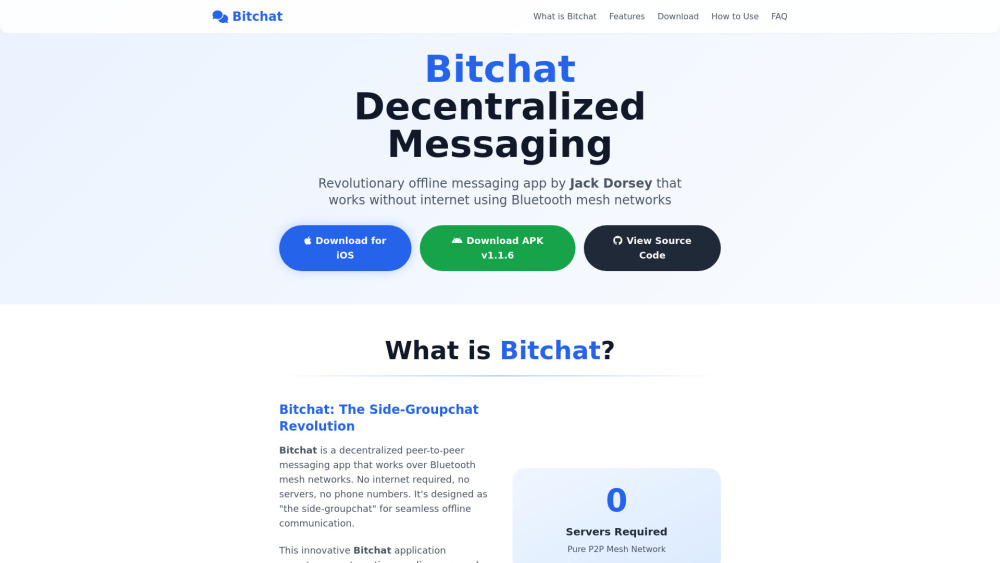
Bitchat: Jack Dorsey’s decentralized offline messaging app—no internet needed. Uses Bluetooth mesh for secure, peer-to-peer chats anywhere.
Directory : Other
Introducing Bitchat: Decentralized Offline Messaging via Bluetooth Mesh
Bitchat redefines resilient communication by eliminating dependence on infrastructure. Built as a permissionless, serverless messaging protocol, it leverages Bluetooth Low Energy (BLE) mesh networking to enable real-time, multi-hop conversations—entirely offline. Conceived as “the side-groupchat” for the post-internet era, Bitchat requires no accounts, no phone numbers, and no internet connection. Instead, devices discover each other autonomously, form ad-hoc mesh topologies, and relay messages across up to seven hops—making it uniquely suited for remote deployments, disaster response, civil coordination, and privacy-first environments.
Getting Started with Bitchat
Installation is streamlined: download the official iOS app (iOS 16.0+) or Android APK (v1.1.6), or build from source using the public GitHub repository. On first launch, choose a nickname—no registration required—and Bitchat immediately begins scanning for nearby peers via BLE advertising. Join public channels with IRC-style commands like /j #rescue, list active channels with /channels, or initiate private chats using /m @friend Hello. Channel admins can set passwords (/pass secret), assign moderators, and even transfer ownership—all without central coordination. Messages propagate intelligently through the mesh, respecting TTL limits and avoiding loops via cryptographic message IDs and bloom-filter deduplication.
Bluetooth LE Mesh Architecture (Automatic peer discovery, TTL-limited multi-hop routing, adaptive topology management)
End-to-End Cryptographic Assurance (X25519 key exchange, AES-256-GCM encryption for messages and channels, Ed25519 signatures, forward secrecy, cover traffic obfuscation)
IRC-Native Interaction Layer (Channel topics, password protection, role-based permissions, inline mentions, command-driven moderation)
Intelligent Store-and-Forward (Ephemeral by default; optional persistent caching with automatic redelivery upon peer reconnection)
Zero-Identity Design (No identifiers beyond public keys; no metadata collection; no persistent storage unless explicitly enabled)
Cross-Platform Native Implementation (iOS, macOS, Android—with consistent protocol behavior and interoperability)
LZ4 Message Compression (Dynamically applied to reduce BLE packet overhead by 30–70%, preserving bandwidth and latency)
Adaptive Power Intelligence (Five-tier battery profile: Performance → Balanced → Power Saver → Ultra-Low → Deep Sleep, with configurable scan intervals and duty cycling)
One-Tap Emergency Privacy (Triple-tap the logo to trigger instant, cryptographically verified data wipe)
Public Domain & Open Protocol (No copyright restrictions; fully auditable; designed for integration, extension, and hardware portability)
Where Bitchat Makes a Difference
Connecting communities in geographically isolated or infrastructure-poor regions
Maintaining critical comms during natural disasters, blackouts, or telecom failures
Enabling secure, untraceable coordination under surveillance or censorship regimes
Providing reliable, low-footprint group chat for field teams, festivals, campuses, and emergency responders
Frequently Asked Questions
-
What is Bitchat—and is it really Jack Dorsey’s project?
-
How does Bluetooth mesh enable long-range messaging without Wi-Fi or cellular?
-
Which cryptographic primitives ensure confidentiality and authenticity in Bitchat?
-
Where can I obtain Bitchat—and how do I verify its integrity?
-
How does Bitchat extend device battery life while maintaining mesh responsiveness?
-
Why is Bitchat’s binary protocol more efficient than HTTP or WebSockets over BLE?
-
Are messages stored—and if so, where, for how long, and under what conditions?
-
Who benefits most from adopting Bitchat—and in what real-world scenarios?
-
Is the codebase truly open—and what does ‘public domain’ mean for developers and enterprises?
-
What’s currently stable—and what parts of the protocol are still undergoing security validation?
-
Support & Contact Information
For technical assistance, community support, or refund inquiries, please visit the contact us page().
-
About Bitchat
Bitchat Company name: Permissionless Tech Foundation
Bitchat Company address: San Francisco, CA — distributed globally
Learn more about our mission and philosophy at the about us page(). -
Accessing Bitchat
Bitchat Login Link: Not applicable — no login required
-
Join the Network
Bitchat Sign up Link: No sign-up needed — just launch and connect
-
Contribute & Audit
Bitchat Github Link: https://github.com/permissionlesstech/bitchat
FAQ from Bitchat
What is Bitchat?
Bitchat is a decentralized, infrastructure-free messaging protocol that operates exclusively over Bluetooth LE mesh networks. It enables spontaneous, encrypted group and private conversations without internet, servers, or identity requirements—designed for resilience, privacy, and accessibility.
How to use Bitchat?
Install the app, pick a nickname, and begin interacting immediately. Use /j #channel to join, /msg @user for private notes, /pass to secure channels, and /block to manage trust. All routing, encryption, and discovery happen transparently in the background—no configuration needed.
What is Bitchat and who created it?
Bitchat is an open, public-domain protocol developed by Permissionless Tech—a collective focused on infrastructure-resilient communication tools. While inspired by principles championed by figures like Jack Dorsey, it is a community-owned, non-commercial initiative released without proprietary constraints.
How does Bitchat’s mesh network work?
Each device advertises its presence and listens for others using BLE advertising packets. Messages are serialized into compact binary frames, tagged with hop count (TTL ≤ 7), signed, and forwarded only once per node—preventing loops and ensuring delivery efficiency. Topology adapts dynamically as peers enter or leave range.
What are Bitchat’s security features?
Every message layer is cryptographically protected: X25519 ECDH for session keys, AES-256-GCM for confidentiality and integrity, Ed25519 for authentication, Argon2id for channel password derivation, and ephemeral key rotation for forward secrecy. Optional cover traffic further masks activity patterns.
How can I download and install Bitchat?
iOS users can download directly from the official site (iOS 16.0+); Android users install the signed APK (v1.1.6). macOS support is available via native builds (macOS 13.0+). All binaries are reproducible and verifiable against the public GitHub source.
How does Bitchat optimize battery usage?
Through intelligent power tiering: scanning frequency, advertisement duty cycle, and message processing intensity scale automatically based on remaining battery and user activity. In Ultra-Low mode, Bitchat maintains mesh presence with sub-1% hourly drain—ideal for emergency standby.
What makes Bitchat’s protocol efficient?
A lean binary wire format (1-byte opcodes, variable-length fields), LZ4 compression, bloom-filter duplicate suppression, message aggregation, and adaptive connection throttling collectively minimize BLE airtime and CPU overhead—critical for constrained edge devices.
How does message storage work in Bitchat?
By design, messages reside only in volatile memory—erased on app exit or device reboot. Channel owners may opt into persistent storage using /save on, which encrypts and caches messages locally until manually cleared or wiped via emergency protocol.
What are Bitchat’s main use cases?
From wildfire response teams coordinating without cell towers, to journalists reporting from censored zones, to students sharing notes across campus buildings—Bitchat empowers communication wherever connectivity fails or surveillance threatens.
Is Bitchat open source and what’s the license?
Yes—100% open, auditable, and released into the public domain (CC0). Anyone may use, modify, fork, or embed Bitchat’s protocol without restriction, attribution, or liability—accelerating adoption across humanitarian, defense, and civic tech domains.
What’s Bitchat’s current development status?
Public local chat is production-ready and widely tested. Private messaging and channel administration are fully implemented but undergoing independent cryptanalysis. Future milestones include hardware SDKs, LoRaWAN bridge support, and formal FIPS-aligned validation.