Table of contents
Asksia - AI Tutor & Study Copilot: PDFs, Transcribe, Homework, Notes
Asksia: Your AI tutor & study copilot—upload PDFs, transcribe lectures, ace homework, and organize notes. One smart app, zero clutter. Try free!
What is Asksia?
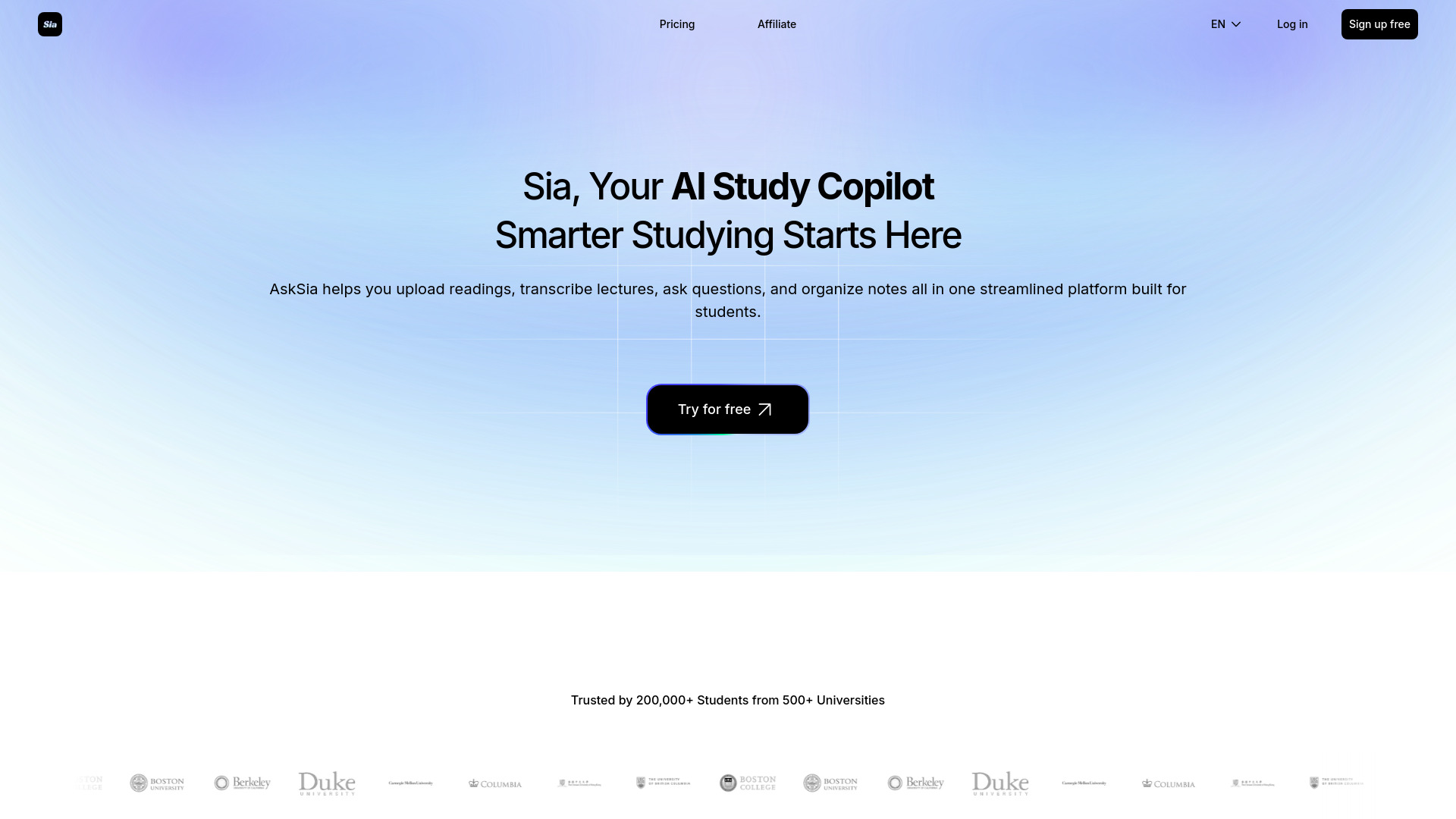
Asksia is an adaptive AI tutor and intelligent study copilot built exclusively for learners who demand precision, speed, and academic depth. More than a chatbot or generic LLM interface, Asksia functions as a subject-aware academic partner—trained on pedagogical frameworks, curriculum-aligned reasoning, and real-world student workflows. It transforms static documents, spoken lectures, handwritten notes, and complex problem sets into dynamic, interactive learning experiences. Whether you're decoding differential equations, synthesizing research papers, drafting lab reports, or preparing for oral exams, Asksia delivers contextual, stepwise guidance—not just answers, but understanding. Designed from the ground up for higher education and rigorous secondary curricula, it bridges the gap between passive consumption and active mastery.
How to Use Asksia
Getting started with Asksia takes seconds—not setup hours. Drag and drop your course materials directly into the workspace: PDF textbooks, annotated slides (PPTX), scanned lecture handouts (JPG/PNG/SVG), Word-based essays, or recorded Zoom/Teams sessions (MP3, MP4, M4A, WAV). Within moments, Asksia processes content intelligently—preserving structure, math notation, diagrams, and speaker turns—and makes every element queryable. Ask “Explain Gauss’s Law in plain terms,” “Show the derivation step-by-step,” or “Summarize the key arguments in this 12-page policy brief.” The AI responds conversationally, cites sources within your uploaded files, and lets you drill down with follow-up questions—all without switching tabs or re-uploading.
Go deeper with power tools designed for academic rigor: activate live lecture transcription during class (or upload recordings after), then let Asksia auto-generate timestamped summaries, highlight conceptual turning points, and tag recurring themes like “thermodynamic cycles” or “Shakespearean motifs.” Convert messy handwritten notes into clean, hierarchical outlines with one click—or use smart highlighting to isolate definitions, formulas, and counterarguments inside dense PDFs. For assignments, toggle into subject-specific modes: Math Solver walks through integrals with domain restrictions; Physics Copilot validates units and sketches free-body diagrams; Essay Assistant critiques thesis clarity and suggests evidence-based revisions—all grounded in your actual coursework.
Key Features of Asksia
- Subject-Intelligent AI Tutor: Not general-purpose AI—Asksia’s models are fine-tuned across STEM, humanities, and social sciences. It recognizes when a calculus question requires epsilon-delta rigor versus AP-level intuition, adapts explanations to your declared course level, and flags knowledge gaps before they compound—making it a true co-learner, not just a lookup tool.
- Universal Document Intelligence: Supports 20+ academic file types—including OCR-enabled PDFs with embedded equations, multi-slide presentations with speaker notes, and mixed-media lecture captures. Asksia doesn’t just read text—it interprets tables, renders LaTeX, extracts code blocks, and cross-references visuals with captions, ensuring nothing gets lost in translation.
- Lecture-to-Learning Workflow: Record, transcribe, distill, and review—all in one flow. Asksia’s transcription goes beyond verbatim speech-to-text: it identifies speakers, detects pauses and emphasis, segments by topic, and generates AI-curated flashcards and concept maps. Turn a 90-minute biochemistry lecture into a targeted study session in under two minutes.
- Homework Engine with Pedagogical Guardrails: Solves problems—but never skips the why. In math, it shows intermediate algebraic manipulations; in coding, it traces logic flow and edge cases; in writing, it highlights rhetorical devices and structural weaknesses. Every solution includes optional “teaching mode” toggles for scaffolding, practice prompts, and common misconception alerts.
- Adaptive Note Architecture: Your notes evolve with you. Upload raw transcripts or bullet-point scribbles → Asksia structures them into expandable outlines, links related concepts across documents, surfaces latent connections (“This economic model parallels yesterday’s game theory lecture”), and exports polished versions to PDF, Markdown, or Notion-ready formats—no manual reformatting required.
Every capability is calibrated for academic integrity, cognitive load reduction, and long-term retention—not quick fixes. Asksia measures success not in response speed, but in improved quiz scores, faster assignment turnaround, and confident self-explanation of concepts weeks later.
Why Choose Asksia?
In a crowded landscape of “AI study tools,” Asksia is engineered for the reality of academic work: ambiguity, complexity, and discipline-specific norms. Unlike broad LLMs that hallucinate citations or misinterpret vector notation, Asksia operates within validated academic boundaries—prioritizing accuracy over fluency, clarity over cleverness, and pedagogy over performance. It’s trusted by university tutoring centers, STEM departments, and honors programs precisely because it augments—not replaces—critical thinking and instructor guidance.
Asksia consolidates what used to require six separate subscriptions: Otter.ai for transcription, Hypothesis for PDF annotation, Wolfram Alpha for math, Grammarly for writing, Notion for organization, and ChatGPT for Q&A. But integration alone isn’t enough—Asksia unifies these functions with shared context. A question about a physics diagram in your uploaded PPT pulls relevant equations from your textbook PDF and references your professor’s lecture transcript. That’s continuity no fragmented toolkit can match. Recognized by aitop-tools.com as a top-tier academic AI, Asksia delivers enterprise-grade reliability with student-first simplicity—whether you’re reviewing organic chemistry mechanisms at midnight or prepping for a capstone defense.
Use Cases and Applications
Pre-med students use Asksia to transcribe anatomy labs, instantly generate labeled muscle-function tables from audio notes, and quiz themselves on histology slide descriptions using AI-generated flashcards tied to their actual lab handouts. Graduate researchers upload dissertation drafts alongside peer-reviewed journal PDFs to detect citation gaps, compare theoretical frameworks side-by-side, and refine methodology sections with discipline-specific feedback.
For high school AP learners, Asksia transforms prep: upload College Board FRQs + official scoring guidelines → get breakdowns of what earned full credit vs. partial points, plus model responses matching the rubric’s language. Language learners upload podcast transcripts + target-language novels to build custom vocabulary decks with pronunciation guides and contextual example sentences pulled from their own reading.
The platform scales seamlessly—from first-year undergraduates building foundational study habits to PhD candidates managing multi-year research portfolios. Instead of juggling cloud folders, sticky notes, and browser tabs, students anchor their entire academic lifecycle in Asksia: ingest (record/upload), interpret (transcribe/analyze), internalize (quiz/outline), and output (draft/revise/export). It’s not another app to learn—it’s the operating system for how modern students think, learn, and achieve.
Frequently Asked Questions About Asksia
What makes Asksia different from other AI tutors?
Asksia is purpose-built for academic fidelity—not conversational flair. Its models are continuously refined on real syllabi, textbook corpora, and graded student work. It understands academic conventions (e.g., proper citation styles, proof structure in proofs, lab report sections) and refuses to generate misleading shortcuts. You’re not getting generic advice—you’re getting a tutor who’s read your course materials and knows your curriculum.
Can Asksia handle technical content like equations, code, or diagrams?
Absolutely. Asksia parses LaTeX, MathML, and handwritten math via OCR. It executes and explains Python/R code snippets, validates syntax against your course’s requirements, and interprets flowcharts, circuit schematics, and molecular diagrams—linking visual elements to textual explanations in your uploaded files.
Does Asksia support collaborative learning or group projects?
Yes. Share annotated documents, synchronized transcripts, or AI-generated study guides with classmates via secure, permission-controlled links. Group members can add comments, ask joint questions (“What does this graph imply for our hypothesis?”), and co-edit structured notes—all traceable back to source materials. Ideal for study groups, peer review, and team-based research.
How does Asksia ensure privacy and data security?
Your materials never train public models. All processing occurs in secure, encrypted environments compliant with FERPA and GDPR standards. Uploaded files are stored temporarily (configurable retention periods), never sold, and automatically purged unless explicitly saved to your private workspace. Institutional plans offer additional compliance controls and audit logs.
Is Asksia accessible on mobile, and what’s the pricing model?
Asksia is fully responsive and optimized for tablets and smartphones—ideal for annotating PDFs on iPad or transcribing lectures on-the-go. A robust free tier includes core features (PDF analysis, transcription, basic homework help) with fair usage limits. Premium plans unlock advanced capabilities (unlimited uploads, priority processing, subject-specific solvers, export options) and are available via monthly or annual subscription. Visit asksia.ai for current plans, academic discounts, and mobile app availability updates.