Table of contents
AI Text Summarizer : Fast, Accurate, 80+ Languages Support
AI Text Summarizer: Get lightning-fast, accurate summaries in 80+ languages—extract key insights, answer questions, and simplify content analysis effortlessly.
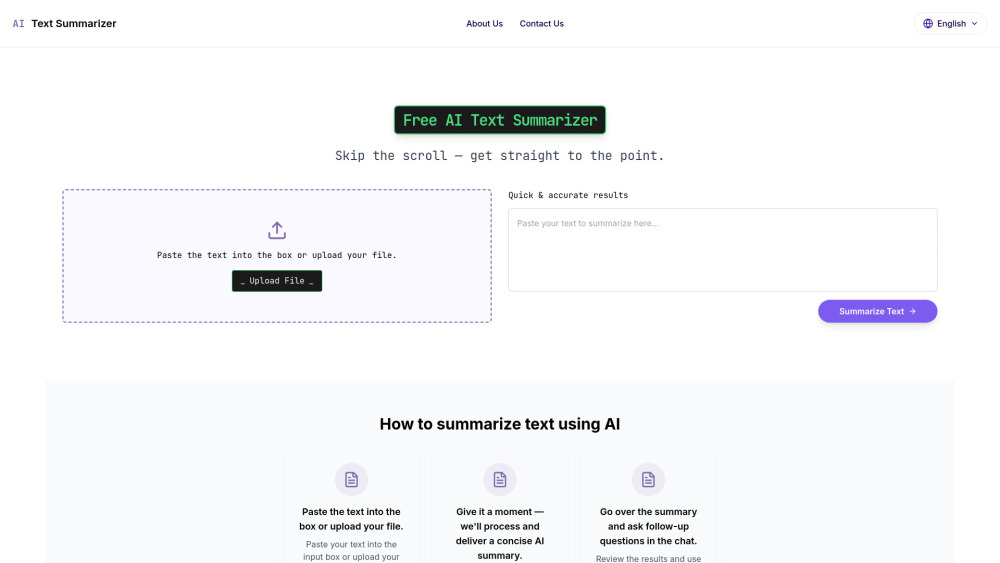
Directory : AI Summarizer
What Is an AI Text Summarizer?
Transform how you consume information — instantly. Our AI Text Summarizer distills lengthy documents, articles, reports, and PDFs into clear, concise, and context-aware summaries — in under 10 seconds. Built for precision, not just compression, it preserves nuance, logic, and key insights across 80+ languages. Plus, its integrated Q&A engine lets you interrogate any part of the source material like a real-time research partner. Whether you're preparing for exams, managing global content, or cutting through information overload — this is intelligent summarization, reimagined.
Why This AI Summarizer Stands Out
Blazing-fast processing: Turn 10,000-word reports into digestible insights before your coffee cools.
Meaning-first accuracy: Goes beyond keyword extraction — understands tone, argument flow, and implicit conclusions to deliver summaries that read like human-written briefs.
Smart contextual Q&A: Ask follow-up questions directly about your summarized content — no re-uploading, no guesswork. The AI remembers what it just read.
Truly multilingual: Supports 80+ languages — from widely spoken ones like Mandarin, Arabic, and Portuguese to regional variants and low-resource languages — with consistent reliability and grammatical fidelity.
Zero-install, everywhere: Works seamlessly across desktops, tablets, and smartphones — no app downloads, no sign-in required for basic use, and full functionality in any modern browser.
Designed for real people: Clean interface, minimal steps, zero learning curve. Paste, upload, summarize — done.
Who Benefits Most?
Students mastering heavy reading loads: Skip skimming — get exam-ready summaries of textbooks, journal articles, and lecture notes, complete with definitions, arguments, and implications highlighted.
Language learners building fluency: Read authentic foreign-language content (news, literature, academic texts) with instant bilingual support — understand *why* a sentence means what it does, not just *what* it says.
Analysts and decision-makers: Cut through dense market intelligence, regulatory filings, or competitive briefs — surface trends, risks, and opportunities in seconds, not hours.
Content creators & writers: Extract core ideas, verify facts, repurpose research, and build outlines faster — so your creativity isn’t bottlenecked by consumption.
Journalists and comms professionals: Convert press releases, transcripts, or policy drafts into tight, accurate leads and bullet-point briefings — meet deadlines without sacrificing depth.
Frequently Asked Questions
-
How does AI-powered text summarization work?
-
Is there a free version — and are there limits?
-
Which languages are supported — and how well do they perform?
-
What file types and text formats can I process?
-
How does “Chat with PDF” actually function?
-
What’s the best way to phrase questions in the chat interface?
-
Support & Contact Information
For technical help, billing inquiries, or refund requests, visit our Contact Us page.
-
About Our Team
AI Text Summarizer Company name: TYY.AI
AI Text Summarizer Company address: San Francisco, CA — with remote teams across Europe and APAC.
Learn more about our mission and technology at our About Us page.
-
Log In to Your Account
AI Text Summarizer Login Link: Sign in securely
-
Get Started — Free Account
AI Text Summarizer Sign up Link: Create your free account in 20 seconds
FAQ from AI Text Summarizer
What is AI Text Summarizer?
It’s a next-generation language model designed to compress complex text while retaining meaning, structure, and actionable insight — powered by fine-tuned transformer architecture and multilingual alignment training. No subscriptions. No hidden tiers. Just fast, trustworthy summarization — in your language.
How does AI-powered text summarization work?
We use advanced natural language understanding (NLU) to identify core propositions, extract salient entities, map logical dependencies, and reconstruct condensed versions that reflect the original’s intent — not just its keywords. Unlike basic extractive tools, ours is abstractive, adaptive, and trained on diverse domains.
Is there a free version — and are there limits?
Yes — our core summarizer is completely free, including multilingual support and PDF processing. Premium features (like batch summarization, custom length control, and API access) are available via optional plans — but nothing essential is paywalled.
Which languages are supported — and how well do they perform?
We support 92 languages — verified through native-speaker evaluation and BLEU/ROUGE benchmarking. Performance remains consistently high for top 40 languages; for others, output quality is optimized for comprehension over formality — ideal for learning, translation prep, or rapid triage.
What file types and text formats can I process?
Text: Plain .txt, .docx, .rtf, and web-pasted content. Documents: PDFs (including scanned OCR-enabled files), PowerPoint (.pptx), and Excel (.xlsx) — with table and footnote preservation where semantically relevant.
How does “Chat with PDF” actually function?
Our system parses your PDF into structured text layers (headers, paragraphs, lists), then indexes content contextually. When you ask a question, it retrieves and reasons over the most relevant passages — delivering answers grounded in your document, not generic web knowledge.
What’s the best way to phrase questions in the chat interface?
Be specific and grounded: “What were the three main recommendations on page 12?” works better than “Tell me about this report.” You can also refine iteratively — e.g., “Summarize that section again, but focus only on cost implications.” The AI adapts to your workflow.