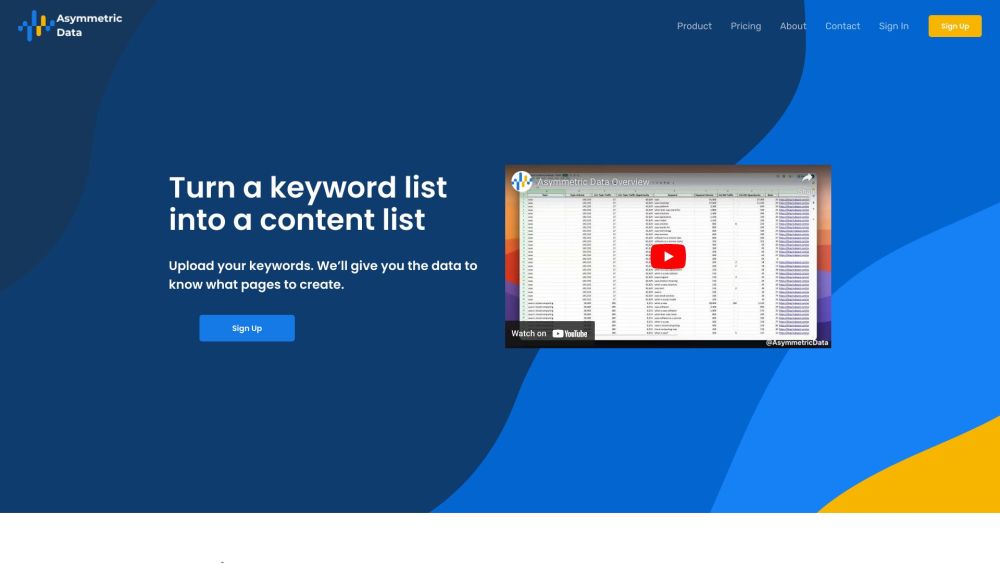
The data driven way to optimize your content marketing strategy. Asymmetric Data is a keyword clustering tool that will group your keywords together when they mean the same thing. Input your keywords and get back a content list.
Explore a specific workflow
Explore organic search tools through the product profiles below. Research and analysis tools help locate, summarize or interpret information. Source retrieval, explanation and numerical analysis need different kinds of evidence.
Check supported documents, datasets and source access. Establish whether the product can inspect your actual material rather than answer from general knowledge.
Follow citations to the original source, recalculate important numbers and check the date and scope of the evidence. Distinguish an explanation from a verified result.
The data driven way to optimize your content marketing strategy. Asymmetric Data is a keyword clustering tool that will group your keywords together when they mean the same thing. Input your keywords and get back a content list.
FAQ
Practical answers to help you take the next step.
Research and analysis tools help locate, summarize or interpret information. Source retrieval, explanation and numerical analysis need different kinds of evidence.
Check supported documents, datasets and source access. Establish whether the product can inspect your actual material rather than answer from general knowledge.
Follow citations to the original source, recalculate important numbers and check the date and scope of the evidence. Distinguish an explanation from a verified result.
Choose a question with known sources and a checkable result. Compare citation accuracy, omissions and reproducibility rather than response length.
The data driven way to optimize your content marketing strategy. Asymmetric Data is a keyword clustering tool that will group your keywords together when they mean the same thing. Input your keywords and get back a content list.
Read about Asymmetric DataLook for usable citations, tables, downloadable data and reproducible steps. A clear answer should let another person inspect how the conclusion was reached.
Run the same small task in each shortlisted product. Compare the price per usable result, usage limits, regeneration costs and time spent correcting the output. Confirm current terms with the provider.
Check who can access uploaded material, how long it is retained and how deletion works. Use a non-confidential test file while evaluating a product.
No. The organic search label groups related applications, but each product description defines its actual scope. Compare the input and output for your specific task.
Open the product profile, follow its official website link and review its documentation or plan comparison. Directory descriptions and screenshots may predate product changes.