Table of contents
VibeKit: Open-Source SDK for Secure, Isolated, Privacy-First Sandboxes
VibeKit: Open-source SDK for secure, isolated coding agent execution—privacy-first, developer-friendly sandboxes. Build confidently.
Directory : AI Code Assistant, AI Code Generator, AI Developer Tools, Large Language Models LLMs, AI Agent, AI Copilot, AI API, AI Workflow
Introducing VibeKit: The Privacy-First SDK for AI Coding Agents
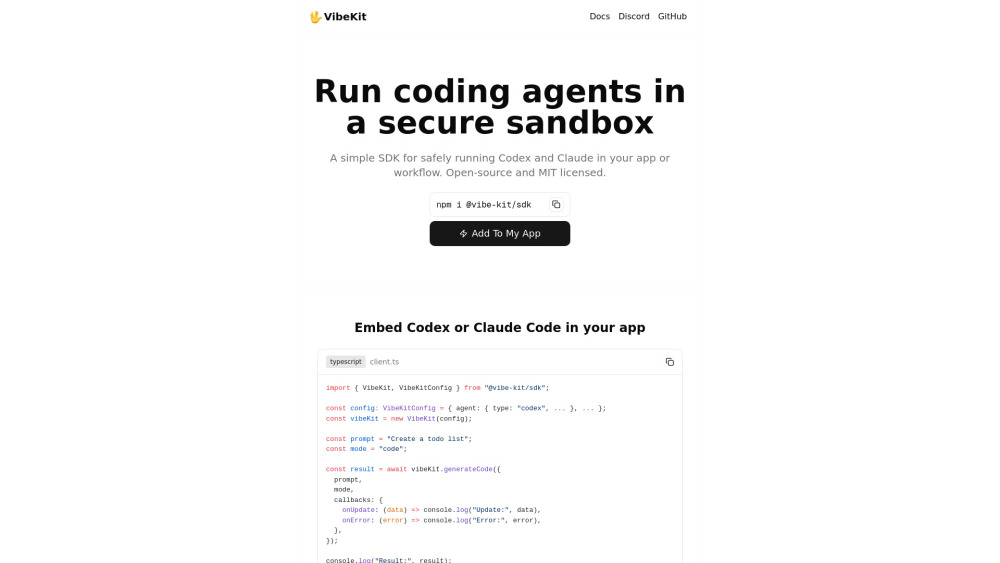
VibeKit is a modern, open-source SDK engineered from the ground up to execute AI coding agents—such as OpenAI Codex, Anthropic Claude, and emerging LLMs—in rigorously isolated, privacy-preserving sandboxes. Unlike generic execution layers, VibeKit enforces strict process-level isolation, network egress control, and ephemeral environment lifetimes by default. It empowers developers to safely delegate code generation, dependency installation, repository analysis, and even pull request authoring—all while maintaining full auditability, zero data persistence, and end-to-end telemetry. Built in TypeScript and licensed under MIT, VibeKit is provider-agnostic, extensible, and designed for production-grade trust.
Getting Started with VibeKit
Integrating VibeKit takes seconds: install via npm (`npm i @vibe-kit/sdk`), import `VibeKit`, configure your preferred sandbox backend and agent model (e.g., `'claude-sonnet'` or `'codex-pro'`), then instantiate. Use intuitive methods like `runTask()` or `askCodeQuestion()`—each accepting prompts, optional context (e.g., GitHub repo URLs or file trees), and real-time callbacks for streaming tokens, stdout/stderr, and structured error payloads. Built-in retry logic, timeout safeguards, and sandbox health monitoring ensure resilience without boilerplate.
Why Developers Choose VibeKit
Secure, Isolated Sandboxing by Default
Open-source MIT license — inspect, fork, extend, or self-host without restrictions
Real-time streaming of agent output, logs, and execution traces
On-demand environment customization: install packages, set env vars, mount read-only codebases
Dual-mode operation: generate executable code *or* answer technical questions about existing code
Native GitHub integration: clone repos, analyze diffs, propose changes, and auto-create PRs
Production-ready observability: built-in async task orchestration, structured telemetry, and sandbox lifecycle metrics
Sandbox-agnostic architecture: works today with E2B; plug-ins planned for Daytona, Modal, Fly.io, and custom runtimes
Real-World Applications
Internal Engineering Tools: Build secure CI/CD assistants, automated refactoring bots, onboarding playgrounds, and debugging copilots that never leak source or credentials.
Developer-Facing Products: Embed trusted AI coding capabilities into IDEs, low-code platforms, or SaaS tools—without exposing customer code to external inference endpoints.
Rapid Prototyping: Spin up disposable environments to test library integrations, benchmark algorithms, or explore architectural alternatives—no local setup required.
Compliance-Aware Automation: Automate GDPR-compliant code reviews, SOC2-aligned infrastructure scaffolding, or HIPAA-safe documentation generation—all within auditable boundaries.
Frequently Asked Questions
-
What makes VibeKit “privacy-first”?
-
Which sandbox providers are supported out of the box?
-
How does VibeKit ensure security and isolation?
-
Can I use VibeKit offline or in air-gapped environments?
-
VibeKit Company
VibeKit is developed and maintained by Superagent Technologies, Inc. — a team focused on responsible AI infrastructure for engineering teams.
-
VibeKit GitHub
Explore the source, contribute, or report issues at: https://github.com/superagent-ai/vibekit
FAQ from VibeKit
What makes VibeKit “privacy-first”?
VibeKit treats privacy as a foundational constraint—not an afterthought. All sandboxed executions occur in memory-isolated, network-restricted containers with no persistent storage, no telemetry exfiltration by default, and opt-in-only logging. Code, dependencies, and credentials never leave the sandbox boundary unless explicitly authorized via secure, auditable channels (e.g., signed GitHub webhooks).
Which sandbox providers are supported out of the box?
E2B is fully integrated and production-ready. Official adapters for Daytona and Modal are in active development and scheduled for Q4 2025. VibeKit’s pluggable runtime interface also allows teams to bring their own sandbox—whether Kubernetes-native, WebAssembly-based, or hardware-isolated—via a lightweight adapter SDK.
How does VibeKit ensure security and isolation?
VibeKit leverages OS-level primitives (namespaces, cgroups, seccomp-bpf) and sandbox-specific hardening (e.g., E2B’s unikernel isolation, Modal’s microVMs) to enforce strict process, filesystem, and network boundaries. Each agent session runs in a fresh, short-lived environment—destroyed immediately post-execution—with no shared state between invocations.
Can I use VibeKit offline or in air-gapped environments?
Yes. VibeKit’s core SDK is fully decoupled from cloud services. When paired with self-hosted sandbox runtimes (e.g., E2B Enterprise or Modal Self-Hosted), it enables fully offline, on-premises AI coding workflows—ideal for regulated industries and sovereign cloud deployments.