Table of contents
The AI Labor Index: Tracks Task Automation Potential
The AI Labor Index reveals which tasks AI can automate—helping businesses and workers adapt faster to the future of work.
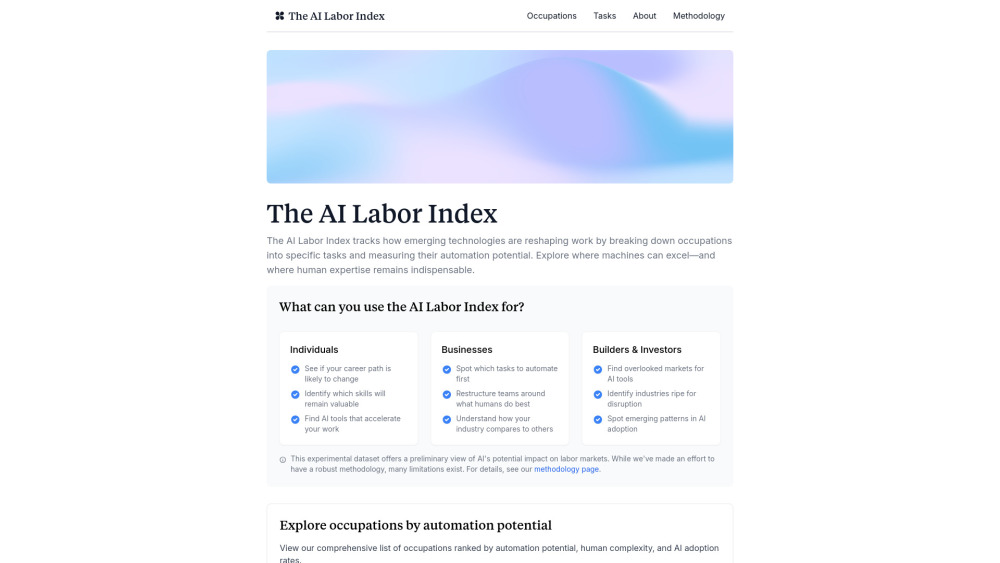
Introducing The AI Labor Index
The AI Labor Index is a forward-looking analytical framework that quantifies how AI and automation technologies are transforming the world of work—not by judging jobs as “at risk” or “safe,” but by evaluating the automation potential of the discrete tasks that constitute them. It translates occupational complexity into measurable dimensions: task-level AI readiness, human-cognitive demand, and real-world adoption velocity—offering a granular, evidence-based lens into labor market evolution.
Navigating the Index: A Practical Guide
The platform empowers users to interact with labor data dynamically: filter occupations by sector, compare automation susceptibility across roles, and visualize trade-offs between machine efficiency and irreplaceable human capabilities. Interactive dashboards display wage exposure estimates, task automation thresholds (e.g., “fully automatable,” “augmentable,” or “human-dependent”), and AI integration maturity scores. You can also benchmark your field against national trends—or discover emerging occupational clusters where human judgment, empathy, and contextual reasoning create durable competitive advantage.
Foundational Capabilities of The AI Labor Index
Granular task taxonomy: 16,038 validated tasks mapped across 66 high-impact occupations
Task-level automation scoring using multimodal AI feasibility models
Three-dimensional occupational ranking: automation readiness × human complexity × AI adoption pace
Labor economics layer: modeling wage distribution shifts tied to task displacement and augmentation
Automatability spectrum analysis—from routine cognitive tasks to embodied, adaptive, and socially embedded work
Interactive complexity-automation heatmaps revealing capability gaps and synergy opportunities
Longitudinal AI adoption tracking across industries, updated quarterly with real-world deployment signals
Who Benefits—and How
Professionals gain foresight: identify skill adjacencies, anticipate role evolution, and prioritize learning investments aligned with enduring human value.
Enterprises leverage strategic intelligence: align automation roadmaps with workforce capabilities, optimize reskilling pipelines, and redesign workflows for human-AI collaboration.
Innovators and investors uncover asymmetric opportunities: spot under-served labor segments, assess startup viability in AI-augmented services, and anticipate regulatory or ethical inflection points.
Frequently Asked Questions
-
What makes The AI Labor Index different from traditional job-risk assessments?
-
How comprehensive is the underlying task dataset?
-
What share of tasks are classified as highly automatable today?
-
How does this index inform workforce resilience planning?
-
What are the methodological boundaries of this analysis?
-
About The AI Labor Index
The AI Labor Index is an independent research initiative dedicated to mapping the evolving frontier between human labor and artificial intelligence. Its mission is to replace speculation with structured insight—enabling better decisions for workers, organizations, and policymakers navigating rapid technological change.
Learn more about our methodology, team, and vision at the about us page (https://www.ailaborindex.com/about).
-
Follow the Conversation
Stay updated with latest findings, updates, and commentary from the research team on X (Twitter): https://x.com/samaysham
FAQ from The AI Labor Index
What makes The AI Labor Index different from traditional job-risk assessments?
Unlike broad occupational risk ratings, it operates at the task level—recognizing that even “low-risk” jobs contain automatable components, while “high-risk” roles often rely on non-automatable human capabilities. This precision reveals pathways for augmentation, not just replacement.
How comprehensive is the underlying task dataset?
The index draws from the U.S. Department of Labor’s O*NET database, rigorously curating and validating 16,038 distinct tasks across 66 occupations representing ~68% of U.S. nonfarm employment—prioritizing roles with high economic impact and AI relevance.
What share of tasks are classified as highly automatable today?
Based on current AI capabilities (LLMs, RPA, computer vision, and robotic process orchestration), 45% of analyzed tasks meet criteria for full automation—though real-world deployment lags due to integration cost, regulatory constraints, and trust barriers.
How does this index inform workforce resilience planning?
It identifies “complexity anchors”—tasks requiring synthesis, moral reasoning, or dynamic interpersonal adaptation—that define future-proof roles. Organizations use these insights to design upskilling programs focused on strengthening those anchors, rather than merely defending legacy functions.
What are the methodological boundaries of this analysis?
This is an evolving, experimental model—not a predictive oracle. It synthesizes technical feasibility, economic viability, and sociotechnical adoption signals—but cannot account for unforeseen breakthroughs, policy shifts, or cultural resistance. All findings are presented with transparent uncertainty ranges and versioned methodology documentation.
future of workBusiness strategyskills developmentinvestment opportunitiesWorkforce transformationAI automation impactjob automation riskAI labor market analysistask automation potentialAI job displacementoccupation automation scoresAI economic impactlabor market disruptionAI task analysisautomation readinessjob transformationAI workforce trendstask complexity measurementlabor market insightscareer planninghuman-AI collaboration