Table of contents
Morph : Rapid LLM Code Edits – Precision, Speed, Autonomy
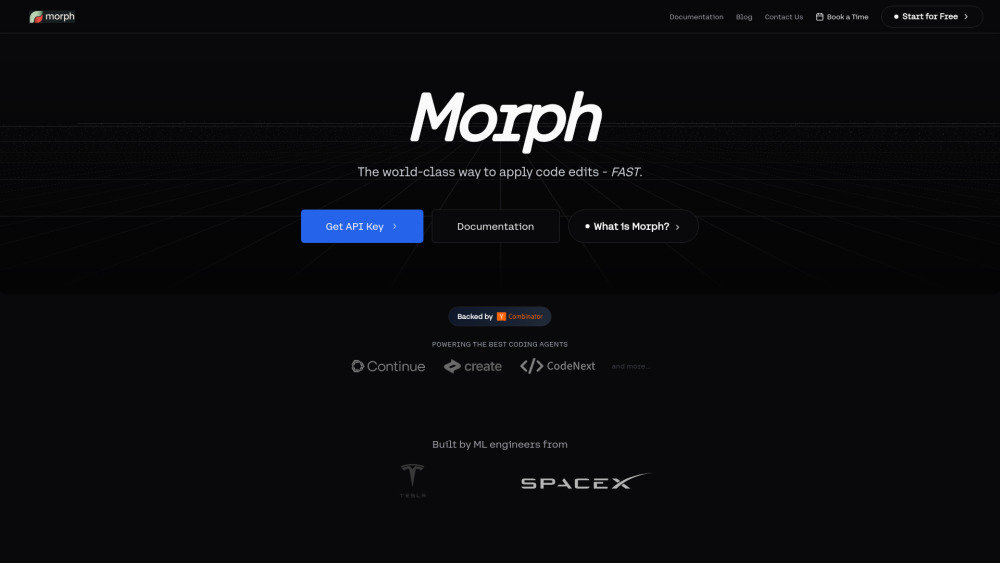
Morph: The AI agent’s lightning-fast “Write” layer—applies LLM-powered code edits to files in seconds. Precision. Speed. Autonomy.
Directory : AI Rewriter, AI Code Assistant, AI Code Generator, AI Developer Tools, AI Productivity Tools, Large Language Models LLMs, AI Agent, AI Copilot, AI Code Review, AI API, AI Workflow
Introducing Morph: Where LLM Code Edits Meet Production-Grade Precision
Morph redefines how AI-generated code transitions from suggestion to execution. It’s not another language model—it’s a purpose-built *code synthesis engine* that ingests LLM output (from GPT-4o, Claude 3.5, or custom fine-tuned models) and transforms it into syntactically sound, semantically consistent, and contextually grounded edits—delivered at up to 2,200 tokens per second. Acting as the intelligent “write” interface for autonomous coding agents, Morph bridges the gap between generative intent and executable reality. Trained exclusively on real-world GitHub commits, PR diffs, and refactor histories, its architecture includes proprietary code-aware embeddings, contextual rerankers, and speculative decoding pipelines—all optimized for fidelity, speed, and developer trust.
Getting Started with Morph
Integration is streamlined: send your source file + an LLM-generated edit instruction (e.g., “add error handling to `fetchUser()`” or “convert this function to async/await”) via Morph’s REST API or SDK. Morph validates, aligns, and applies the change—preserving formatting, comments, and surrounding logic—without requiring manual diff review. Developers receive an API key instantly upon signup, enabling immediate use in CI/CD pipelines, IDE extensions, or agent orchestration layers.
Why Morph Stands Apart
Blazing-Fast Apply Engine: Processes edits at 2,000–2,200+ tokens/sec—up to 10× faster than native LLM inference for code patching.
Code-Native Embeddings: Fine-tuned on 42M+ commit diffs to understand semantic intent—not just syntax—so “rename variable for clarity” lands correctly every time.
Contextual Reranker: Prioritizes edits that preserve type contracts, test coverage, and call-site compatibility—especially critical for large monorepos.
Speculative Edit Execution: Leverages predictive token caching and parallel validation to reduce latency while guaranteeing correctness.
Zero-Trust Deployment: Fully containerized, self-hostable in your VPC, air-gapped environment, or private Kubernetes cluster—with no outbound telemetry or data egress.
Real-World Applications
Automated technical debt reduction—applying consistent fixes across thousands of files in minutes.
AI pair programming assistants that *edit*, not just suggest—integrated directly into VS Code, JetBrains, or GitHub Copilot extensions.
Autonomous agent workflows: From bug triage → root-cause analysis → targeted patch generation → safe merge-ready PR creation.
Intelligent codebase search & retrieval: Powering LLM prompts with precise, version-aware snippets—not broad file dumps.
Type-safe refactoring at scale: Enforcing TypeScript interfaces, Rust lifetimes, or Python typing contracts during AI-driven transformations.
Frequently Asked Questions
-
What problem does Morph solve?
-
Does Morph support on-prem or air-gapped deployment?
-
Is Morph limited to source code—or can it handle configs, schemas, or documentation?
-
Why not rely solely on stronger LLMs like GPT-4o or Claude Sonnet?
-
How do you measure Morph’s accuracy and reliability?
-
Can Morph be used in regulated environments (e.g., finance, healthcare)?
-
Support & Contact
Reach our engineering-led support team at [email protected]. For urgent issues, SLA-backed enterprise support, or compliance inquiries, visit https://morphllm.com/contact.
-
About Morph
Morph is developed by Morph Labs—a team of compiler engineers, ML researchers, and open-source maintainers focused on making AI-assisted software development fast, reliable, and developer-first.
-
Access Your Dashboard
Log in to manage keys, monitor usage, and configure deployments: https://morphllm.com/dashboard
FAQ from Morph
What is Morph?
Morph is a high-performance, code-specialized inference engine that converts natural-language LLM instructions into validated, production-ready code edits—executed with surgical precision and unmatched velocity. It’s the missing “apply” layer in today’s AI coding stack.
How to use Morph?
Call Morph’s API with three inputs: (1) original source code, (2) an LLM-generated edit directive (plain text or structured JSON), and (3) optional context (e.g., AST metadata or test results). Morph returns a clean, line-accurate diff—and optionally applies it directly to your filesystem or Git repo.
What problem does Morph solve?
LLMs excel at *generating* code—but struggle with *precise, localized, context-aware edits*. Morph eliminates manual verification, merge conflicts, and silent regressions—turning hours of developer review into milliseconds of deterministic application.
Does Morph support on-prem or air-gapped deployment?
Yes. Morph ships as a lightweight, stateless Docker image with full offline capability—including embedded embeddings and reranking models. No external dependencies, no cloud calls, no data leakage.
Is Morph limited to source code—or can it handle configs, schemas, or documentation?
Morph is architected for *structured, parseable artifacts*: source code (Python, TS, Rust, Go, etc.), configuration (YAML, TOML, JSON), infrastructure-as-code (Terraform HCL), and OpenAPI/Swagger specs. Unstructured prose (e.g., READMEs) is supported only when edits are scoped, deterministic, and format-preserving.
Why not rely solely on stronger LLMs like GPT-4o or Claude Sonnet?
General-purpose LLMs weren’t trained to *apply edits*—they’re trained to *generate sequences*. Morph replaces brittle regex-based patching and slow LLM re-inference with a dedicated, low-latency, high-fidelity transformation engine—delivering 10× cost efficiency and 5× higher edit success rates in benchmarked repos.
How do you measure Morph’s accuracy and reliability?
We evaluate against real-world GitHub PRs using semantic correctness (AST equivalence), build success rate (>99.2% on TypeScript/Python), and behavioral fidelity (test pass-through retention ≥98.7%). All metrics are publicly auditable via our open benchmarks repo.
Can Morph be used in regulated environments (e.g., finance, healthcare)?
Absolutely. Morph meets SOC 2 Type II, ISO 27001, and HIPAA-compliant deployment requirements. With zero data persistence, full audit logging, and FIPS 140-2 validated crypto, it’s built for mission-critical infrastructure.