Table of contents
LLM Gateway: Route, Manage & Analyze LLM Requests
LLM Gateway: One API to route, manage & analyze all your LLM requests—simplify orchestration, boost observability, and cut latency.
Directory : AI Developer Tools, Large Language Models LLMs, AI Models, AI API, Open Source AI Models
Introducing LLM Gateway: Your Intelligent Hub for LLM Operations
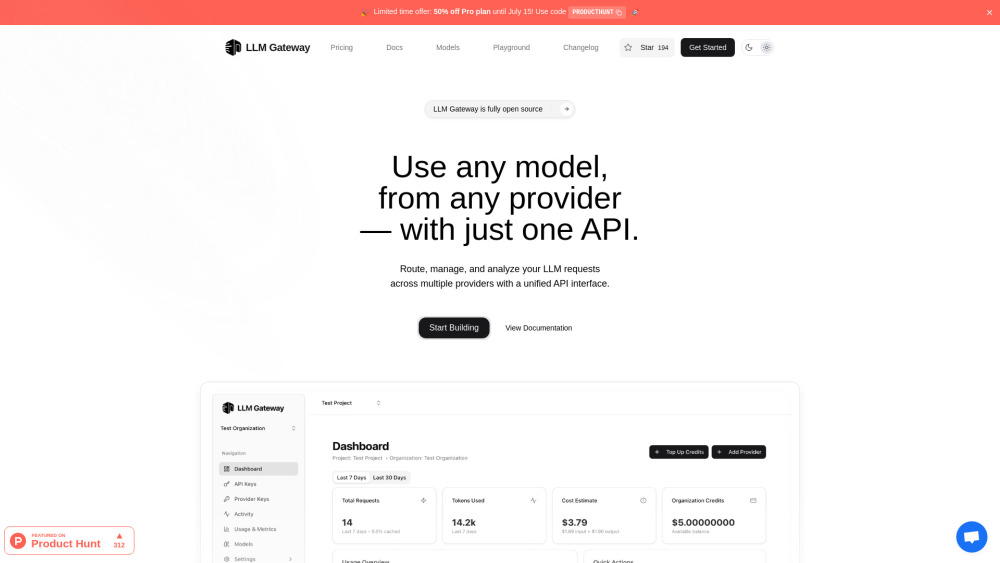
LLM Gateway is a developer-first orchestration layer designed to unify, optimize, and introspect AI inference traffic. It acts as a smart proxy—routing prompts intelligently across dozens of LLM providers (OpenAI, Anthropic, Google, Groq, Ollama, and more), enforcing policies, capturing granular telemetry, and abstracting complexity—all through a single, OpenAI-compatible API endpoint.
Getting Started in Seconds
Integration takes under a minute: swap your current OpenAI base URL (`https://api.openai.com/v1`) with `https://api.llmgateway.io/v1`, inject your LLM Gateway API key, and keep your existing SDKs and logic untouched. Whether you're building with Python’s `openai` client, Next.js App Router, Rust’s reqwest, or Java Spring Boot—the transition is invisible. Behind the scenes, LLM Gateway handles provider selection, fallback strategies, token accounting, and real-time observability.
Built for Scale, Security & Insight
OpenAI-API-Native Interface
Multi-Provider Load Balancing & Fallback
Per-Request Analytics Dashboard (latency, tokens in/out, cost attribution, model choice)
Real-Time Performance Heatmaps & Anomaly Detection
Fine-Grained API Key Permissions & Scoped Access Tokens
Zero-Trust Self-Hosting (Docker/Kubernetes) or Managed Cloud
Intelligent Model Routing Engine (based on latency SLA, cost thresholds, or quality signals)
Drop-in SDK Support Across 10+ Languages & Frameworks
Where Teams Deploy LLM Gateway
Consolidating fragmented LLM vendor integrations into one auditable, governable pipeline.
Enabling FinOps for AI—tracking spend by team, project, model, or prompt category in real time.
Future-proofing applications against vendor lock-in or API breaking changes.
Running private, air-gapped LLM gateways for compliance-sensitive workloads (HIPAA, SOC2, GDPR).
A/B testing models side-by-side—measuring accuracy, speed, and cost per task—not just per token.
Frequently Asked Questions
-
How does LLM Gateway compare to OpenRouter?
-
Support & Contact
Reach our engineering-led support team at [email protected]. For urgent issues, enterprise SLAs, or refund inquiries, visit our Contact page.
-
About the Project
LLM Gateway is developed and maintained by The Open Co., a public-benefit open-source collective focused on infrastructure transparency and AI interoperability.
-
Log In to Your Dashboard
Access your analytics, keys, and routing rules: https://llmgateway.io/login
-
Start Free — No Credit Card Required
Sign up instantly and begin routing requests: https://llmgateway.io/signup
-
Follow Our Development
Join the conversation on X (Twitter): https://x.com/llmgateway
-
Contribute & Audit the Code
Explore, fork, and audit the full MIT-licensed codebase: https://github.com/theopenco/llmgateway
FAQ from LLM Gateway
What is LLM Gateway?
LLM Gateway is an open, extensible control plane for generative AI infrastructure—empowering teams to route, govern, monitor, and optimize LLM traffic across heterogeneous backends without rewriting application logic.
How do I integrate it?
Point your existing OpenAI-compatible client to `https://api.llmgateway.io/v1`, authenticate with your LLM Gateway API key, and let the gateway handle provider dispatch, retry logic, logging, and cost attribution—transparently and at scale.
What sets LLM Gateway apart from OpenRouter?
LLM Gateway prioritizes operational autonomy: fully self-hostable, MIT-licensed, with no enforced vendor markup—even on paid tiers. Its analytics go deeper (per-prompt cost allocation, response-time percentiles, model-level drift detection), and its routing engine supports custom policies (e.g., “route coding queries to Claude-3.5-sonnet unless latency > 800ms, then fallback to Groq”).