Table of contents
Line0: AI Pair Programmer for Express.js API Development
Line0: Your AI pair programmer—build Express.js APIs faster, smarter, and with fewer bugs. Backend dev, reimagined.
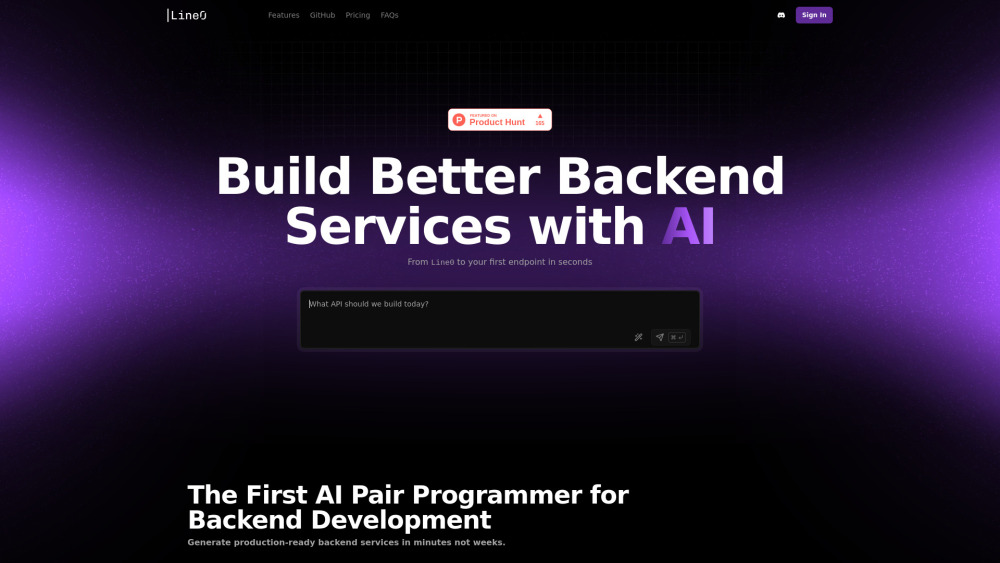
Introducing Line0: Your AI Pair Programmer for Express.js API Development
Line0 is a purpose-built AI coding companion engineered exclusively for backend engineers and full-stack developers building RESTful APIs with Express.js. Unlike general-purpose AI assistants, Line0 understands the nuances of Node.js runtime behavior, middleware patterns, routing conventions, error handling, and security hygiene—so every generated service is not just functional, but production-intentional. From defining routes and integrating databases to adding authentication layers and auto-generating OpenAPI documentation, Line0 translates plain-English requirements into clean, maintainable, and well-structured Express code—in minutes. It features an embedded browser-based IDE, intelligent prompt expansion, GitHub-native bidirectional sync, and contextual chat threads scoped per API endpoint or feature—ensuring clarity, continuity, and control throughout development.
Getting Started with Line0
Begin by signing in and connecting your GitHub account—then describe your API need in everyday language: “Create a /users endpoint that supports GET (all users) and POST (create user) with email validation and password hashing.” Line0 interprets intent, infers dependencies, scaffolds the Express app structure, writes modular route handlers and controllers, configures environment-aware settings, and even suggests test cases. Press Tab to refine your prompt on-the-fly or click Enhance to add constraints like “use PostgreSQL,” “include rate limiting,” or “follow OWASP Top 10 guidelines.” All code lives in your GitHub repo from day one—and future updates will let you invoke the integrated API client to send live requests, view real-time database state, and witness hot-reloaded changes without leaving the browser.
Why Developers Choose Line0
Specialized AI for Express.js Backend Workflows
Zero-config API Generation — From Spec to Server in Seconds
Natural Language → Production-Ready Code (No YAML, No DSL)
Smart Prompt Expansion: Tab-to-Suggest, Enhance-to-Refine
Feature-Centric Chat Threads — One Conversation Per Endpoint
Built-in Compliance: Folder Structure, Input Sanitization, CORS, Helmet, Logging
Two-Way GitHub Sync — Push, Pull, Fork, Import, and Version Natively
Embedded API Client (Beta Launch Q4 2025)
Live Database Inspector & Schema Preview (Coming Soon)
Who Benefits Most from Line0?
Backend Teams Accelerating MVP Delivery Without Sacrificing Quality
Solo Developers Building Scalable APIs Without Boilerplate Overhead
Startups Requiring Fast Iteration Across Multiple Microservices
Engineering Managers Standardizing API Patterns Across Teams
Students & Bootcamp Learners Practicing Real-World Express.js Best Practices
Frequently Asked Questions
-
Why build an AI tool only for Express.js?
-
Will Line0 support NestJS, Fastify, or Python backends soon?
-
Does Line0 replace frontend or mobile development tools?
-
What’s included in the Free plan?
-
Who owns the generated source code?
-
Does Line0 handle cloud deployment or CI/CD integration?
-
About Line0
Line0 is developed by Vratix, a team of backend-first engineers and AI researchers committed to elevating developer velocity—not by abstracting complexity, but by mastering it. Every line of AI logic is trained and validated against real-world Express.js architecture patterns, security audits, and performance benchmarks.
-
Access Line0
Start building: https://www.line0.dev/auth
-
Explore Integration Options
GitHub integration guide & open-source tooling: https://www.line0.dev/#github
FAQ from Line0
What is Line0?
Line0 is a focused AI pair programmer built for Express.js backend development—designed to generate secure, scalable, and standards-compliant API services directly from natural language prompts. It combines deep framework knowledge with real-time collaboration features like GitHub sync, per-feature chat context, and prompt intelligence—all delivered through an intuitive in-browser interface.
How do I start building with Line0?
After authenticating and linking GitHub, simply type what your API should do—e.g., “Add JWT-authenticated /products CRUD endpoints backed by MongoDB.” Line0 scaffolds the project, writes idiomatic Express code, adds validation and error responses, generates Swagger-compatible docs, and commits everything to your repo. Use Tab to dynamically extend your request or Enhance to inject technical guardrails.
Why focus on backend APIs?
Because backend logic is where scalability, security, and correctness are decided—not deferred. Line0 eliminates weeks of repetitive setup, boilerplate, and configuration drift so teams can invest engineering time in business logic, not infrastructure glue.
Is it available for other frameworks and backend languages?
Express.js is our foundation—and our current priority—but official support for Fastify, NestJS, and Python-based backends (Flask/FastAPI) is actively in development and scheduled for phased rollout starting late 2025.
Can I build websites or mobile apps with Line0?
No. Line0 does not generate frontend UIs, React components, or native mobile code. However, its output is fully compatible with any frontend stack—you get clean, documented, CORS-enabled REST APIs ready for consumption by Next.js, Flutter, Swift, or any client.
Is it free?
Yes. The Free plan includes up to 50 AI messages per day, 10 public GitHub repos, access to core Express.js generation, community support, and early access to beta features—including the upcoming API client and DB preview tools.
Do I own the code?
Absolutely. All generated code belongs to you—Line0 never claims ownership, licensing rights, or usage restrictions. With two-way GitHub sync, your repository remains the single source of truth, and all artifacts reside under your control at every stage.
Can Line0 deploy my API services?
Not yet—but it prepares your code for deployment. Line0 outputs production-ready Express apps structured for seamless hosting on Vercel Edge Functions, Render, Railway, or traditional Node.js servers. Deployment automation integrations are planned for 2026.