Table of contents
Capacity: AI Platform for Full-Stack Apps via Natural Language
Build full-stack web apps instantly—no code needed. Just describe your idea in plain English. Capacity: AI-powered, end-to-end app creation.
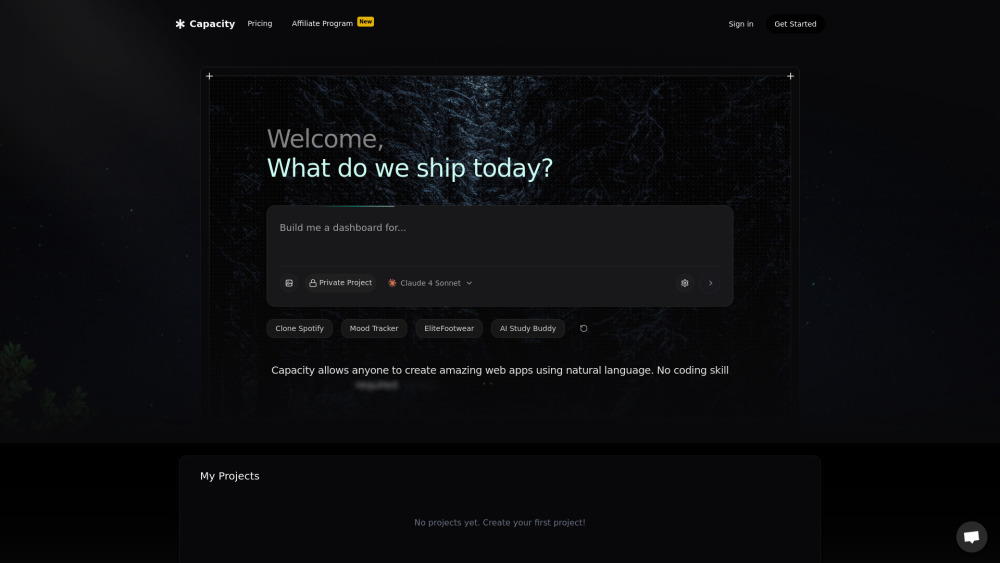
Introducing Capacity: The Natural Language Engine for Full-Stack Development
Capacity redefines software creation—not as a technical gatekeeping exercise, but as an intuitive act of expression. It’s an AI-native platform that turns plain-language prompts into production-ready, full-stack web applications in moments. Whether you're a non-technical founder, a product manager validating an idea, or a developer accelerating delivery, Capacity delivers real code, responsive UIs, secure backend logic, and deployable infrastructure—no syntax required.
How It Works: From Sentence to Server
Describe what you want—“A habit-tracking app with streak analytics, email reminders, and dark mode”—and Capacity interprets intent, infers architecture, generates clean TypeScript, configures database schemas, wires APIs, builds accessible UIs with Tailwind, and deploys a live, scalable application. Every layer—from frontend interactivity to authentication flows—is co-authored by AI and grounded in engineering best practices.
Why Developers and Builders Choose Capacity
True full-stack generation—not just mockups or static pages
Natural language as the primary interface (English, Spanish, and French supported)
Up to 20× faster iteration than manual coding—MVPs ship in minutes, not weeks
Eliminates 90% of upfront dev cost—ideal for bootstrapped teams and early-stage ventures
Output is production-grade: typed, tested, modular, and security-aware (CSP, authZ, input sanitization)
Full ownership and extensibility—you own the repo, edit locally, or push to your CI/CD pipeline
Real-time collaboration: shared editing, versioned prompts, role-based permissions, and PR-ready diffs
Built on battle-tested modern stack: Next.js App Router, TypeScript, tRPC, PostgreSQL, and Vercel Edge Functions
Real-World Applications
End-to-end SaaS products (e.g., customer feedback portal, cohort-based course dashboard)
High-conversion landing pages with embedded analytics and lead capture
Internal ops tools—inventory trackers, approval workflows, HR onboarding portals
Investor-ready MVPs with real data models, user accounts, and API integrations
Rapid concept validation—test demand before writing a single line of custom code
Side-project acceleration—turn weekend ideas into hosted, monetizable apps
Application replication with adaptation—e.g., “Build a Notion-like workspace—but focused on academic research”
Domain-specific utilities—like a GDPR-compliant consent manager or a clinical trial screening tool
Frequently Asked Questions
-
What kinds of applications can Capacity build?
-
Do I need prior programming knowledge?
-
Can I download, modify, and host the generated code myself?
-
Does Capacity support team workflows and handoffs?
-
How does Capacity compare to low-code platforms or frontend-only AI builders?
-
Is there a no-risk way to try Capacity?
-
Which frameworks and infrastructure does Capacity generate for?
FAQ from Capacity
What is Capacity?
Capacity is a generative development platform where natural language serves as the source of truth for building complete, deployable full-stack applications. It merges AI reasoning with software engineering rigor—so every generated app is not just functional, but maintainable, scalable, and ready for real users.
How to use Capacity?
Start by typing a goal-oriented prompt—like “An AI-powered study planner for medical students that syncs with Google Calendar and generates flashcards from lecture notes.” Capacity parses requirements, selects optimal patterns, writes idiomatic code, provisions cloud resources, and delivers a live URL—all within a single session.
What can I build with Capacity?
Anything from simple CRUD tools to complex multi-user applications: dashboards with real-time charts, authenticated admin panels, e-commerce microsites with Stripe integration, internal knowledge bases with search, and even regulated-domain solutions—with configurable compliance guardrails baked in.
Do I need to know how to code?
No. But if you do, Capacity becomes a force multiplier: generate scaffolding in seconds, then refine logic, optimize queries, or integrate proprietary services. It speaks both human and developer fluently.
Is the code exportable?
Yes—fully. You receive a private GitHub repository with clean, well-documented, MIT-licensed code. No lock-in. No obfuscation. Just standard, framework-native files you can extend, audit, test, or deploy anywhere.
Can I collaborate with others?
Yes. Invite teammates to co-edit prompts, review generated architecture diagrams, comment on UI components, approve deployments, and manage environment variables—all synced in real time. Designed for hybrid teams: product + design + engineering.
How is Capacity different from other AI tools?
Most AI coding tools assist *within* the development loop. Capacity replaces the loop entirely—generating working, secure, documented, and observable full-stack systems—not fragments. It reasons across layers, enforces consistency, and evolves with your needs through iterative prompting.
Is there a free trial?
Yes. Sign up for a free tier with unlimited prompt exploration, three deployed apps, and full code export—no credit card, no time limit. Experience end-to-end flow before upgrading to Pro or Team plans.
What tech stack does Capacity use?
Capacity outputs modern, standards-compliant stacks: Next.js 14+ (App Router), TypeScript 5+, Tailwind CSS with JIT compilation, tRPC for type-safe APIs, Prisma ORM, PostgreSQL or Neon, and optional Vercel or Cloudflare deployment configurations—including edge middleware and ISR caching strategies.