Table of contents
BAGEL : Unified Multimodal AI for Understanding, Generation, Editing
BAGEL: Open-source multimodal AI for seamless understanding, generation & editing—unified, transparent, and built for everyone.
Directory : Text to Image, AI Video Generator, AI Chatbot, AI Models, AI Image Generator, AI Research Tool, AI Photo Editor, Open Source AI Models, AI Style Transfer, AI Describe Image
Introducing BAGEL: The Unified Multimodal AI Engine
BAGEL—developed by ByteDance-Seed—is a breakthrough open-source multimodal foundation model licensed under Apache 2.0. Unlike modular or pipeline-based approaches, BAGEL unifies understanding, generation, editing, and spatial reasoning into a single, cohesive architecture. Trained from the ground up for native multimodality, it delivers GPT-4o–level fluency and Gemini 2.0–grade visual fidelity—while remaining fully customizable, lightweight enough for edge deployment, and rigorously open for research, fine-tuning, and commercial integration.
Interacting with BAGEL
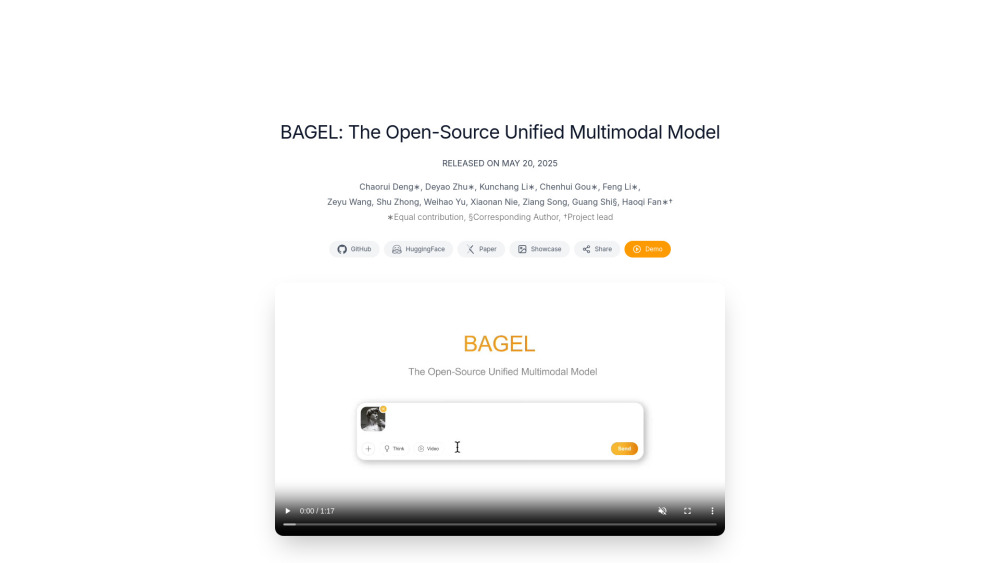
BAGEL operates through a seamless, context-aware interface where images and text coexist fluidly—no preprocessing, no format switching. Whether you're describing a complex scene, generating cinematic video keyframes, editing a portrait while preserving micro-expressions, navigating a 3D simulation, or iteratively refining creative concepts via chain-of-thought prompting, BAGEL responds in real time with compositional awareness and cross-modal consistency.
Architectural & Functional Pillars
True Unified Multimodality (No Modality Silos)
Bidirectional Image–Text Comprehension (with grounding and attribution)
High-Fidelity Generation (photorealistic images, temporal video frames, structured captions)
Semantic-Preserving Editing (object-level manipulation without artifacting or identity drift)
Adaptive Style Transfer (context-aware, resolution-invariant, style-consistent)
Embodied Navigation (spatial reasoning across photorealistic, synthetic, and abstract environments)
Compositional Interaction (multi-step task decomposition and memory-aware dialogue)
Thinking Mode (internal self-reflection loops for prompt optimization, error correction, and output calibration)
LLM-Informed Pretraining (leveraging linguistic structure to bootstrap vision-language alignment)
Mixture-of-Transformer-Experts (MoT) — dynamic routing for efficiency, scalability, and modality-specific specialization)
Real-World Applications
Visual QA & Accessibility (e.g., “Explain the layout, people, and emotional tone in this photo”)
Prompt-Guided Creation (e.g., “A hyper-detailed studio shot of a steampunk owl perched on a brass astrolabe, golden hour lighting”)
Precision Image Revision (e.g., “Replace the background with a Tokyo night street—but keep the subject’s pose, lighting, and clothing textures intact”)
Cross-Domain Stylization (e.g., “Render this architectural sketch as a watercolor painting with visible paper grain and pigment bleed”)
Interactive Simulation Control (e.g., “In the VR museum tour, turn left at the Renaissance wing, then zoom into the brushwork of the central fresco”)
Creative Co-Engineering (e.g., “Draft three brand-aligned slogans for an eco-friendly toy line, then critique and refine the strongest one using design principles”)
Iterative Prompt Synthesis (e.g., activate Thinking Mode to expand ‘a cozy cabin’ into a production-ready prompt with material specs, lighting conditions, and seasonal context)
Frequently Asked Questions
-
What is BAGEL?
-
What makes BAGEL uniquely unified?
-
How does BAGEL handle complex, multi-step tasks?
-
Is BAGEL available for commercial use?
-
BAGEL Company
BAGEL is developed by ByteDance-Seed, the advanced AI research division of ByteDance.
-
BAGEL GitHub Repository
Explore, contribute, and deploy: https://github.com/bytedance-seed/BAGEL
FAQ from BAGEL
What is BAGEL?
BAGEL is a natively multimodal, open-weight AI system that eliminates modality boundaries—processing, reasoning across, and generating image-text sequences as a single coherent stream. Built for transparency and extensibility, it sets a new standard for open multimodal intelligence.
What makes BAGEL uniquely unified?
Unlike models that stitch together separate vision and language modules, BAGEL uses a shared token space, joint attention mechanisms, and MoT-based expert specialization—enabling true cross-modal grounding, zero-shot transfer, and consistent latent representations across all tasks.
How does BAGEL handle complex, multi-step tasks?
Through its dual-path interaction framework: Compositional Mode chains discrete actions with memory retention, while Thinking Mode runs internal reasoning traces—evaluating alternatives, validating constraints, and optimizing outputs before final delivery.
Is BAGEL available for commercial use?
Yes. Released under the permissive Apache 2.0 license, BAGEL permits unrestricted use—including in proprietary products—provided copyright notices and disclaimers are retained. No usage fees, no vendor lock-in.
When was BAGEL released?
BAGEL launched publicly on May 20, 2025—marking the first open multimodal model to match top-tier closed systems in both benchmark performance and real-world versatility.