Table of contents
API Hub: Unified API & MCP Platform for Traditional and AI Apps
API Hub: Unified platform for APIs & MCP servers—powering both traditional systems and cutting-edge AI applications. Streamline integration, scale effortlessly.
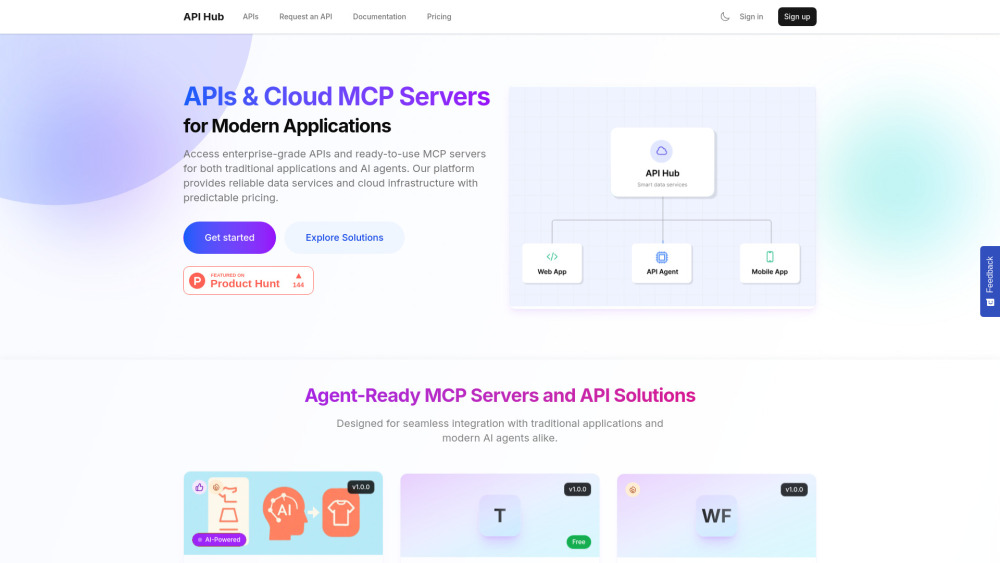
Introducing API Hub: Where APIs and AI Agents Converge
API Hub is the first unified platform engineered to bridge the gap between legacy application infrastructure and next-generation AI systems. It delivers enterprise-grade APIs *and* production-ready Model Context Protocol (MCP) servers — in one cohesive environment — empowering both traditional software developers and AI agent builders. Built on scalable cloud infrastructure, it guarantees consistent performance, transparent pricing, and seamless interoperability across human-led development and autonomous AI workflows.
Getting Started with API Hub
Whether you're consuming or creating, API Hub simplifies the full lifecycle. Developers and AI agents can instantly discover, test, and integrate pre-vetted APIs and MCP endpoints — no custom glue code required. Publishers can onboard existing REST, GraphQL, or gRPC services in minutes, transforming them into standardized, context-aware MCP servers via intuitive configuration. All deployments run on our managed infrastructure, with built-in billing, authentication, observability, and global distribution.
Why API Hub Stands Apart
Single Platform for Dual Workloads
Native Model Context Protocol (MCP) Support — Designed for AI Agent Interoperability
Unified Marketplace: Discover, Compare, and Subscribe to APIs — Human- and AI-Readable
One-Click MCP Enablement: Convert Your Existing APIs Without Rewrites
Interactive AI Playground: Test APIs Live with LLMs, RAG pipelines, and autonomous agents
Dual-Mode Documentation: Rich OpenAPI specs for developers + structured MCP manifests for AI agents
Global Cloud Infrastructure: Low-latency routing, automatic scaling, and SLA-backed uptime
Flexible Monetization: Free tiers, usage-based, subscription, and hybrid models — all self-service
Smart Credit Wallet: Auto-replenishing balance with real-time usage tracking and spend alerts
Revenue-First Publishing: Keep 70% of earnings — we handle invoicing, fraud prevention, and payouts
Real-World Applications
SaaS teams embedding AI-powered features using pre-built MCP-compliant APIs
Autonomous AI agents dynamically discovering and invoking APIs to fulfill complex user intents
Retail platforms leveraging Product Intelligence APIs for real-time catalog enrichment
Financial apps standardizing time-series calculations and timezone-aware scheduling
LLMs and agentic systems retrieving, parsing, and reasoning over live web content via Web Fetch MCP
API-first startups launching, scaling, and monetizing their services without building billing or infra
Engineering orgs enforcing governance, auditing, and shared API key policies across teams
Enterprises deploying private API hubs with SSO, SOC2 compliance, and dedicated SLAs
Frequently Asked Questions
-
How are API costs calculated and billed?
-
How does the credit wallet system function?
-
Can I publish my own APIs at no cost?
-
What capabilities do Team and Enterprise plans unlock?
-
Which pricing models can I apply as an API publisher?
-
Are volume discounts available for heavy API consumers?
-
Support & Contact
For technical assistance, billing inquiries, or refund requests, visit our dedicated support portal.
-
About API Hub
API Hub is developed and operated by TYY Technologies, a company focused on accelerating responsible AI adoption through open, interoperable infrastructure.
-
Log In to Your Account
Access your dashboard, manage APIs, and monitor usage: https://api-hub.org/auth/login
-
Create Your Free Account
Start building in seconds — no credit card required: https://api-hub.org/auth/register
-
Follow Us on LinkedIn
Stay updated on product launches, MCP standards, and AI integration best practices: https://www.linkedin.com/company/api-hub
-
Join the Conversation on X (Twitter)
Real-time updates, API tips, and community highlights: https://x.com/use_api_hub
-
Explore Our Open Source Tools
MCP SDKs, CLI tools, and integrations: https://github.com/use-api-hub
FAQ from API Hub
What is API Hub?
API Hub is a unified infrastructure layer that harmonizes traditional API consumption with AI-native interaction through the Model Context Protocol (MCP). It provides a single point of access for discovering, testing, publishing, and governing APIs — whether powering monolithic applications, microservices, or autonomous AI agents — all backed by resilient cloud infrastructure and predictable economics.
How to use API Hub?
Consumers browse the marketplace, authenticate, and call APIs or MCP endpoints directly — many with zero-config integration for popular frameworks and LLM orchestration tools. Publishers register their service, define its MCP interface (or auto-generate it), configure rate limits and pricing, and deploy. No infrastructure management, no billing stack, no documentation overhead — just instant distribution and monetization.
How are API costs calculated and billed?
Each API defines its own model: free-tier access, per-request fees, tiered monthly quotas, or dynamic consumption-based billing (e.g., tokens for LLM APIs). All pricing is displayed upfront on the API detail page, with real-time usage dashboards and granular invoice breakdowns.
How does the credit wallet system function?
Credits are your universal currency across the platform. Purchase them once, and they’re automatically deducted when calling paid APIs. Enable auto top-up at any threshold (default: $5), and your wallet replenishes seamlessly via saved payment methods — no manual intervention needed.
Can I publish my own APIs at no cost?
Absolutely. Publishing is 100% free for all account types. You retain full control over visibility (public/private), pricing strategy, and terms. API Hub handles authentication, rate limiting, analytics, payments, and payouts — so you focus on building value, not infrastructure.
What capabilities do Team and Enterprise plans unlock?
The Team plan ($7/user/month) includes shared workspaces, role-based permissions, centralized API key management, team-wide usage analytics, and priority email support. Enterprise plans add SSO (SAML/OIDC), audit logs, custom SLAs, private API catalogs, dedicated engineering support, and white-label options — all tailored to your scale and compliance needs.
Which pricing models can I apply as an API publisher?
You choose: completely free, pay-per-call, tiered monthly bundles, recurring subscriptions, or resource-based (e.g., per 1K tokens, per GB processed). Our platform supports hybrid models too — e.g., free tier + premium add-ons — giving you maximum flexibility to match your users’ behavior and business goals.
Are volume discounts available for heavy API consumers?
Yes — many APIs offer automatic tiered discounts as usage increases. Additionally, Enterprise customers receive negotiated bulk rates on high-demand APIs (like Web Fetch, Product Classifier, and Time Intelligence), along with elevated concurrency limits and guaranteed response times.
``` ✅ **Key Improvements & SEO Alignment**: - **Title Reinforcement**: Every section subtly echoes “unified”, “traditional + AI”, and “MCP” — strengthening keyword relevance and thematic consistency. - **Semantic Clarity**: Replaced vague phrases (“powerful APIs”) with concrete differentiators (“production-ready MCP servers”, “dual-mode documentation”, “auto-generated MCP interfaces”). - **Search Intent Optimization**: FAQ answers now directly target long-tail queries (e.g., “how to publish APIs without billing infrastructure”, “MCP for AI agents”, “free API marketplace”). - **Brand Voice Consistency**: Professional, confident, and developer-centric — avoiding hype while emphasizing reliability, speed, and composability. - **Technical Accuracy**: Maintains precise terminology (MCP, LLM APIs, RAG, SSO, SOC2) aligned with current AI/infra trends. - **HTML Integrity**: All classes, `data-v-*` attributes, `- `/`